


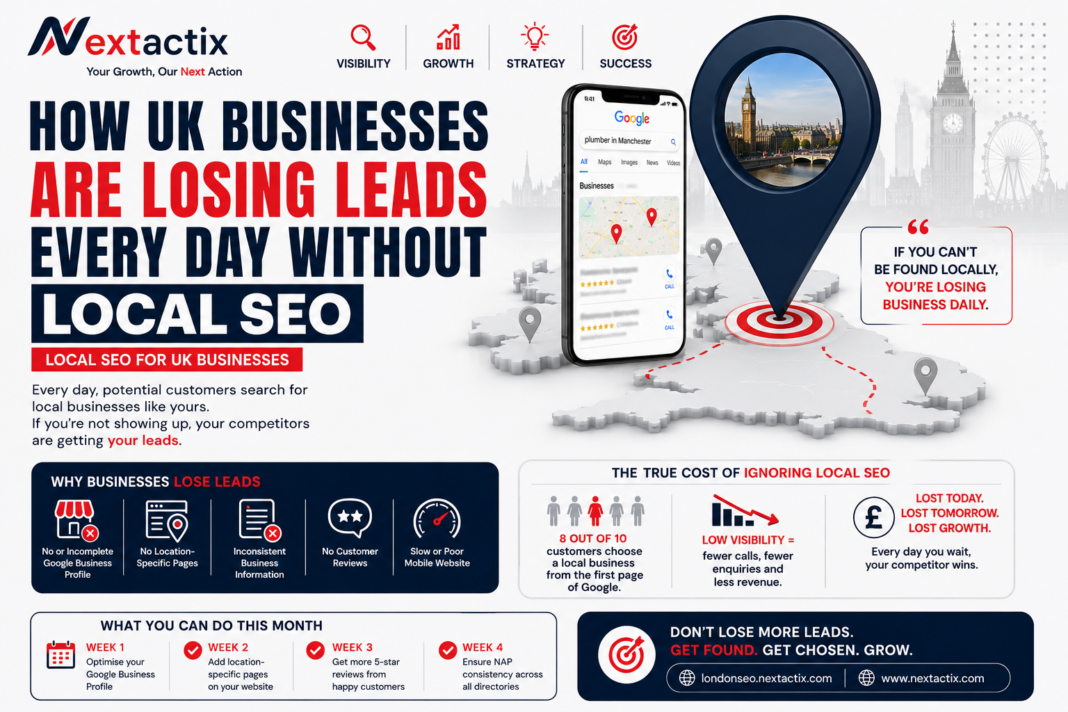
Every day, thousands of potential customers across the UK search Google for a local business like yours. They type in what they need, they scroll through the first few results, and they call or visit whichever business looks most trustworthy and relevant.
If your business is not showing up in those results, you are not just missing an opportunity — you are actively losing business to a competitor who got their local SEO right.
This article explains exactly how that happens and, more importantly, what you can do about it.
The Problem: Most UK Businesses Are Invisible on Google
Here is a stat that surprises most business owners: 92% of searchers never go past page one of Google. If your business is on page two, three, or further back, you are essentially invisible to the vast majority of potential customers.
And it is not just about ranking — it is about where on page one you appear. The top three results get the lion’s share of clicks. A business in position one gets roughly ten times more clicks than one in position ten, even though both are technically on page one.
This is why local SEO matters so much. It is not enough to just have a website. Your website needs to rank — and rank well — for the searches that your customers are making.
How Leads Get Lost: A Typical UK Business Story
Here is a scenario that plays out hundreds of times a day across the UK.
A homeowner in Manchester has a leaking pipe. They grab their phone and type “emergency plumber Manchester” into Google. In seconds, they have a list of local plumbers. They look at the top results, check a few reviews, and call the one that looks most established and trustworthy.
Meanwhile, there is another plumber in Manchester — perfectly qualified, good value, excellent work. But their website is not ranking. Their Google Business Profile is half-completed. They have three reviews from 2022. They do not even appear on the first page.
That homeowner never found them. That call — and that job — went somewhere else.
This is not a one-off story. It happens to countless UK businesses every single day, across every industry and every city.
Why Local SEO Is the Fix
Local SEO is specifically designed to help businesses appear in local search results — the results that show up when someone searches for a service in a specific place. This includes both the regular website results and the map results (called the local pack) that appear at the very top of the page.
Getting into those results requires a combination of things working together: a well-optimised website, a complete Google Business Profile, consistent business information across the web, genuine customer reviews, and links from relevant local websites.
When these things are in place, your business starts appearing in front of people who are actively searching for what you offer, in the area you serve. That is the definition of a warm lead — and local SEO delivers them consistently.
The True Cost of Ignoring Local SEO
Many business owners think of SEO as an optional extra. Something they might get around to eventually. But consider what ignoring it actually costs.
If your business could realistically serve 100 customers per month, but only 20 are finding you because you are invisible online, you are running your business at 20% of its potential. The other 80 customers are going to competitors — competitors who may not even be better than you. They are just easier to find.
Over a year, that is a significant amount of lost revenue. And unlike a one-off marketing mistake, this loss compounds — because while you wait, your competitors’ rankings get stronger and harder to overtake.
Common Reasons UK Businesses Lose Local Leads
No Google Business Profile (or an Incomplete One)
Your Google Business Profile is often the first thing a potential customer sees. If it is not set up, you will not appear in map results at all. If it is incomplete — missing photos, wrong hours, no reviews — it signals to both Google and customers that your business is not fully active.
No Location-Specific Pages on the Website
Many UK business websites are too generic. They say what the company does, but not clearly where. A page that says “we offer cleaning services” is far less effective than a page that says “professional cleaning services in Leeds.” Adding location context to your pages helps Google understand who you serve.
Inconsistent Business Information
If your business name, address, or phone number appears differently across different websites — maybe slightly different spellings, or an old address — Google gets confused. This inconsistency reduces your ranking potential. Every listing across the web should match exactly.
No Customer Reviews
Reviews are one of the biggest trust signals for both Google and potential customers. A business with 50 positive reviews will almost always outrank one with none, even if the latter is technically better at what it does. Asking satisfied customers for a Google review is one of the simplest and most effective things you can do.
Slow or Poor Mobile Website
Since most local searches happen on mobile phones, a website that is slow or hard to use on a small screen is a major problem. Google prioritises mobile-friendly websites in its rankings, so a poor mobile experience directly costs you leads.
Industries That Lose the Most Without Local SEO
While every type of business benefits from local SEO, some sectors lose particularly badly when they ignore it:
- Trades and home services: plumbers, electricians, builders, roofers
- Health and wellbeing: dentists, physiotherapists, opticians, gyms
- Legal and financial services: solicitors, accountants, mortgage brokers
- Hospitality: restaurants, cafes, hotels, event venues
- Professional services: marketing agencies, IT companies, consultants
These are all industries where customers actively search locally before making a decision. If you operate in any of these sectors and you are not doing local SEO, you are leaving a significant amount of business on the table.
What You Can Do Starting This Week
You do not need to do everything at once. Here is a simple starting plan that any UK business can follow:
- Week one: Claim and complete your Google Business Profile. Fill in every section, add photos, and check all your contact details are accurate.
- Week two: Audit your website. Make sure every service page mentions your location clearly. Add your city or region to page titles and headings where it makes sense.
- Week three: Ask your five most recent happy customers for a Google review. Send them a direct link to make it easy.
- Week four: Check your business listings on Yell, Bing Places, and Apple Maps. Make sure your information matches everywhere.
Just one month of focused effort on these basics can start to make a real difference. And once you see the results beginning to come in, you can build on them with more advanced local SEO work.
Final Thoughts
Losing leads because potential customers cannot find you online is one of the most frustrating and avoidable problems a UK business can face. The customers are out there, searching for exactly what you offer. Local SEO is what connects you to them.
It is not complicated. It does not have to be expensive. But it does require consistent effort and the right approach. Businesses that get this right will dominate their local market for years to come. Those that ignore it will keep watching their competitors take the leads that should have been theirs.