


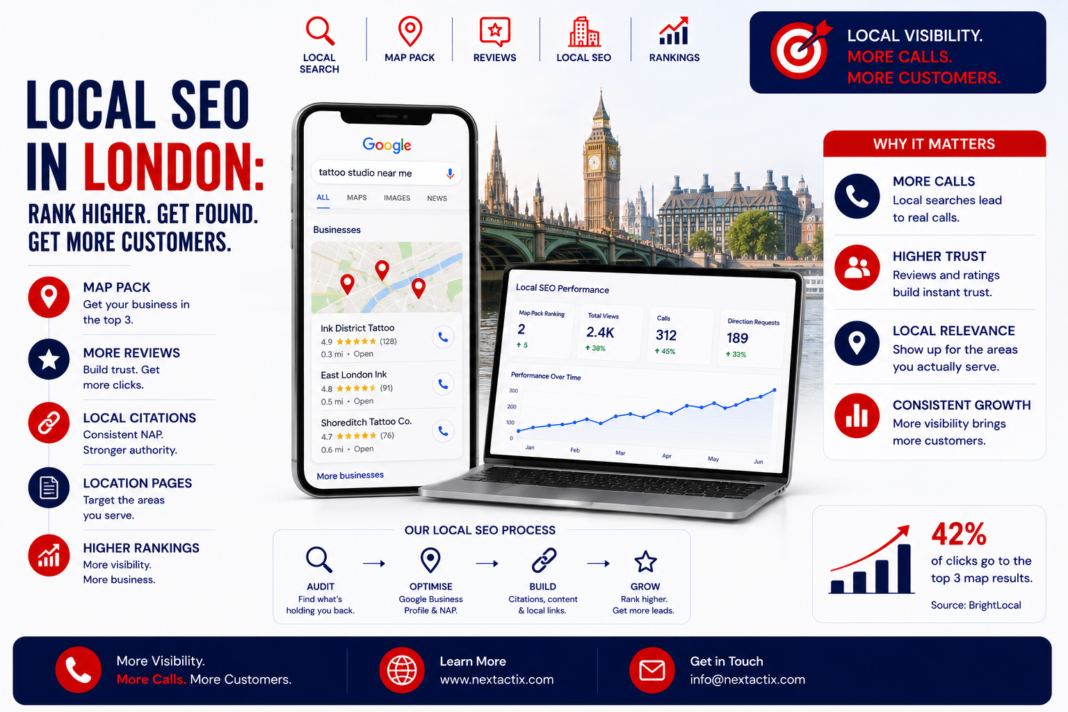
If you run a business in London, you already know the problem. You searched your own service on Google, on your phone, standing in your own shop, and you were nowhere. Three other businesses showed up in that little map box at the top. None of them were you. Meanwhile your rent is due, your competitor down the road has 200 reviews and a queue outside, and you’re still waiting for someone to explain why your website isn’t bringing in calls.
We looked at what’s currently ranking for “local SEO London” before writing this. Most of it reads the same: an agency telling you they’re “award-winning,” a pricing table, a contact form. Nobody actually explains what local SEO in London looks like in practice, what it costs to get wrong, or what a real project looks like from week one to month six. So that’s what this article is. No fluff, no “unlock your potential” nonsense — just how it works, what it costs businesses when they skip it, and how we run it at NextActix.
Why London specifically is a harder game than anywhere else in the UK
Local SEO isn’t the same difficulty everywhere. A plumber in a mid-sized town might be competing against six other plumbers. A plumber in Hackney is competing against sixty, half of whom are also running paid ads and have been collecting Google reviews since 2015.
A few things make London uniquely tough:
The borough problem. London isn’t one market — it’s 32 boroughs stitched together, and Google treats them almost like separate cities. A dentist in Shoreditch and a dentist in Richmond are not competing for the same searches, even though both say “London” on their website. Businesses that just write “serving London” on their homepage, without targeting the specific area they’re actually based in and near, get buried under competitors who did the work of targeting Camden, or Clapham, or Croydon by name.
Search volume attracts bigger players. Because London searches are high-volume, national chains and well-funded agencies pile into the same keywords a local shop is trying to rank for. A single-location cafe in Shoreditch isn’t just fighting other cafes — it’s sometimes fighting a chain with an in-house SEO team.
Proximity math changes street by street. Google’s local ranking system weighs how physically close a searcher is to a business heavily. In a dense city like London, someone standing in Angel and someone standing in Old Street are less than a mile apart but might see completely different map results. That means a business’s exact address, and how it’s tagged in Google Business Profile, matters more here than in a spread-out town where “10 miles away” is still local.
The businesses that skip local SEO, and what it costs them
Here’s what tends to get missed when people talk about local SEO in the abstract: it isn’t a nice-to-have marketing extra. For a huge share of London businesses, it’s the main way new customers find them.
Some numbers worth sitting with, from recent industry research (BrightLocal, Backlinko, and Google’s own Business Profile data among the sources): roughly 46% of all Google searches now carry local intent, and on mobile, a large majority of people who run a “near me” search visit or contact that business within 24 hours. Within local search results, the map pack — the three listings shown with a map at the top — takes somewhere around 42-44% of all clicks in that search, more than the organic results below it and more than paid ads combined. Businesses that land in that map pack get well over double the calls, clicks, and direction requests compared with businesses sitting in positions four through ten.
Put plainly: if you’re not in that box of three, you’re fighting for scraps. And most businesses we start working with in London aren’t in that box, not because their business is worse than the competitor’s, but because nobody ever built out their Google Business Profile properly, nobody built local citations, and nobody wrote content that told Google exactly which streets and postcodes they serve.
There’s also a review problem specific to competitive cities. Profiles that cross 50 genuine reviews earn dramatically more clicks than ones sitting under five — some research puts it at over four times the click rate. In London, where three or four competitors on the same street might already have 100+ reviews, a business with 12 reviews isn’t just behind, it looks untrustworthy by comparison, even if the service itself is better.
What Google actually looks at when ranking the map pack
There’s a lot of guessing in this industry, but the ranking factors aren’t really a mystery anymore — Whitespark and Moz both publish yearly local ranking factor studies based on surveys of hundreds of practitioners, and the pattern is consistent year to year:
- Primary and secondary category selection on your Google Business Profile — picking the wrong or vague category is one of the most common reasons a genuinely good business doesn’t show up.
- Proximity — how close the searcher is to your listed address, which you can’t fully control but can work around with area-specific content.
- Review signals — not just star rating, but volume, recency, and whether you’re replying to them.
- NAP consistency — your Name, Address, and Phone number matching exactly across your website, Google, Bing, Apple Maps, and every directory you’re listed on. Even small mismatches (Street vs St, a old phone number still live on one directory) quietly hurt you.
- Link authority — the same backlink signals that matter for normal SEO still feed into local rankings.
- On-page and website relevance — does your site actually mention the areas you serve, in real sentences, not just a footer stuffed with borough names.
- Behavioural signals — click-through rate, calls, and direction requests your listing generates, which is part of why the review and photo quality on your profile matters beyond just “looking nice.”
Most agencies treat this as a checklist you do once. It isn’t. Every one of these signals moves month to month, and competitors are actively working on the same list.
How we actually run a local SEO project for a London business
This is the part most articles skip, so here’s the real sequence, roughly how a project unfolds when a London business comes to us.
Weeks 1-2: Audit and competitor teardown. Before we touch anything, we pull the current map pack results for your core searches and analyse the three businesses sitting in it — not just glance at them, but actually check their review velocity, their category setup, how many of their photos are recent, what their backlink profile looks like, and where their citations are coming from. You can’t outrank three competitors without knowing exactly what they’ve done right. We also run a full technical check on your existing website: page speed, mobile experience, whether your schema markup exists at all (most London small business sites have none).
Weeks 2-4: Google Business Profile rebuild. This is the single highest-leverage piece of the whole project and it’s the part most agencies rush. We rewrite your business description properly, correct and expand your category selection, add every relevant service listed as a separate item, upload a proper photo set (not four blurry phone shots from 2019), and set up a review-request system so new reviews come in consistently rather than in one panicked burst.
Weeks 3-6: Citations and NAP cleanup. We audit every place your business is currently listed — old directories, Companies House-linked listings, delivery apps, review sites — and fix every inconsistency. Then we build out new citations on the directories that actually carry weight in the UK (Yell, Thomson Local, Cylex, and industry-specific directories relevant to your trade), rather than the generic global directory spam a lot of cheaper services use.
Weeks 4-8: Location-specific content. If you serve more than one area of London, you need more than one page saying so. We build out genuinely useful pages for each borough or postcode area you actually work in — not a template with the area name swapped out, but content that reflects real differences in how you serve that area.
Ongoing: Reviews, reporting, and adjustment. From month two onward it becomes a maintenance and growth cycle — review generation, new content, backlink building, and a monthly report that tells you plainly what moved and why, not a wall of graphs with no explanation attached.
Tools we use, and why
Because people always ask what’s actually running behind the scenes: we pull ranking and competitor data from Ahrefs and BrightLocal, use Whitespark for citation audits and building, track map pack position across multiple London postcodes with local rank trackers (a single citywide rank check is close to meaningless in a city this spread out), and run technical audits through Screaming Frog and Google Search Console. For review monitoring and reputation tracking we use dedicated GBP monitoring tools rather than manually checking each profile. None of these tools do the work by themselves — they tell us where to point the effort.
A real example: the London tattoo studio project
One recent project worth walking through honestly. A tattoo studio in London came to us with a dated website and almost no organic visibility — they were relying entirely on Instagram and word of mouth. The brief was straightforward: get found by people searching for a tattoo studio in their part of London, not just people who already followed them on social media.
We rebuilt the website itself first, since the old one was slow and didn’t work properly on mobile — a dealbreaker for local search since the majority of “tattoo studio near me” searches happen on a phone. Alongside that, we ran a full local SEO build: Google Business Profile optimisation, area-specific content for the neighbourhoods they actually served, and a structured approach to getting genuine client reviews after appointments rather than leaving it to chance.
The result wasn’t overnight — local SEO in a competitive city rarely is — but the studio’s local rankings improved, the site became genuinely fast, and they started getting a steady stream of enquiries directly through organic search, rather than depending entirely on Instagram traffic. That’s the actual pattern with local SEO: it’s not a single fix, it’s removing the ten small things that were each quietly costing you visibility.
What we’d tell you to check right now, for free
Before you hire anyone — us included — go and search your own business on your phone, not your laptop, using the kind of phrase a customer would actually type. Check three things: are you in the map pack at all, does your Google Business Profile have more than 20 recent reviews, and does your website actually mention the specific London area you’re in more than once. If any of those three are a no, that’s where the leak is.
If you want someone to actually dig into it properly rather than guess, that’s what we do. Get in touch and we’ll run the audit before you commit to anything.