

A consultant dermatologist in South Kensington noticed something odd last spring. Her clinic was ranking well on Google — top five for several key treatment terms she had worked to build over two years. But new patient enquiries had softened. Not collapsed, just quietly slowed. She assumed it was a seasonal dip and moved on.
Three months later, a patient who had eventually booked mentioned, almost in passing, that she had first asked ChatGPT which London dermatologists were known for treating rosacea. The clinic’s name had not come up. She had ended up on the website through a Google search after that, but two other patients she mentioned had stuck with whoever ChatGPT recommended and never clicked any further.
This is the gap that has opened up in healthcare search over the past eighteen months, and it is moving faster than most private clinic owners realise. This article explains what is actually happening, why the standard SEO playbook does not fully cover it, and what London clinics can practically do about it.
The Split That Most Guides Get Wrong
Before anything else, it is worth understanding something that the majority of AI SEO content for healthcare gets wrong: Google’s AI Overviews behave very differently depending on the type of search.
BrightEdge tracked healthcare queries across Google throughout 2025 and published clear data on this. By December 2025, Google had removed AI Overviews entirely from local provider intent searches — the kind of search where someone types “cardiologist near me” or “private GP Harley Street.” Google tested these and pulled back, apparently concluding that a patient looking for a specific provider nearby is better served by a map pack and direct results than by an AI-generated summary.
What this means in practice: for the searches that bring you new local patients — the ones with a location and a service need — traditional local SEO still governs. Your Google Business Profile, your review volume, your NAP consistency, your local citations. None of that has been displaced.
But for informational searches — the ones where a potential patient is still working out what they need, researching a condition, comparing treatment options, or asking which type of specialist handles a particular problem — Google AI Overviews appear frequently and consistently. Health-related informational queries are among the highest-trigger categories for AI Overviews that BrightEdge tracks. And these informational searches often happen before the local search. A patient who asks “what causes recurring tension headaches” and sees your clinic cited in the AI answer is primed to search your name or service in their area next.
Key point: Local queries (‘dermatologist near me’) = traditional local SEO still runs this. Informational queries (‘what to expect from Botox treatment’) = AI Overviews are active and your clinic needs to be the cited source.
Why Private Clinics Specifically Have a Problem Here
Most private clinic websites were built around service pages and booking flows. They describe treatments, list prices, and invite the patient to get in touch. That structure works fine for someone who has already decided they want a service and is now comparing providers.
It does not serve the patient who is still in the research phase — and research-phase content is exactly what AI Overviews draw from. A generic “our dermatology services” page tells an AI system very little it can confidently extract and cite. A detailed, clearly written page about what triggers perioral dermatitis, what treatment approaches exist, and what a consultation at a specialist clinic involves gives an AI system something specific to quote.
The clinics that are being cited in AI Overviews for health queries in London right now tend to have one thing in common: content that reads like it was written by a clinician who actually treats the condition, not by a marketing team describing a service. That distinction is the single most important thing to understand about healthcare AI SEO.
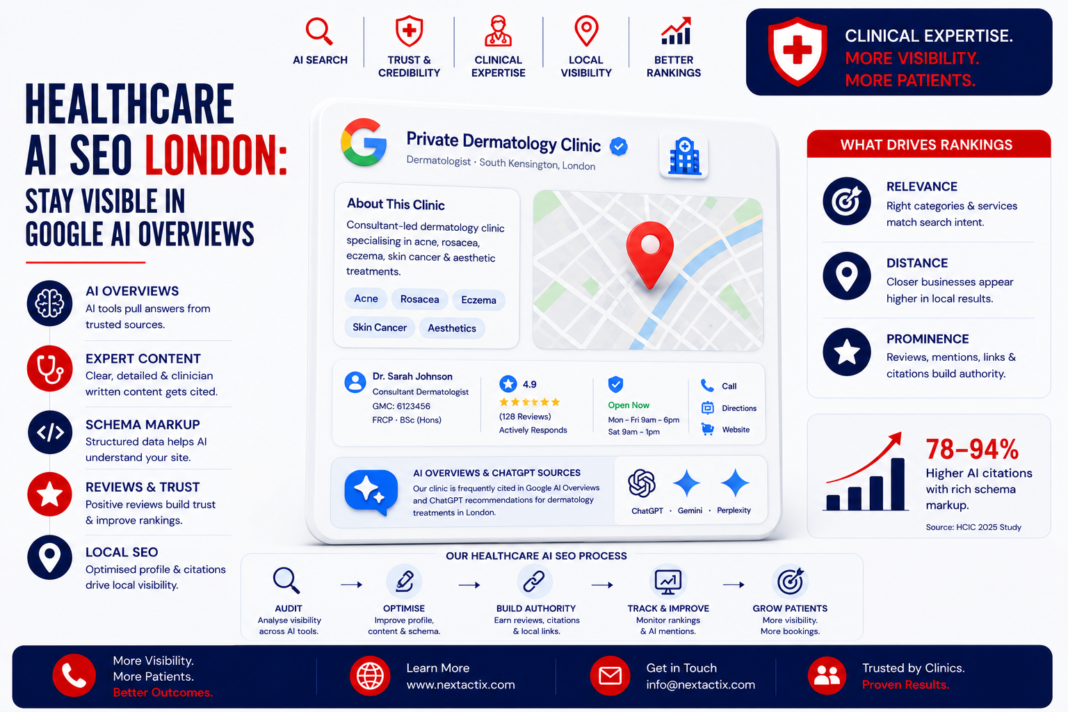
Research presented at HCIC 2025 found that healthcare sites with rich, properly connected schema markup saw their AI citation rates in Google’s AI Mode increase by between 78% and 94%. Authoritative, structured content was three times more likely to be cited than narrowly focused service pages. These are not small margins.
The E-E-A-T Factor in a YMYL Environment
Google’s quality guidelines categorise health content as YMYL — “Your Money or Your Life” — meaning queries where bad information could seriously harm the person asking. For these categories, Google applies stricter E-E-A-T standards: Experience, Expertise, Authoritativeness, and Trustworthiness.
For a private clinic, this is actually good news if you handle it correctly. You have real clinicians with real credentials. You have patients with real outcomes. The E-E-A-T signals AI systems look for in healthcare content are exactly the signals your clinic can genuinely provide — but most clinic websites bury them or leave them out entirely.
A named consultant with their GMC registration number, their Royal College fellowship, their clinical interests, and their treatment philosophy stated clearly on their own profile page is an E-E-A-T signal. A page that says “our expert team” with a stock photo is not. This is where many clinic websites fall short, and it is one of the first things worth correcting.
Schema Markup for Clinics — What Actually Matters
Schema markup is behind-the-scenes code that tells search engines and AI systems what a piece of content is, rather than leaving them to guess from the surrounding text. For private clinics, a few types are particularly important.
MedicalOrganization and Physician schema
These label your clinic as a healthcare provider and your clinicians as medical professionals, with proper credentials attached. Without this, an AI system looking at your website sees a business and some names. With it, the system sees a GMC-registered physician practising a specific specialty at a verified clinical facility in a specific location.
FAQPage schema
FAQ schema maps question-and-answer content directly to the conversational, question-led format that AI Overviews are designed to respond to. A page about laser skin resurfacing that includes clear, direct answers to the questions patients actually ask — how long does it take to heal, who is not a suitable candidate, how many sessions are typically needed — structured with FAQPage schema, is far more extractable for an AI system than narrative promotional copy.
MedicalCondition and TreatmentProtocol schema
For clinics that publish condition guides or treatment explainers, these schema types explicitly label the content as clinical information rather than general marketing material. They raise the confidence level an AI system assigns when deciding whether to cite the content.
| Content type | Without schema | With schema |
| Clinic homepage | Business website — low confidence | MedicalOrganization — verified clinical entity |
| Treatment page | Service description | MedicalProcedure with indicators and outcomes |
| FAQ section | Generic Q&A text | Structured question-answer pairs, directly citable |
| Clinician bio | Staff profile | Physician with GMC reference, specialty, credentials |
Content That Actually Gets Cited
The content gap in most clinic websites is not volume — many have plenty of pages. It is extractability. AI systems prefer content that states conclusions clearly, near the top of each section, rather than building toward a point over several paragraphs.
A patient asking ChatGPT “how do I know if I need to see a dermatologist or a GP for my skin concern” wants a direct, confident answer. If your clinic has a page that dances around this question for three paragraphs before arriving at anything useful, the AI system will either pass your page over or quote only the most direct sentence it can find — which may not be the one you would choose.
Writing with an answer-first approach means putting the direct response within the first sentence or two after each heading. The explanation, nuance, and supporting detail follow. This does not mean dumbing down clinical content — it means respecting the reader’s time and the AI system’s extraction logic at the same time.
Practical example: Instead of ‘Our clinic provides a range of advanced dermatological treatments designed to address the full spectrum of skin concerns…’ try ‘We treat acne, rosacea, eczema, and skin cancer, including conditions that have not responded to GP-level care.’
Local Visibility Alongside AI Visibility
Since Google has confirmed that local provider searches do not trigger AI Overviews, your traditional local SEO work remains important and should not be neglected in favour of pure AI content strategy.
For private London clinics, this means a complete and actively maintained Google Business Profile with the correct primary category, recent patient photos, and regular responses to reviews. It means consistent NAP information across the main UK healthcare directories — CQC, NHS Choices where applicable, Doctify, Trustpilot for health, and any specialty-specific directories relevant to your practice area.
Doctify specifically deserves attention for private clinics in London. Its listings are indexed well by Google and carry domain authority that contributes to your broader entity footprint. A clinic with a complete, review-rich Doctify profile is giving AI systems one more third-party source confirming who you are and what you are known for, which contributes even to AI citation decisions beyond local search.
What NextActix Does Differently for Healthcare Clients
The team at NextActix approaches healthcare AI SEO as two separate but connected disciplines — the informational content layer, which determines whether AI Overviews cite the clinic for research-phase queries, and the local entity layer, which determines whether patients find the clinic when they are ready to book.
For private clinics in London, this means starting with an audit of how AI tools currently describe the clinic: what ChatGPT says when asked about relevant treatment areas, which competitors are cited in Google AI Overviews for key clinical topics, and where the clinic’s entity footprint is thin or inconsistent. The audit shapes the work that follows rather than applying a generic checklist.
On the content side, the agency works with clinicians directly rather than writing around them — because the signal that most reliably improves AI citation in a YMYL healthcare context is genuine clinical expertise showing clearly in the text, not SEO technique applied to generic content.
Where to Start if You Are a London Clinic
Run an honest test first. Ask ChatGPT: “Which private clinics in London are well regarded for [your specialty]?” Then ask Google: “[your main treatment] London” and read the AI Overview if one appears. If your clinic is not mentioned in either, that is your baseline.
Then look at your existing content with fresh eyes. Do your treatment pages answer the questions a patient in the research phase would actually have? Do your clinician profiles mention GMC numbers, fellowship memberships, and specific conditions treated? Does your site have any FAQPage schema on the questions patients ask most often?
These are not complex changes. They are mostly content and structural work that the clinic team or an agency with healthcare experience can work through systematically over several weeks. The clinics doing this work now are building an advantage that will compound, because the alternative — staying passive while AI tools learn to associate your specialty terms with other London providers — is genuinely difficult to reverse once it has set in.