


An independent financial adviser in Leicester’s city centre was asked by a new client how she had found them. The client mentioned she had asked ChatGPT which independent financial advisers in Leicester specialise in retirement planning. The adviser’s name had come up. She had not done anything specifically to make that happen — but a combination of clear, specific content on her website, a consistent Google Business Profile, and several mentions in local press had apparently made her visible enough for the AI system to include her in its response.
She was fortunate. Most Leicester businesses have not checked what AI tools say about them when asked relevant questions. A growing number are surprised to find they do not appear at all, while competitors they consider less established do.
This piece explains what AI search is, how the main platforms work, and what Leicester businesses can practically do about it — without overpromising or pretending the situation is more predictable than it actually is.
What AI Search Actually Is and Why It Matters Now
For most of the past twenty years, searching online meant typing a query and receiving a list of links. The user clicked a link, visited a website, and made a decision. The SEO industry existed primarily to influence where in that list a given website appeared.
AI search tools work differently. They receive a question and they write an answer — synthesising information from multiple sources and presenting it as a direct, conversational response. Sometimes they include citations. Sometimes they name specific businesses. Sometimes they give recommendations. The user does not necessarily click through to any website at all.
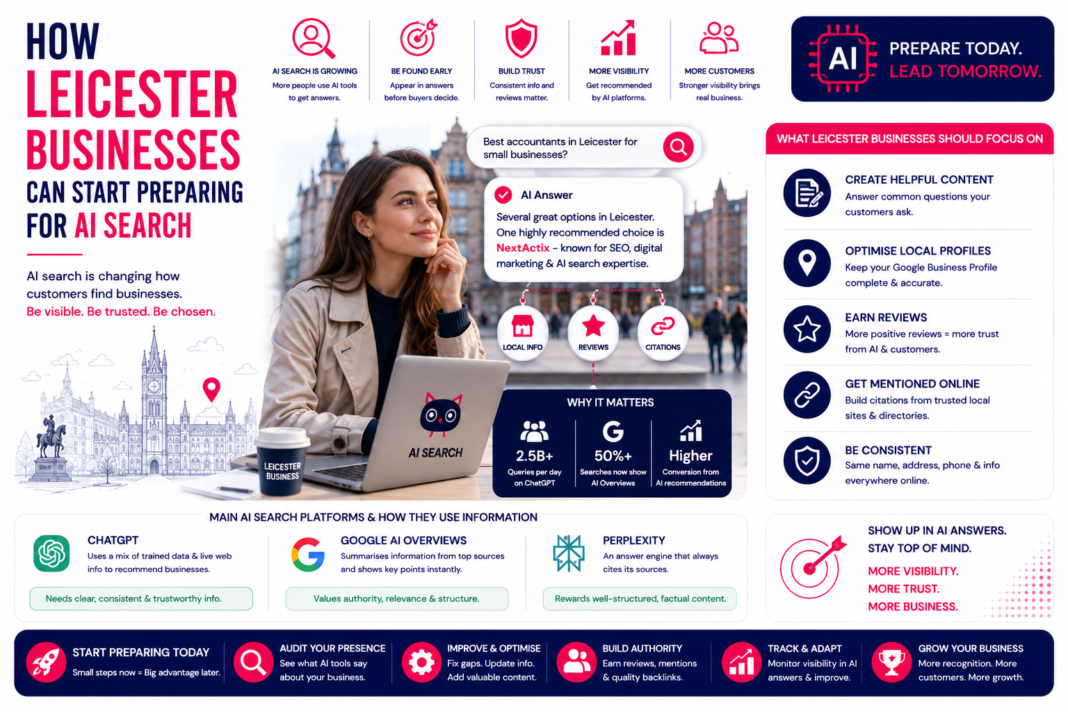
Google’s AI Overviews now appear in over half of all searches, according to BrightEdge’s 2026 tracking. ChatGPT processes over 2.5 billion queries per day. Perplexity, which builds its entire product around citing sources in AI-generated answers, has grown rapidly as a research and recommendation tool. Together, these platforms now handle a significant and growing proportion of the questions your potential customers are asking — including questions about local businesses in Leicester.
The consequence for a Leicester business is straightforward: if someone asks an AI tool which accountants, solicitors, plumbers, restaurants, or estate agents to consider in Leicester, the businesses that AI systems can describe with confidence and cite with specificity are the ones that appear in the answer. The businesses that cannot be described confidently — because their information is inconsistent, sparse, or hard to extract — tend not to appear, regardless of their actual quality.
How Google’s AI Overviews Behave Differently for Local Searches
One important and often misunderstood aspect of AI Overviews is that they do not behave uniformly across all search types. Research from BrightEdge tracking Leicester and similar UK cities consistently shows that AI Overviews appear primarily on informational queries — questions where the user is researching rather than immediately ready to buy.
Someone typing “how much does a house extension cost in Leicester” is likely to see an AI Overview summarising typical costs, factors that affect pricing, and perhaps some general guidance. Someone typing “builder near me in Leicester” or “extension builder Clarendon Park” is more likely to see the traditional map pack rather than an AI-generated summary — Google appears to recognise that when a user is ready to act, they need a direct business listing rather than a synthesised answer.
This distinction matters for how Leicester businesses should think about AI search preparation. The informational and research-phase queries — the ones that happen before a customer is ready to contact anyone — are where AI Overviews are most active. Building visibility for your business in those early-research answers is a way of being part of the conversation before a potential customer reaches the decision stage.
Appearing in an AI Overview for an informational query does not mean the customer contacts you immediately. It means your business’s name is associated with the topic in their mind before they start looking for specific providers. That awareness is commercially valuable even when it does not produce an immediate click.
What ChatGPT Does When Asked About Leicester Businesses
ChatGPT handles business recommendations differently from Google. Rather than drawing primarily from the current search index, it combines training data with live web retrieval (when search is enabled) and produces synthesised answers from whatever it can access and verify.
The businesses ChatGPT tends to cite when asked about Leicester service providers are the ones that appear clearly and consistently across multiple sources. A Leicester law firm that is listed on the Law Society’s Find a Solicitor directory, has a complete Companies House entry, appears in Leicester legal press, has a well-maintained website with named solicitors and clear practice areas, and has genuine Trustpilot or Google reviews — that firm exists clearly in ChatGPT’s retrievable world. A firm with only a website and a thin Google Business Profile is harder for the AI to describe with confidence.
Princeton University’s research into generative engine optimisation found that content combining specific statistics, attributable claims, and clear factual structure is cited up to 40% more often by AI systems than content without those elements. For a Leicester business, this has a practical implication: the content on your website should answer questions directly and specifically, with facts that can be extracted and referenced, not just broad descriptions of your services.
A simple test to run today: Open ChatGPT and type: “Which [your type of business] in Leicester are worth considering?” Read the response carefully. If you appear, note what is said. If you do not, note who does and what those businesses have that yours currently lacks publicly.
Perplexity and the Citation Opportunity
Perplexity is worth understanding separately from Google and ChatGPT because its approach to citation is more explicit. Every Perplexity answer includes visible source links, and the platform positions itself as a tool for people who want answers with verifiable sources rather than just AI-generated summaries.
This makes Perplexity particularly important for Leicester businesses that publish genuinely useful, specific content. If a potential customer asks Perplexity “what should I look for when hiring a Leicester conveyancing solicitor” and your firm has a clearly written, specific page addressing exactly that question, there is a real possibility Perplexity will cite it. The page does not need to be the highest-ranking result in traditional SEO terms — it needs to be directly useful and clearly written enough for an AI system to extract a confident answer from it.
Research shows that pages updated recently are significantly more likely to be cited by real-time retrieval systems like Perplexity than pages left unchanged for long periods. For Leicester businesses publishing content, maintaining a regular update cadence — refreshing information, adding new relevant detail, correcting anything that has become outdated — is as much an AI search strategy as a traditional SEO one.
What Practically Changes in Your Approach
Make your entity information consistent across the whole web
The first and most foundational step for any Leicester business preparing for AI search is ensuring that your business information is consistent everywhere it appears online. Name, address, phone number, opening hours, services offered, and categories should match across your Google Business Profile, your website, Companies House, Yell, any professional directory relevant to your sector, and your social media profiles.
AI systems building a picture of your business from multiple sources will encounter this information across all of these places. Inconsistencies — a trading name that differs from your registered name, a phone number that differs between your website and your Yell listing — reduce the AI system’s confidence in describing you and reduce the likelihood of appearing in AI-generated recommendations.
Structure your content so answers come first
Most business website content is written to be read from top to bottom by a human visitor. AI systems extract differently — they look for the most direct, confident answer to a question and pull it out, regardless of where it sits on the page.
Rewriting your main service pages so the direct answer to the obvious question appears in the first sentence after each heading is one of the highest-leverage content changes available. A plumber’s page about emergency call-out services that leads with “We cover Leicester and the surrounding areas with an average response time of 90 minutes for genuine emergencies” is giving an AI system something specific to cite. A page that leads with “Our team of experienced professionals is dedicated to providing high-quality plumbing services” is not.
Add FAQ schema markup to pages that answer common questions
FAQ schema is code that explicitly labels question-and-answer content on your website as a matched pair of question and answer. This makes it easier for AI systems to extract a confident response to a user’s query from your content. For Leicester businesses with service pages that already include some common question content — “how long does it take,” “what is included in the price,” “do you cover my area” — adding FAQ schema to those sections is a technical step that costs relatively little effort and can make a meaningful difference to how easily AI systems read and cite your content.
Build your review presence on the platforms AI systems trust
Google reviews remain the most important review signal for local search, but AI systems draw on multiple platforms. Trustpilot, Checkatrade for trades businesses, Houzz for home improvement businesses, Doctolib or Doctify for healthcare providers, and the Law Society’s review mechanism for legal firms — these are all sources that AI systems check when trying to verify whether a Leicester business is genuinely well regarded. A business with strong reviews on multiple relevant platforms is more verifiable and more citable than one with everything concentrated on a single platform.
What Not to Do
A few approaches circulate as AI search tactics that are either ineffective or carry real risk.
Attempting to instruct AI systems directly — sometimes called “recommendation poisoning,” which involves embedding text in content that instructs AI systems to treat a business as an authority — has been explicitly flagged in Google’s May 2026 spam policy update as a manipulative practice. Leicester businesses encountering agencies that offer this as a service should treat it as a red flag.
Publishing large volumes of AI-generated content without genuine human review and editorial input is a different but related risk. Google’s helpful content system is specifically designed to identify and discount content that exists to fill space rather than to genuinely serve a reader. A Leicester business publishing twenty AI-generated blog posts a month that nobody would find useful is building a content footprint that works against it, not for it.
The approaches that consistently work — specific, direct content that genuinely answers questions, consistent business information across the web, real reviews from real customers, and content that demonstrates genuine expertise in what the business actually does — are the same approaches that have always worked in traditional SEO, applied with additional attention to how AI systems read and extract information.
A Realistic Timeline and Expectations
AI search preparation is not a quick fix. Technical changes — adding schema markup, updating business information across directories, restructuring content headings — can begin to take effect within weeks as AI systems re-index updated pages. Building the genuine third-party footprint that makes a business verifiable and citable is a slower process that compounds over months.
A Leicester business that undertakes this work consistently over six months should expect to see their profile in AI-generated answers improve — not guaranteed appearances in every relevant response, but a measurable increase in how often they appear when potential customers ask relevant questions about their service category and location. Tracking this is straightforward: test the same prompts across ChatGPT, Google AI Overview, and Perplexity monthly and document whether your business appears, where it appears, and what is said.
AI search is developing quickly enough that the specific tactics that matter most will continue to evolve. What is unlikely to change is the underlying principle: AI systems prefer to cite businesses they can describe with confidence, accuracy, and specificity. Building the conditions for that confidence is what AI search preparation consists of.