


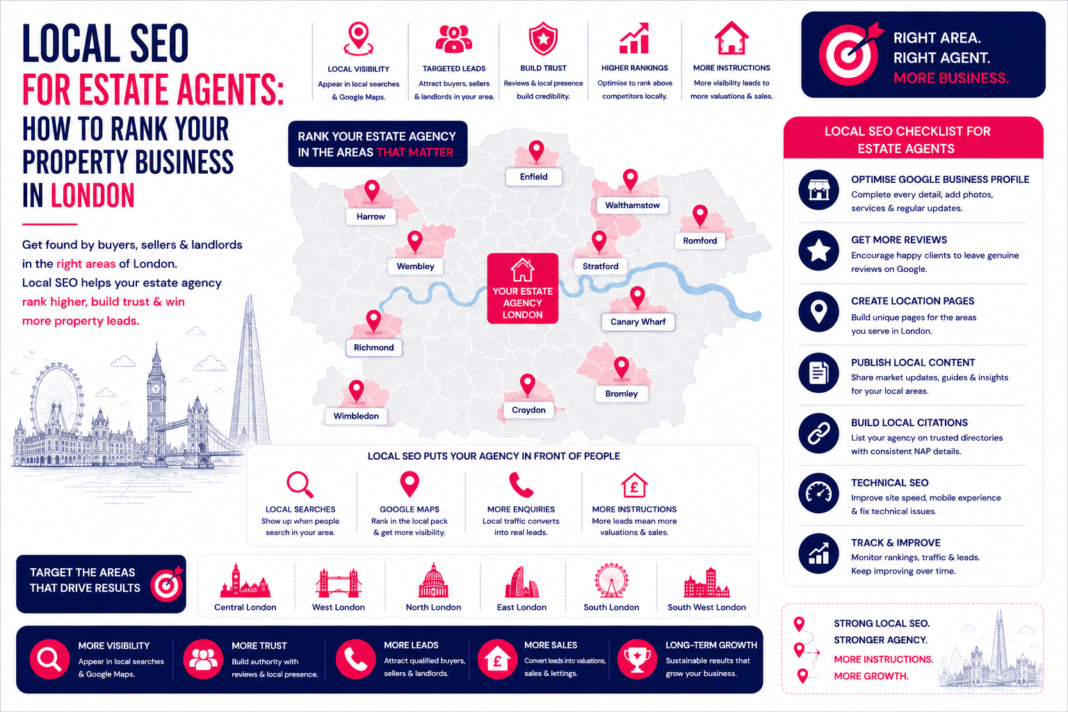
For an estate agent, being found by people in the right part of London is often more valuable than attracting visitors from across the country.
Someone searching for an estate agent in London is already showing some commercial intent. But a person searching for an estate agent in a particular borough, neighbourhood or area is giving you something even more useful: a clear indication of where they need help.
That is why local SEO matters so much to property businesses.
The difficulty is that London’s local search results are crowded. An estate agent may be competing with established agencies, property portals, directories, franchise networks and businesses that have been building their online presence for years.
Ranking locally therefore requires more than adding a London address to a website and creating a Google Business Profile.
A successful local SEO strategy needs to make it clear what the business does, where it operates, which property services it provides and why someone in that area should consider it.
What does local SEO mean for an estate agent?
Local SEO is the process of improving a business’s online presence so that it can appear when people search for products or services within a particular geographic area.
For an estate agent, those searches can take many forms.
A homeowner might search for:
“estate agent near me”
A landlord could search for:
“letting agent in East London”
Someone preparing to sell might search for:
“property valuation in Wimbledon”
A buyer may search for:
“estate agents in Richmond”
These searches are different, but they share one important characteristic: location is part of the customer’s intent.
Google needs to understand both the service and the geographic relevance of a business before it can decide which local results are useful.
This is why local SEO for estate agents involves more than traditional keyword optimization. The website, business profile, reviews, location information and broader online presence all contribute to how the business is understood.
Why local search can be valuable for London estate agents
Property is inherently local.
A person looking for an estate agent generally does not want to contact a company that happens to rank well somewhere hundreds of miles away. They want someone who understands the market in which their property is located.
That makes local search particularly important.
Consider the difference between these two searches:
“real estate SEO”
and
“estate agents in Chelsea”
The first is broad and informational. The second tells us much more about the person’s immediate requirement.
They have identified a location and are actively looking for a particular type of business.
For an estate agent, these commercially relevant local searches can be much more valuable than chasing large amounts of untargeted traffic.
The challenge is that London contains an enormous number of potential local searches. There are boroughs, neighbourhoods, districts and smaller areas, each with their own property markets and audiences.
A strong local SEO campaign should therefore focus on the locations that the agency genuinely serves rather than trying to claim relevance everywhere.
Your Google Business Profile is one of the first places to start
When someone searches locally for an estate agent, Google may show a map and a group of local businesses before the traditional organic results.
This makes the Google Business Profile an important part of a local SEO strategy.
The profile should accurately represent the business and provide enough information for both Google and potential customers to understand what the agency offers.
That includes the business name, category, contact details, website, opening information and relevant service information.
But completing the profile is only the beginning.
An estate agent should also pay attention to the quality and consistency of the information presented to potential customers.
If your website describes your business one way, directory listings use another name and your business profile contains incomplete information, you create unnecessary ambiguity.
Consistency helps establish a clearer connection between the business and its online presence.
Choose the right primary category rather than trying to cover everything
Business categories are an important part of Google’s understanding of local businesses.
An estate agency should select the category that most accurately represents its primary business.
Additional categories can be useful where they genuinely describe services offered by the business, but adding unrelated categories simply to increase visibility is not a sensible strategy.
The same principle applies throughout local SEO:
accuracy is more valuable than trying to manipulate relevance.
If an agency primarily handles residential property sales, its online presence should make that clear. If it also provides lettings or property management, those services can be represented naturally through the website and supporting information.
Reviews matter because property decisions involve trust
Choosing an estate agent is not an insignificant decision.
A homeowner may be trusting the agency with the sale of a property worth hundreds of thousands of pounds. A landlord may be deciding who will manage a valuable rental property.
People naturally look for evidence that an agency is reliable.
Reviews can provide that evidence.
The objective should not be to collect meaningless one-line reviews simply because there is a number to increase.
Detailed, genuine feedback is far more useful.
A review that explains how an agency handled a valuation, communicated during a sale or helped resolve a difficult letting situation tells future customers considerably more than a simple “great service.”
Businesses should also never manufacture reviews or encourage misleading feedback. Authentic customer experiences are much more valuable for long-term reputation.
Local relevance needs to exist on your website too
A Google Business Profile cannot compensate for a website that gives Google and customers very little information about where the business operates.
Your website should make your geographic focus clear.
For example, an agency serving several parts of London might have dedicated pages explaining its services in the areas it genuinely covers.
But there is an important difference between a useful location page and a page created solely to target a keyword.
A useful page could explain the agency’s experience in that area, the types of properties it works with, the services available and the kinds of customers it helps.
It can also provide genuinely useful local information where appropriate.
Simply creating:
Estate Agents in London
Should an estate agent create a page for every London neighbourhood?
Not necessarily.
This is one of the areas where SEO campaigns can go too far.
London has an enormous number of neighbourhoods and localities. It can be tempting to create hundreds of pages in the hope that each one will generate another ranking opportunity.
The problem begins when those pages have nothing meaningful to say.
If an estate agent genuinely operates across several areas and has useful information about each one, individual location pages can make sense.
If the agency has no real presence in a location and the page simply repeats generic information, there is little reason for the page to exist.
A smaller number of genuinely useful local pages is often a better foundation than a large collection of thin ones.
Think about how people actually search for property services
Customers do not always search using the exact phrase an SEO tool suggests.
Someone may search:
“best estate agent near me”
while another person searches:
“estate agency to sell my house in South London”
Someone else might type:
“letting agents near Canary Wharf”
These searches reveal different needs.
The first person may be comparing agencies.
The second may be preparing to sell.
The third may be looking for rental or landlord services.
A good local SEO strategy therefore considers topics, intent and geography together.
Instead of trying to force one keyword onto every page, build useful pages around the real questions and services your customers care about.
Local landing pages should help people make a decision
A location page should not exist simply because you want to rank for the location.
It should help a potential customer decide whether your agency is relevant to them.
Imagine someone has searched for an estate agent in a particular London area and arrives on your page.
They will probably want to know:
Do you actually operate here?
What type of property do you handle?
Do you work with sellers, landlords, buyers or tenants?
Do you understand this local market?
What services can you provide?
How can I contact you?
What do your existing customers say?
A strong page should answer those questions naturally.
The page does not need to turn into a giant block of sales copy. In fact, excessive promotional language can make it less useful.
The strongest local pages tend to combine specific information with clear commercial pathways.
Local content should demonstrate knowledge rather than repeat place names
One of the easiest ways to make SEO content sound artificial is to repeat the location in every sentence.
A page about an area should instead demonstrate why the location matters.
For an estate agent, useful local information might include the types of homes commonly encountered, differences between nearby areas, considerations for buyers and sellers, transport accessibility or other property-related information that is genuinely relevant.
The exact content should depend on the agency’s expertise.
There is no reason to manufacture statistics or make claims about a neighbourhood simply to make a page look “local.”
If the business has real experience working in the area, that experience should be reflected in the content.
Internal linking can connect London’s locations and services
A property website can quickly become large.
An agency may have pages covering sales, lettings, valuations, property management and multiple London areas.
Those pages should not exist as isolated documents.
They should form a logical website structure.
For example, a page about selling property in a particular area could link to the agency’s valuation service.
A valuation page could link to relevant location pages.
An area guide could reference the agency’s sales or lettings services when appropriate.
This helps visitors find related information without repeatedly returning to the homepage.
It also helps search engines understand the relationships between different sections of the website.
Internal links should be added because they help the reader, not because every page needs a predetermined number of links.
Local citations still have a role, but quality matters
Estate agents may appear across various property directories, business directories, local websites and industry platforms.
These mentions can help establish a consistent online footprint.
However, submitting the business to hundreds of low-quality directories is not a modern local SEO strategy.
The focus should be on relevant and trustworthy places where customers might actually expect to find the business.
The agency’s business name, address and contact information should also be consistent where appropriate.
If the business has moved offices or changed its contact details, outdated information should be identified and corrected.
A clean digital footprint is much more useful than a large collection of irrelevant directory profiles.
What about “near me” searches?
“Near me” searches are particularly relevant to local businesses.
A person might search:
“estate agents near me”
or:
“property valuation near me”
Google can use location signals to determine which businesses may be relevant to that search.
An estate agent cannot simply rank everywhere in London for these searches by putting “near me” into website copy.
The more useful approach is to build strong local relevance around the areas the business actually serves.
That includes the business profile, website, location information, reputation and overall consistency of the business’s online presence.
Property listings and local SEO should work together
Property listings can provide another layer of local relevance.
Suppose an agency is marketing properties in several London neighbourhoods.
Those listings naturally contain information about the locations in which the business operates.
However, property listings should not replace dedicated service and location pages.
A listing is usually focused on a particular property. A location page can explain the broader service and local expertise of the agency.
Both serve different purposes.
The listing helps someone interested in that particular property.
The location or service page can help someone who is still deciding which agency to use.
A well-structured website connects those experiences.
Don’t ignore the technical side of local SEO
Local SEO is still SEO.
If Google’s crawlers cannot properly access important pages, local relevance alone will not solve the problem.
Technical checks should include:
- Indexability of important pages
- XML sitemap configuration
- Canonical URLs
- Internal links
- Mobile usability
- Page performance
- Broken links
- Duplicate pages
- Structured data where appropriate
- Correct redirects
This becomes particularly important for property websites because they often generate many URLs through property listings, filters and categories.
A technically clean website gives search engines a much clearer view of the pages that actually matter.
Local SEO and AI search are beginning to overlap
The local search landscape is no longer limited to Google’s traditional results.
People increasingly use AI platforms to research businesses and make decisions.
Someone might ask an AI system to recommend estate agents in a particular London area, compare property services or explain which agencies specialize in a certain type of property.
This means estate agents should think beyond traditional rankings.
The underlying requirement remains similar: be a credible, understandable and useful business online.
Clear business information, strong service pages, local expertise, genuine reviews and useful content can all contribute to a stronger digital presence.
At NextActix, we also consider this wider search environment when developing SEO strategies for businesses that want to remain visible as search behaviour changes.
Our approach to real estate SEO in London combines traditional search optimization with the broader requirements of modern AI-driven discovery.
How should an estate agent measure local SEO?
A local SEO campaign should not be judged solely by whether a business appears in Google’s map results.
There are several signals worth watching.
Organic impressions can show whether local pages are appearing more frequently.
Search queries can reveal what people are actually looking for.
Website visits can indicate whether visibility is translating into traffic.
Calls and enquiry forms provide a much more useful commercial signal.
Google Business Profile interactions can also provide insight into how people discover and interact with the business.
Ultimately, the most important question is not:
“Did our ranking improve?”
It is:
“Are more relevant people discovering the business and taking the next step?”
For an estate agency, that next step might be a valuation request, viewing enquiry, landlord enquiry or direct call.
Common local SEO mistakes estate agents should avoid
Local SEO problems are often caused by trying to do too much rather than too little.
Creating hundreds of nearly identical location pages is one example.
Another is filling website content with unnatural repetitions of phrases such as “estate agent London” without adding useful information.
Some businesses also concentrate entirely on their Google Business Profile while neglecting their website.
Others publish large numbers of articles that attract visitors but have little relationship to their actual services.
There is also the temptation to purchase cheap links or fake reviews to create the appearance of authority.
These approaches may produce activity, but activity is not the same as sustainable visibility.
A better strategy is usually slower and more deliberate: build useful pages, maintain accurate business information, earn genuine reviews, improve the website and create content that answers questions relevant to the people you actually want as customers.
How to build a local SEO strategy for a London estate agency
The first step is to understand where the business genuinely operates.
From there, identify the services that generate the most value and the locations in which those services are offered.
The website can then be organized around those priorities.
For example, an agency might have a central residential sales page supported by relevant London location pages and useful guides for sellers.
A lettings-focused business could build a different structure around landlords, tenants and property management.
There is no single website architecture that works for every estate agency.
That is precisely why local SEO should begin with the business rather than a generic SEO package.
Once the structure is established, the campaign can focus on improving technical performance, strengthening local pages, developing useful content, improving the business’s online reputation and monitoring how visibility changes.
Local SEO is about proving that your business belongs in the local search results
Ranking an estate agency in London is not simply a matter of putting the word “London” across the website.
Google has to understand what the business does, where it operates and whether its online presence provides a useful result for someone searching locally.
Customers need to reach the same conclusion.
They should be able to look at the website, business profile, reviews and local information and understand why the agency is relevant to their property needs.
That is the real purpose of local SEO.
For an estate agent, the strongest strategy combines local relevance, useful information, technical SEO, reputation, service-focused pages and a website built around the way property customers actually search.
And in a market as competitive as London, that foundation can become an important part of generating consistent organic enquiries rather than relying entirely on paid visibility.
If your property business wants to build a broader search presence across Google and modern AI search platforms, you can explore our Real Estate SEO London service for a strategy built specifically around the property industry.