

So you’ve run an SEO audit. Maybe it was the NextActix free AI SEO audit tool, maybe it was something else. Either way, you’ve got a list of findings and you’re not quite sure what to do with them. That’s more common than you’d think, and it’s worth talking about.
SEO audit results fall into a few distinct categories, and not all of them deserve your immediate attention. Understanding the difference between a genuine problem and a technical imperfection that makes no practical difference to your rankings is one of the most useful skills in digital marketing. This post walks through that.
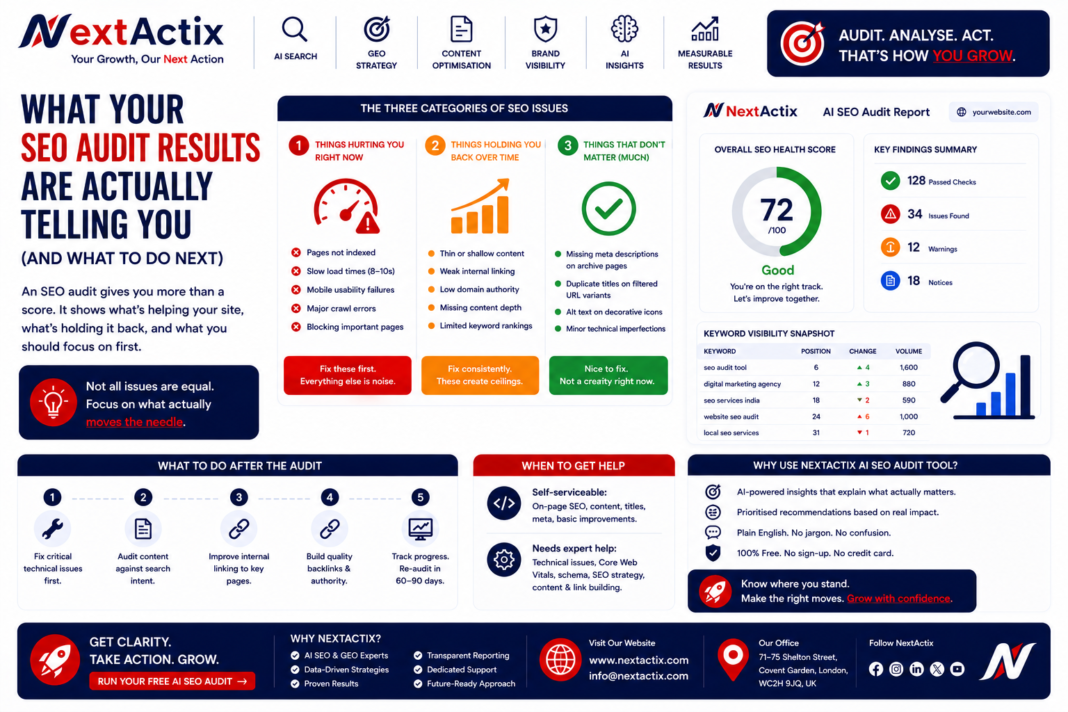
The Three Categories of SEO Issues
Things That Are Actually Hurting You Right Now
These are the issues that, if you fixed nothing else, would still move the needle. They typically include things like: pages that should be indexed but aren’t, severe page speed problems (we’re talking 8-10 second load times, not 2.5 vs 2.8 seconds), mobile usability failures, or major crawl errors that are hiding important pages from Google.
If your site has these, they’re the only thing that matters until they’re fixed. Everything else is noise.
Things That Are Holding You Back Over Time
This is where most sites live. They’re technically crawlable, they load reasonably quickly, but they’re missing the content depth, internal linking structure, or external authority that would push them from page three to page one. These issues don’t create emergencies but they do create ceilings.
Fixing them requires ongoing work rather than a one-time technical fix. This is where content strategy, link building, and consistent optimisation come in.
Things That Are Technically ‘Issues’ but Probably Don’t Matter
Every audit tool flags things that, in practice, have little to no impact on rankings. Missing meta descriptions on paginated archive pages. Duplicate title tags on filtered product URL variants. Image files without alt text on decorative icons. These might technically be imperfect, but treating them as priorities when there are real problems elsewhere is a distraction.
A good AI-driven audit tries to separate these from the real issues. The NextActix tool scores issues by actual impact on search visibility, not just technical severity in the abstract.
Reading the Keyword Visibility Section
The section that often surprises people most is keyword visibility — where the audit shows which search terms your site currently ranks for, and roughly how well.
Two things tend to come out of this. First, many businesses discover they rank for terms they didn’t deliberately target — sometimes usefully, sometimes not. Second, many discover they don’t rank for the terms they care most about, even though they thought they were targeting them on their website.
This matters because there’s a difference between having a keyword on your page and actually ranking for it. Google needs to understand that your page is the most relevant, most useful, most trustworthy result for that query — which involves a lot more than mentioning the keyword a few times. If you’re not ranking for your core terms, the audit results will help you understand whether that’s a content issue, an authority issue, or a technical one.
What to Do After the Audit
Here’s a practical framework for working through your results:
- Fix critical technical issues first. If pages aren’t being indexed or the site loads painfully slowly, nothing else will work well until that’s addressed.
- Audit your content against search intent. Are your key pages actually answering the questions people have when they search for your services? Or are they just describing what you do in the language you use internally?
- Look at your internal linking. Is your most important content linked to from other pages on your site, or is it buried three clicks deep with no pathways pointing to it?
- Consider your backlink situation. If your domain is new or has very few external links, content work will only take you so far without some authority building alongside it.
- Track progress. Run the audit again in 60-90 days. Progress on organic search is slow and uneven, and without tracking you won’t know if your efforts are working.
When to Get Help
Some of what comes out of an SEO audit is genuinely self-serviceable, especially the on-page stuff. Improving your title tags, writing better meta descriptions, improving your page’s content depth — these are things many business owners can do themselves with the right guidance.
Other things — Core Web Vitals fixes, technical crawlability issues, structured data implementation — typically require a developer. And building an ongoing SEO programme that compounds over months and years is something most businesses benefit from having specialist help with.
The NextActix free AI SEO audit tool is a starting point. It’s designed to give you a clear, honest picture of where you stand — not to upsell you into a package before you’ve had a chance to understand what you actually need. Run it, read it, and then make an informed decision about what comes next. That feels like the right order of things.