


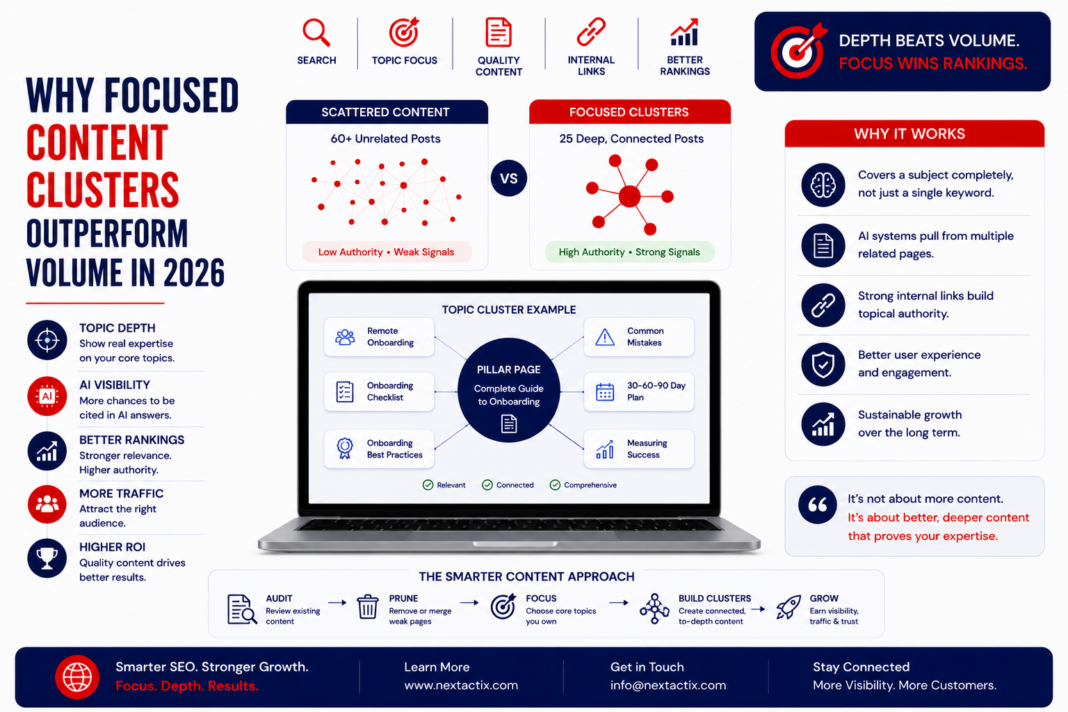
A pattern keeps showing up when you look at which sites gained ground after Google’s core updates this year and which ones lost it. It has almost nothing to do with how much content a site published, and almost everything to do with how few unrelated things it tried to cover.
Sites with sixty scattered blog posts on loosely related topics are losing ground to sites with twenty-five tightly connected ones. That’s a genuinely uncomfortable finding for anyone who spent the last few years treating content marketing as a volume game, and it’s worth understanding why it’s happening before deciding what to do about it.
The Shift From Pages to Subjects
Google’s ranking systems have moved from evaluating individual pages in isolation toward evaluating how completely a site covers a subject. A page can be well-written and still underperform if it sits alone on a site with no supporting content around it — no related explainer, no deeper dive into a subtopic, nothing showing the site actually knows the territory beyond that one article.
This is the logic behind topic clusters, which isn’t a new idea, but has become considerably more consequential over the past year. The structure is simple enough: one central page covering a subject broadly, supported by several more focused pages that each go deep on a specific piece of it, all linked back to the hub and to each other where it genuinely makes sense. What’s changed is how much weight that structure now carries, and why.
Part of the reason is a shift in how AI-generated answers get built. When someone asks an AI system a question, it isn’t matching that question to a single best page. It’s often breaking the question into smaller pieces and pulling passages from wherever answers each piece most convincingly — sometimes from several different pages on the same site if that site has genuinely thorough coverage. A site with real depth on a subject gives an AI system more opportunities to be the one it draws from and cites, across a whole cluster of related questions rather than one.
Where Most Businesses Are Getting This Backwards
The instinct, still, is to keep publishing. More posts, more coverage, more keywords targeted. The problem is that a lot of that output is genuinely thin — content that restates what’s already been said elsewhere, without adding anything a reader or an AI system couldn’t get from ten other sources just as easily.
Recent analysis of sites that pruned a meaningful share of their weaker, low-performing pages found something that surprises most people: removing content improved performance rather than hurting it. Search visibility went up, not down, within weeks. That only makes sense once you accept that a site’s overall quality is being judged partly on the average of what it publishes, not just the sum of it. A cluster of twenty genuinely useful articles outperforms a scattered eighty when a meaningful share of those eighty are adding nothing.
This doesn’t mean cutting content for its own sake. It means being honest about which existing pages are getting seen in Google Search Console — decent impressions, but nobody’s clicking — because those are usually pages that showed up for a relevant search but didn’t convince anyone they were worth reading. Rewriting or consolidating those tends to move the needle faster than starting something new from zero, because the page already has some standing with Google. It just isn’t earning it yet.
What “Depth” Actually Means in Practice
A pillar page on, say, employee onboarding shouldn’t try to explain everything about onboarding in one sprawling article. It should cover the subject at a level someone new to the topic can follow, then link out to focused pieces — one on remote onboarding specifically, one on onboarding checklists, one on common onboarding mistakes — each of which goes considerably deeper than the pillar page could afford to.
The pages that actually earn citations and links tend to share one thing in common: they contain something that couldn’t have been produced by simply asking an AI tool to summarise what’s already out there. That might be a genuinely original data point from the business’s own work, a specific example drawn from real experience rather than a hypothetical, or an honest, first-hand account of what actually happened when something was tried. Original survey data, a detailed account of a specific project, or a considered opinion that goes against the industry consensus all qualify. A generic explainer that reads like every other generic explainer on the same topic doesn’t, no matter how well it’s structured.
A Realistic Example
Picture a mid-sized accounting firm that’s been publishing roughly two blog posts a week for two years — general tax tips, generic “why hire an accountant” pieces, holiday-themed filler content. Traffic has plateaued, and a chunk of that traffic isn’t converting into anything.
Working through this properly usually starts with an honest audit: which of those hundred-plus posts are actually getting search impressions, and which are sitting untouched. A meaningful share typically get quietly retired or merged into stronger pieces. What remains gets organised around two or three subjects the firm genuinely has depth in — small business tax planning, say — with a proper pillar page and cluster pages covering specific scenarios: what changes when a sole trader incorporates, how quarterly payments actually work, what happens during an HMRC enquiry. Each cluster page includes something specific — a real example from client work, described in general terms without identifying anyone, or a genuinely considered answer to a question competitors gloss over.
None of this requires publishing more. It usually requires publishing less, and making sure what remains actually says something.
The Role AI Tools Genuinely Play Here
None of this is an argument against using AI in the writing process. AI tools are genuinely useful for research, for identifying gaps in existing coverage, for drafting an outline faster than starting from a blank page. What they can’t do is supply the actual experience or judgment that makes a piece of content worth citing in the first place. A tool can help structure an article about what happens during a tax enquiry. It can’t have sat in the room during one.
The businesses getting real value from AI in their content process tend to use it the way a good editor uses a research assistant — to speed up the parts that are genuinely mechanical, while keeping a person responsible for the parts that require actual judgment: what to say, what’s true, and what’s worth someone’s time to read.
Getting the Order Right
For a business with limited time, the sequence that tends to work best starts with an honest look at what’s already published, rather than jumping straight to new content. Identify what’s underperforming and either fix it or retire it. Pick two or three subjects the business genuinely has depth in, rather than trying to cover everything a competitor covers. Build proper clusters around those subjects, with real internal linking rather than a token mention. And make sure at least some of that content includes something genuinely original — a real number, a real example, a real opinion — rather than a competent restatement of what’s already out there.
That’s a smaller, slower-looking plan than “publish more content.” It’s also the one showing up consistently in what’s actually working this year.