


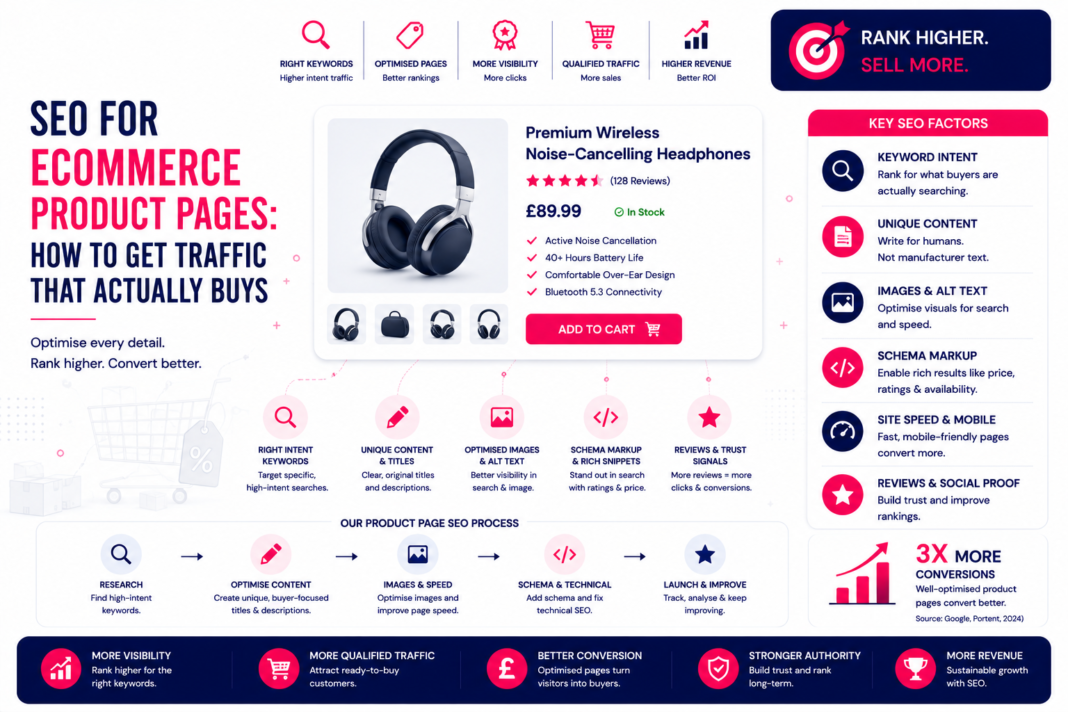
Most ecommerce stores have the same problem. The product pages exist. Some of them even rank on Google. But the people landing on them are not converting at the rate the business needs — and it is not always clear why.
Usually the issue is not one thing. It is several things happening at once. The page might be ranking for a broad keyword when the buyer was actually searching for something specific. The product description might be reused from the supplier’s catalogue. The images might be slow to load on a phone, where most of the traffic is coming from. And there is probably no structured data telling Google what the page contains, which means the listing in search results looks identical to every other result on the page.
Getting SEO for ecommerce product pages right means addressing all of these together. Not as a checklist — more as an understanding of what the buyer actually experiences from the moment they type something into Google to the moment they either add to cart or leave.
Start With What the Buyer Is Actually Searching For
The first thing to get right is keyword intent — and it is where most product pages go wrong before anything else happens.
There is a significant difference between someone searching ‘running shoes’ and someone searching ‘lightweight running shoes for flat feet under £100.’ The first person is browsing. The second person is ready to buy. A product page that ranks for the first term will attract enormous amounts of traffic and convert very little of it, because most of those visitors are nowhere near a purchase decision. A page that ranks for the second term will attract far fewer visitors and convert many more of them.
This is what search intent means in ecommerce. The goal is not to rank for the most popular keyword in your category. The goal is to rank for the keywords that buyers use when they know what they want and are ready to commit. These longer, more specific phrases — what SEO practitioners call long-tail keywords — tend to have lower competition because most brands ignore them in favour of the high-volume head terms. That makes them easier to rank for and more commercially valuable at the same time.
The practical way to find these keywords is to think about how your actual customers describe the product they are looking for. What specific features do they mention? What problem are they trying to solve? What comparisons are they running before they decide? Those descriptions, in your customers’ natural language, are the keyword targets that should be shaping your product page content.
Product Titles and Descriptions That Work for Search and for Buyers
Once you know what people are searching for, the product title is the most important piece of text on the page — for both Google and the buyer.
A good product title includes the most important descriptive terms — material, type, key feature, size or variant where relevant — in a way that is clear to a human reader. ‘Men’s Lightweight Merino Wool Running Socks — Cushioned, UK Size 6-11’ tells Google what the page is about and tells the buyer immediately whether this is what they are looking for. ‘Running Socks — Product 2847B’ tells neither.
Product descriptions have a slightly different job. They do not need to be long — they need to be specific. The description that sells and ranks well is one that tells the buyer something they could not have figured out from the product title or the images alone. The material and why it was chosen. How the sizing runs. What the product is particularly good for and what it is not ideal for. That level of specificity serves the buyer’s decision-making process and gives Google genuinely unique content to evaluate — rather than a paragraph that reads identically to the same product on fifty other websites.
Manufacturer descriptions copied across websites are one of the most common SEO problems in ecommerce. If your product description is identical to the text on the supplier’s website and on every other retailer selling the same product, Google has no reason to rank your page over any of theirs. Writing original descriptions for your key products is not a small effort, but it is one of the most direct paths to better organic rankings for competitive product categories.
The product description that ranks and converts is not the one that sounds most impressive. It is the one that gives the buyer the specific information they need to decide with confidence.
Images, Alt Text and Visual Search
Fashion, homeware, beauty, and electronics are all categories where visual search is a meaningful and growing traffic source. Google Lens searches have grown consistently year on year, and Google Images drives direct product page traffic for many ecommerce stores.
Every product image needs descriptive alt text — not for accessibility alone, but because Google reads alt text to understand what an image contains. ‘mens-merino-running-socks-cushioned-grey.jpg’ with alt text ‘Men’s cushioned merino wool running socks in grey, UK size 6-11’ is telling Google something useful about the image. A generic filename with no alt text is invisible to search.
Beyond alt text, image file size has a direct effect on page loading speed. An ecommerce page with eight uncompressed product images will load significantly more slowly than the same page with properly optimised WebP images. Given that over 60% of ecommerce traffic is on mobile devices, and that Google evaluates mobile page performance for ranking purposes, slow images are not just a user experience problem — they are a ranking suppressor.
Schema Markup: The Technical Layer Most Stores Skip
Product schema markup is code you add to your product pages that tells search engines exactly what information the page contains. When implemented correctly, it enables Google to display enriched search results — star ratings, price, availability, and review count — directly in the search listing, before the buyer has clicked anything.
These enriched results stand out visually in a page of standard blue links. They give the buyer more information to work with before clicking, which means the clicks you get are from people who were already somewhat sold on what they saw. Click-through rates from schema-enriched listings are consistently higher than from standard results, and the buyers who arrive are more informed and more likely to convert.
The schema types most useful for ecommerce product pages are Product schema (price, availability, brand, and description), AggregateRating schema (combined review score and count), and BreadcrumbList schema (showing the category path in search results). None of these are technically complex to add if your website runs on a platform with schema support — Shopify, WooCommerce, and most major ecommerce platforms have options for this either built in or through a plugin.
Site Speed, Mobile Experience and Why They Connect to Sales
There is a consistent and well-documented relationship between page loading speed and ecommerce conversion rate. Research from Google found that a one-second delay in mobile loading time reduces conversions by 20%. For a store doing £50,000 a month in revenue, that is a £10,000 monthly cost that shows up nowhere obviously in analytics — it manifests as a slightly lower conversion rate with no obvious explanation.
The March 2026 core update tightened Google’s Core Web Vitals thresholds. The LCP benchmark — measuring how quickly the main content loads — moved from 2.5 seconds to 2.0 seconds. Ecommerce stores with image-heavy product pages that were passing before the update are now being evaluated against the stricter threshold. Google Search Console’s Core Web Vitals report shows exactly how your product pages score and which specific issues are contributing to a poor rating.
Mobile experience goes beyond loading speed. A product page that requires pinching and zooming to read the description, has an add-to-cart button that is difficult to tap on a phone, or shows size variants in a dropdown that is awkward on a touchscreen is losing sales at the moment of purchase. These are not SEO problems in the traditional sense, but they are conversion problems that SEO drives traffic into — and fixing them improves the commercial return on every ranking you have.
Customer Reviews and What They Do for Ecommerce SEO
Product reviews do several things simultaneously that make them valuable far beyond the obvious trust benefit.
They add continuously updated, keyword-rich content to your product pages without any effort from your team. When customers describe your product in their own words — mentioning specific use cases, features they valued, comparisons they ran before buying — they are naturally using the language that other potential buyers search for. That user-generated content helps Google understand what the product is used for and by whom.
Reviews also directly influence your schema-enabled search listing. If your Product schema pulls in an AggregateRating, Google can display those stars in the search result. A listing showing 4.7 stars from 94 reviews looks meaningfully different from an identical listing with no rating displayed. The star display drives clicks. More clicks from people already primed to trust you drives better conversions.
Building a consistent review collection process — asking at the right moment after purchase, making it easy with a direct link, and responding to reviews including the negative ones — is the ecommerce equivalent of social proof infrastructure. It works in the background, building trust and feeding search signals, without requiring ongoing manual effort once the system is in place.
NextActix helps ecommerce businesses with the full range of product page optimisation — from keyword research and content to schema markup, site speed, and conversion rate improvements. Start with a free audit to see exactly what your product pages need.