


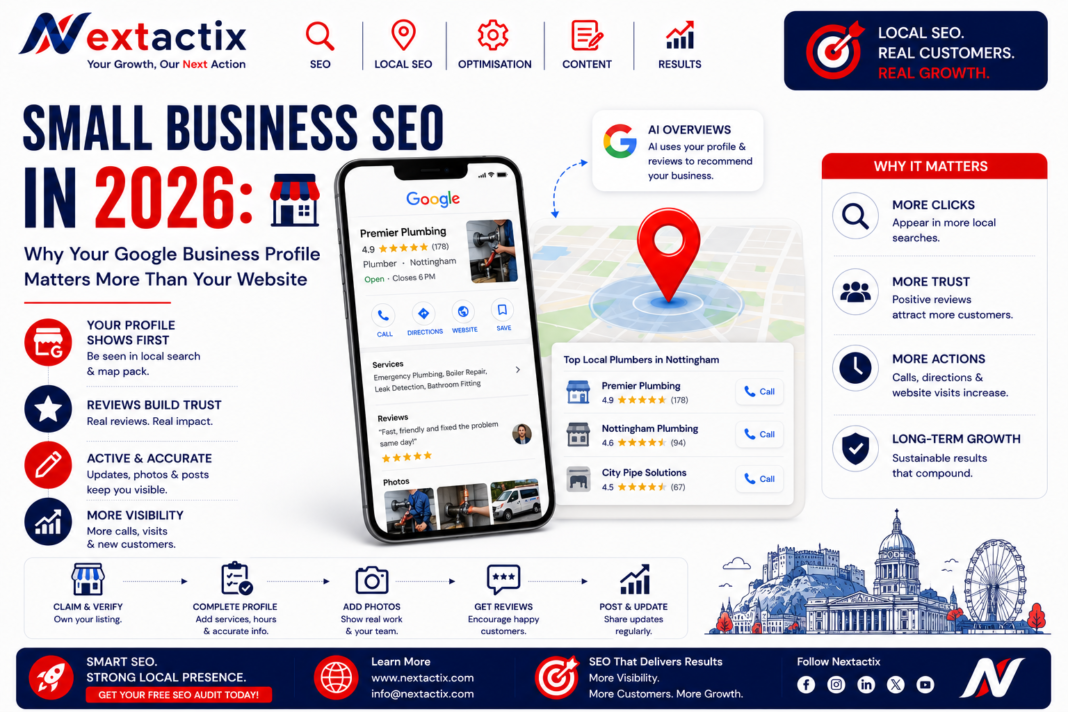
A local plumber, an independent dentist, and a family-run café have very different websites. What they increasingly have in common is that fewer people are actually visiting those websites before deciding to call.
Search data from Semrush puts zero-click search — where someone gets their answer without clicking through to any website — at over a quarter of all US search traffic now, and rising. For a local business, that mostly plays out through the Google Business Profile and the map pack, not the homepage. Someone searches “emergency plumber near me,” sees a business’s hours, reviews, and phone number directly on the results page, and calls without ever loading the website. Whether that business “wins” that search has almost nothing to do with how good its site looks.
Google Business Profile Has Quietly Become the Primary Asset
This is a genuine shift from how small business SEO used to work. A few years ago, the website carried most of the weight, and the Google Business Profile was treated as a supporting listing. Now it’s closer to the reverse for a lot of local searches. Google’s AI Overviews, which were originally limited to informational questions, now answer local queries like “best electrician near me” or “family dentist in [town]” directly, pulling from Business Profile data, reviews, and structured content rather than sending the searcher to a website at all.
That means a business with an unclaimed or half-finished profile can be doing everything else right — a decent website, a reasonable reputation locally — and still be effectively invisible for the exact searches that would bring in new customers. Verification alone makes a measurable difference; profile data shows verified listings consistently outperform unverified ones on both visits and direct actions like calls and direction requests.
What “Complete” Actually Means Now
A complete profile used to mean filling in the obvious fields — name, address, phone number, hours. That’s still the baseline, but it’s no longer enough on its own. The category selection matters more than most owners realise; choosing the single most specific category available, rather than a broad one, has a real effect on which searches a business shows up for. The business description needs to actually describe what the business does and where, in plain language, rather than reading like a slogan. And the services list should be filled in individually, not left as a single vague summary, because AI systems increasingly index that list directly when deciding whether to mention a business for a specific request.
Photos matter more than they used to as well — not just a logo and a storefront shot, but images of the actual work, the team, and the space, refreshed periodically rather than uploaded once and forgotten.
Reviews Are Being Read, Not Just Counted
Star ratings still matter, but they’re not the whole story anymore. AI systems generating local recommendations are increasingly reading the actual text of reviews, not just averaging the scores — looking for whether customers mention the specific services a business wants to be found for. A landscaping company with forty five-star reviews that only say “great service, highly recommend” gives an AI system far less to work with than one where customers specifically mention “cleared our garden after the storm” or “fixed our irrigation system in one visit.”
This is part of why encouraging detailed, specific reviews — rather than just more reviews — has become a genuinely useful tactic rather than a nice-to-have. A simple prompt after a job, asking a customer to mention what was actually done, tends to produce far more useful review content than a generic “please leave us a review” request.
A Realistic Example
Consider a small physiotherapy clinic with two practitioners, competing against several similar clinics within a few miles. Its website is reasonably built, but its Google Business Profile was set up years ago and mostly left alone — a general “physiotherapist” category, a two-line description, no posts, and a handful of reviews that all say some version of “very professional.”
The clinic isn’t invisible, but it’s thin. Working through this properly starts with tightening the category to the more specific option available rather than the broad one, and rewriting the description to actually name the conditions and treatments the clinic focuses on. It continues with building out the services list individually — sports injury rehab, post-surgery physiotherapy, chronic pain management — rather than one generic entry. Weekly posts, even simple ones about clinic hours around a bank holiday or a new practitioner joining, signal an active, currently-run business rather than a listing nobody’s touched in years. And a habit of asking patients, after a good outcome, what specifically helped them — rather than a blanket review request — starts producing reviews that mention real conditions and treatments by name, which is exactly the kind of detail both patients and AI systems respond to.
None of this requires a marketing department. It requires someone spending a couple of hours a week treating the profile as an actively managed asset rather than a listing that exists because it has to.
Consistency Across Platforms Still Matters, Maybe More
Business name, address, and phone number need to match exactly across every platform a business appears on — its own website, its Google Business Profile, directories, social profiles. This has always been a local SEO fundamental, but it carries more weight now because AI systems cross-reference these sources when deciding what to trust. A mismatch that used to just look untidy can now actively cause an AI assistant to surface the wrong hours or an old phone number, which damages trust in a more direct way than a low ranking ever did.
Where a Website Still Earns Its Keep
None of this makes the website irrelevant. It’s just no longer the first thing most local customers see. A website still matters for the searches that involve genuine research — comparing services, checking pricing, reading longer explanations of how a process works — and it remains the place where content marketing, like a detailed local guide or an explainer article, can build the kind of long-term authority a Business Profile alone can’t. The businesses doing this well tend to treat the website and the Business Profile as two parts of the same system, kept consistent with each other, rather than one being an afterthought to the other.
The Businesses Actually Pulling Ahead
The pattern showing up repeatedly isn’t about budget. It’s about which businesses treat their Google Business Profile as something that needs weekly attention — a post, a review response, an updated photo — rather than something set up once and left alone. That consistency is unglamorous, but it’s the single clearest difference between the local businesses gaining visibility this year and the ones quietly losing it.
Frequently Asked Questions
Is Google Business Profile really more important than a website for local businesses now? For the specific moment someone searches “near me” or asks an AI assistant for a local recommendation, yes, it’s often the deciding factor. The website still matters for research-stage searches and longer-term content, but the Business Profile increasingly wins the immediate, high-intent local search.
How often should a small business post to its Google Business Profile? Roughly two to three times a week is a reasonable target based on current local SEO research, though even weekly posting is far better than the common pattern of setting up a profile once and never touching it again.
Do negative reviews hurt a small business’s local SEO? Occasional negative reviews, especially ones handled with a professional response, don’t do much damage on their own. What hurts more is inconsistency — a business with almost no reviews at all, or one that never responds to feedback either way.
How long does it take to see results from improving a Google Business Profile? Some changes, like completing missing fields or fixing category selection, can affect visibility within weeks. Building up a stronger base of detailed reviews and consistent posting activity tends to show clearer results over a few months.
Should a small business worry about being visible on AI tools like ChatGPT or Gemini, not just Google? It’s worth paying attention to, particularly since Google’s own AI Overviews already pull heavily from Business Profile data. The groundwork is largely the same one that helps traditional local SEO — accurate, detailed, consistent information across every platform the business appears on.