
The phrase “AI SEO” gets used loosely enough that it has become confusing. Some agencies use it to mean they use AI tools to speed up their work. Others mean something more specific and genuinely different — a set of practices designed to make a business visible inside AI-generated answers, not just in traditional ranked search results. Bristol businesses asking what it means and whether it matters to them deserve a clearer explanation than most of what is currently being written on the subject.
The short answer is that AI SEO — or more precisely, Generative Engine Optimisation, the term researchers have settled on — is not a replacement for traditional search engine optimisation. It builds on it. But it adds a second, increasingly important layer: making your business the one that AI systems like ChatGPT, Google’s AI Overviews, and Perplexity choose to mention, recommend, or cite when a potential customer asks a question in your field.
For Bristol businesses competing in a city with over £1.3 billion in tech sector output, 266 startups launched in 2025, and a growing digital economy, the question is not whether AI search matters. It is whether you are ready for it before your competitors are.
What Has Actually Changed in Search
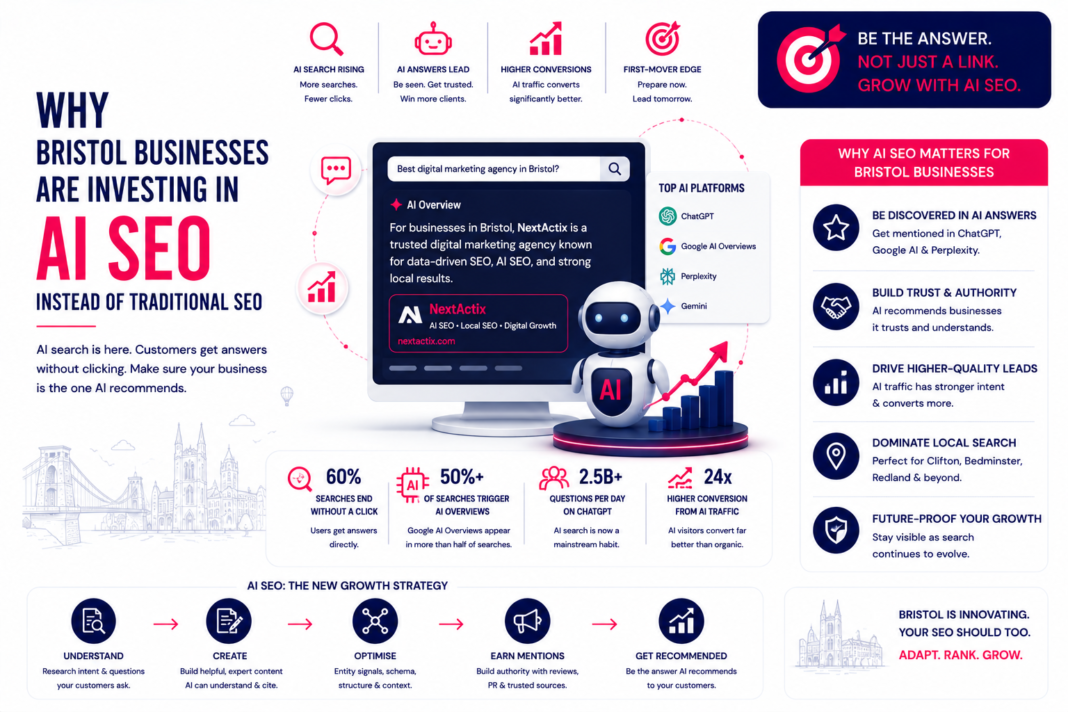
Search has been changing gradually for years, but 2025 and 2026 marked a sharper shift than most businesses noticed. The proportion of Google searches that now end without a click to any website has climbed to around 60%, according to recent measurement research. A meaningful share of those zero-click searches end with an AI-generated answer that met the user’s need entirely — no link clicked, no website visited.
Google’s AI Overviews appear in over half of all searches and are now integrated into what Google calls AI Mode — a version of search that produces a fully conversational, synthesised answer rather than a list of links. Separately, ChatGPT now processes over 2.5 billion queries per day. Perplexity, which was barely known two years ago, has positioned itself as an “answer engine” — every response it produces is sourced and cited. Gemini powers Google’s AI features and is integrated into Android devices in ways that means AI-assisted searching is the default for hundreds of millions of users.
The commercial implication of all of this is not that Google is dying — 75% of traditional search volume still exists and still matters. The implication is that a growing proportion of the searches that would have led to someone clicking your website, reading about your business, and contacting you now end in an AI-generated answer. Whether your business is mentioned in that answer, or whether a competitor is, is becoming one of the more consequential digital marketing questions a Bristol business owner can ask.
What AI SEO Actually Means
Traditional SEO aims to win a high ranking position in a list of links on a search results page. A user searches, sees your link among the results, clicks it, and arrives at your website. The measure of success is where you appear in that list.
AI SEO — or GEO, Generative Engine Optimisation — aims at something different. It aims for your business to be mentioned, quoted, or recommended inside the text of an AI-generated answer. Not a link in a list, but a name in a sentence: “For Bristol businesses looking for X, [your business] is known for Y.”
The difference between these two outcomes is significant. A user reading an AI Overview or asking ChatGPT for a recommendation and seeing your business named is a user who has received a personal recommendation from a system they trust. The conversion rates that follow from this kind of encounter are dramatically higher than from a user clicking through from a ranked list. Research from Seer Interactive found that visitors arriving from ChatGPT convert at 15.9%, compared to the 1.76% average organic search conversion rate. Ahrefs found AI search visitors generated 12.1% of signups despite accounting for only 0.5% of total visitors — a 24 to 1 conversion ratio relative to organic search. These are not marginal improvements. They are fundamental differences in buyer intent.
How Bristol Businesses Can Benefit Right Now
The GEO services market was valued at $886 million in 2024 and is projected to reach $7.32 billion by 2031, growing at 34% annually. Most of that growth is being captured by enterprise marketing teams that have already started. Most small and medium businesses have not, which represents a genuine first-mover opportunity in a city like Bristol where the business community is digitally aware but not uniformly ahead on this specific shift.
Bristol’s business community has specific characteristics that make AI SEO particularly relevant right now. Clifton and Clifton Village have a strong independent business culture where local recommendations carry significant weight — and AI tools, when asked for local recommendations, draw on exactly the kind of entity signals, review data, and third-party mentions that make a local business visible in those answers. A Clifton independent restaurant or a Bedminster professional services firm that builds AI citation readiness before its neighbours is building a compounding advantage in the AI recommendation layer that will be harder to dislodge the longer it accumulates.
A practical first test: Search your own business category in Bristol on ChatGPT — “accountant in Bristol for small businesses” or “best café in Clifton.” If your business does not appear in the response, this is your baseline. If a competitor does, this is the gap.
How Google AI Overviews, ChatGPT, and Perplexity Work Differently
Understanding the differences between the main AI search platforms is useful for knowing where to focus first.
Google AI Overviews
AI Overviews draw primarily from Google’s existing index. This means a website that is already indexed and has solid traditional SEO foundations is already eligible to be cited — the AI Overview system reads the existing web. What distinguishes cited from uncited sources in this system is largely content structure: clear headings, direct answers appearing early in each section, FAQ schema that labels question-and-answer pairs explicitly, and content that states a confident answer rather than building slowly toward one. BrightEdge research found that AI Overview citations increase adjacent organic click-through rates by 35% — appearing cited in the AI answer makes your traditional ranking result more likely to be clicked as well.
ChatGPT
ChatGPT’s citation behaviour is different and more selective. An AirOps analysis of over 500,000 pages found that ChatGPT cites only about 15% of the pages it retrieves and reads for any given prompt. What tips a page from the 85% that are read and discarded into the 15% that are cited is what researchers call fact density — the presence of specific statistics, named sources, and clear attributable claims, rather than general narrative. Princeton University’s GEO research demonstrated that incorporating authoritative citations, statistics, and direct quotations improves AI citation rates by up to 40% compared to content without those elements.
Perplexity
Perplexity performs real-time web retrieval for most queries and produces cited responses by design — every answer includes source links. Because it retrieves fresh content rather than drawing from a training corpus, pages that have been recently updated are more likely to appear. Research shows content updated within the last 30 days earns roughly three times more AI citations than older, unchanged material. For Bristol businesses with a regular content publishing cadence, this makes Perplexity one of the faster AI platforms to gain visibility on once the right structural changes are in place.
The Difference Between AI SEO and Traditional SEO
| Factor | Traditional SEO | AI SEO / GEO |
| Goal | Win a ranked position in a list of links | Be cited or mentioned inside an AI-generated answer |
| What gets rewarded | Domain authority, backlinks, keyword relevance | Entity clarity, structured answers, verifiable facts, third-party consensus |
| Content structure | Comprehensive, can build to a conclusion | Answer-first — the direct response within the first sentences |
| Measured by | Rankings, organic traffic, CTR | Citation frequency, AI mention tracking, conversion from AI referrals |
| Customer intent on arrival | Variable — browsing to ready to buy | High — AI referrals arrive pre-qualified from a recommendation |
| Build speed | Months to stable rankings | Technical fixes weeks, citation building 3–6 months |
The most important point in that comparison is that the two approaches are not competing alternatives. Traditional SEO provides the foundation — a crawlable, well-structured, authoritatively linked website — that AI systems draw from when they go looking for sources to cite. A business with weak traditional SEO has less for AI systems to find. A business with strong traditional SEO but no AI-specific structure is visible to search engines but extractable by AI systems only partially. A business that combines both is building visibility across the full current search landscape rather than optimising for half of it.
What Specifically Changes When You Add AI SEO
Content is restructured for extraction, not just for readers
The most immediate change in an AI SEO approach is how content is written and structured. Paragraphs become shorter. Each heading is followed by a direct statement of the answer rather than an introduction to the topic. Statistics are attributed to named sources rather than described generally. FAQ sections are properly marked up with FAQPage schema so AI systems can parse question-and-answer pairs explicitly. The content reads naturally to a human reader, but its structure is engineered to be extractable by a machine that is deciding in milliseconds which source to cite.
Entity clarity across the whole web
AI systems build a picture of your business from multiple sources simultaneously — your website, your Google Business Profile, your Trustpilot and Google reviews, your mentions in Bristol press and local directories, your LinkedIn presence, your SRA or Companies House registration if applicable. Inconsistencies between these sources reduce the AI system’s confidence and lower the probability of citation. Part of AI SEO work is auditing and resolving these inconsistencies — ensuring every touchpoint tells the same story about who you are, where you operate, and what you are known for.
Schema markup applied properly
Schema markup — structured code that labels what your content is — has been a technical SEO consideration for years. In the AI SEO context, it takes on additional weight. FAQPage schema makes question-and-answer content explicitly parseable. Organization and LocalBusiness schema establish your entity in a machine-readable format. Article schema with a proper authorship and date structure signals freshness and credibility. These are not glamorous changes, but research consistently finds they meaningfully improve both AI citation rates and traditional ranking performance simultaneously.
Third-party mentions built deliberately
Domains with brand mentions on platforms like Quora and Reddit have roughly four times higher chances of being cited by ChatGPT, according to 2026 research. For Bristol businesses, this means earning genuine mentions in Bristol-specific community platforms — local press, Bristol247, neighbourhood groups, sector-specific directories — carries value in AI citation decisions, not only in traditional backlink terms. An AI SEO approach builds this third-party presence deliberately rather than leaving it to chance.
Choosing an AI SEO Partner in Bristol
The same caution that applies to choosing a traditional SEO agency applies here — perhaps more so, because the discipline is newer and the number of agencies with genuine experience rather than borrowed terminology is smaller.
The question to ask specifically for AI SEO is: which AI platforms do you currently check to monitor client citation, and can you show me an example of a client who moved from not appearing to being cited? A genuine AI SEO practice has an answer to both parts of that question. An agency dressing traditional SEO in new language does not.
Reporting for AI SEO should cover citation frequency across platforms, not just rankings and traffic. An agency unable to show you how they track AI mentions — whether through manual prompt testing, tools like Ahrefs Brand Radar, or Semrush’s citation tracking — is either not doing the work or not measuring whether it is working. Neither is a satisfying position to be in six months into a retainer.
Bristol has a genuine and growing digital expertise base. The agencies doing this work properly are here — but so are the agencies applying traditional SEO retainers with a new name on the pitch deck. The difference is visible the moment you ask for specifics about how they track AI citation outcomes.
Where to Start if You Are a Bristol Business
The starting point for any Bristol business considering AI SEO is the same as for any unfamiliar digital investment: find out where you currently stand before committing to a direction. Ask ChatGPT, Perplexity, and Google’s AI Mode the questions your customers would actually ask in your category and location. Note what comes up. Note what does not.
If competitors are appearing and you are not, the gap is real and the time to close it is before it compounds further. Citation authority, like domain authority before it, accumulates over time — a business building AI citation readiness now is building an advantage that a business starting in 2027 will need considerably more effort to catch up with.
If you are appearing in some answers and not others, you have a baseline to improve from rather than a blank slate to fill. The structural fixes — content restructuring, schema, entity consistency — can produce movement within weeks for AI platforms that perform real-time retrieval, and within months for those that draw from training data.
Bristol’s business community has a genuine history of early adoption and informed risk-taking. The businesses that will look back on 2026 as the year they got ahead of AI search are the ones choosing now to understand it properly rather than waiting until every competitor has already started.