

There is no shortage of SEO agencies in Bristol. A search for “SEO agency Bristol” produces dozens of results — some local, some national with Bristol offices, some operating remotely but targeting the city. Several of them will rank well on that exact search, which sounds like evidence that they know what they are doing. Sometimes it is. Sometimes it is not. Ranking well for your own agency name in your own city is considerably easier than ranking a client in a genuinely competitive industry.
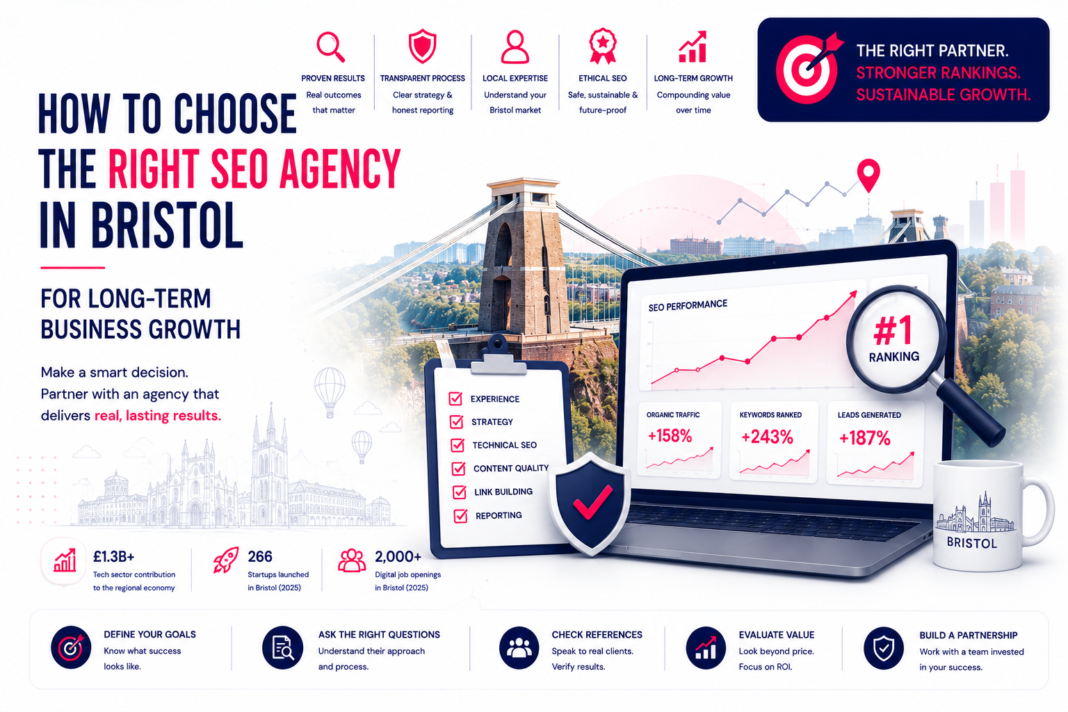
Bristol’s tech and digital economy is substantial. Its tech sector contributes over £1.3 billion annually to the regional economy according to Tech Nation, and the city launched 266 startups and saw nearly 2,000 digital job openings in 2025, according to StartupBlink’s report. That growth has created real demand for SEO services — and, as in any market with real demand, a mixed quality of providers to meet it.
This guide is for a Bristol business owner or marketing manager who needs to make a well-informed decision about which agency to trust with their organic visibility. It covers what to look for, what questions to ask, what to avoid, and why — in 2026 specifically — the right agency has to understand more than just the traditional Google ranking game.
Why Getting This Decision Right Matters More Than It Used To
A few years ago, the cost of choosing the wrong SEO agency was largely the wasted retainer. You could stop after six months, move on, and most of the damage was recoverable. The calculation has changed.
SEO now interacts with AI search in ways that make some mistakes harder to reverse. An agency that builds bulk low-quality backlinks to your domain does not just waste your money — it can produce a link profile that requires significant cleanup before any future agency can make meaningful progress. An agency that produces large volumes of thin, templated content under your domain can trigger Google’s helpful content evaluation in ways that suppress even genuinely good pages on the same site. These are not theoretical risks. They are documented outcomes of the approaches some agencies still sell.
At the same time, the opportunity cost of good SEO has grown. Organic search now competes directly with AI-generated answers for the attention of potential customers. A Bristol business that builds strong, well-structured content with proper entity signals and schema markup is building visibility in both traditional search results and AI Overviews simultaneously. An agency that understands this dual landscape delivers compounding returns. One that optimises only for last year’s version of Google leaves half the opportunity unrealised.
What Bristol Businesses Should Actually Look For
Genuine understanding of your market, not just your keywords
The most common agency pitch goes like this: here are the keywords you should rank for, here is the current competition, here is a plan to outrank them. This is fine as far as it goes, but it misses something important for businesses competing in a specific place.
Bristol has its own commercial geography. Clifton and Clifton Village have one of the strongest independent business cultures in the UK — residents there actively seek local businesses over national chains, and the search behaviour in those neighbourhoods reflects that preference. Stokes Croft carries a different but equally strong community identity. Bedminster, Bishopston, and Southville have grown their own micro-economies with loyal local customer bases. The Temple Quarter enterprise zone has attracted a different type of business entirely — technology, professional services, national companies choosing Bristol for their regional hub.
An agency that understands this geography will give different advice for a Clifton café than for a Temple Quarter software company, because the search intent and the competitive environment are genuinely different. An agency applying the same template to both is telling you something important about how much it actually knows about your market.
Evidence of real results for real businesses
Every agency has a testimonials page. The useful evidence is not there. What you are looking for is specific: which businesses, in which industries, saw which outcomes, over what time period, and can you speak to the person at that business to verify it?
Most reputable agencies will provide references on request. If an agency hesitates, or offers only anonymised case studies, treat that as informative. It does not necessarily mean the results were not real — some clients legitimately request confidentiality. But it does mean you are being asked to trust an unverifiable claim, which is a reasonable thing to push back on before committing a monthly retainer.
Pay attention to what the case studies actually measure. Traffic growth is not the same as enquiry growth. Rankings growth is not the same as revenue growth. An agency that presents traffic charts without conversion data is either not tracking the right outcomes or not comfortable showing you the ones they are tracking.
Transparency about how the work actually gets done
The single clearest dividing line between agencies worth working with and those worth avoiding is transparency about process. A good agency can explain, in plain language, exactly what it will do in the first month, the second month, and the third. It can show you what an audit looks like, what a content brief looks like, how link acquisition actually works, and what the reporting tells you.
An agency that answers specific process questions with vague language about “proprietary methods” or “our unique approach” is either protecting nothing of substance or has something worth hiding. Neither is a good reason to hand over a retainer.
Questions to Ask Before Hiring a Bristol SEO Agency
The following questions are designed to surface real information rather than polished pitches. Ask all of them. Notice which ones produce direct answers and which produce deflection.
“How do you stay current with AI search changes, and how does that affect what you do for clients?”
This question matters because the answer reveals whether the agency is operating in 2026 or 2023. The correct answer acknowledges that AI Overviews, Google AI Mode, ChatGPT, and Perplexity now affect how potential customers find businesses, and explains how the agency incorporates this into its work. A blank look or a dismissive “we focus on Google rankings” is useful information about what you will not be getting.
“Can you show me a Bristol business you work with that we could speak to directly?”
This is the reference request. The way the agency responds tells you as much as whether they can provide one. An agency comfortable with its results should find this question easy to answer. An agency that struggles should prompt you to ask why.
“What happens in the first 90 days, specifically?”
The first three months of an SEO engagement typically involve auditing, baseline setting, and foundational fixes. These should be describable in specific terms — technical audit, keyword mapping, content gap analysis, schema implementation, citation review. If the answer to this question is general rather than specific, it usually means the agency has not yet thought carefully about your account.
“How do you handle a situation where a strategy is not working?”
The honest answer is that SEO involves iteration. Strategies that looked right on paper sometimes underperform, and the response to that should be measurable assessment and adjustment, not doubling down or redefining what success means. An agency that cannot articulate its approach to course-correction has probably not built one.
“What do you not do, and why?”
This is the question most business owners forget to ask. Reputable agencies decline certain tactics — bulk link acquisition, AI-generated content at scale without human review, keyword stuffing, private blog networks. Asking what an agency refuses to do, and listening to the reasoning, tells you more about their values than any pitch about what they do offer.
Red Flags to Avoid
Some of these are obvious. Others are subtler. All of them are worth knowing before you sign anything.
Guarantees of specific ranking positions
No agency can guarantee a position on Google. Google’s own guidelines say this explicitly. Any agency promising first-page rankings within a specific timeframe is either misrepresenting how search works or planning to use tactics that produce short-term results and long-term problems. In either case, the promise is not one they can keep honestly.
Reporting that focuses exclusively on rankings and traffic
Rankings and traffic are inputs to the outcome you actually want, which is enquiries, leads, and revenue. An agency that reports on rankings and traffic without connecting them to business outcomes is measuring the process rather than the result. The more useful question — which agencies worth working with should be asking you — is what a new customer is worth to you, so the SEO investment can be assessed against real business returns rather than abstract digital metrics.
Contracts with no clear deliverables
A retainer that promises “ongoing SEO work” without specifying what that work consists of in measurable terms is a retainer you cannot evaluate. If you cannot tell at the end of month three whether the agreed work was done, you have no basis for assessing whether the agency is delivering value. Insist on specific deliverables per month — number of pages audited, content produced, links built through which methods, schema implemented where — before signing.
Unusually cheap pricing with ambitious promises
Effective SEO in a competitive market requires real time and real expertise. The UK SEO industry generated £24.6 billion in revenue in 2025 to 2026 according to IBISWorld, a market that sustains professional rates for professional work. An agency offering Bristol SEO for £200 per month with promises of significant ranking improvement is either targeting easy, low-competition terms or delivering work at a volume that cannot produce those results for genuinely competitive keywords. Neither is the outcome a growing business needs.
Why Local Knowledge Still Matters in Bristol’s Market
Some SEO work is genuinely location-agnostic. Technical audits, site speed improvements, schema implementation — these require expertise, not local knowledge. But the part of SEO that drives sustained local visibility in Bristol’s specific market is different.
Bristol’s independent business culture means that local link acquisition — mentions in local press, partnerships with local organisations, appearances in Bristol-specific community platforms — carries meaning that generic national backlinks do not replicate. The Bristol Post, Bristol247, the Bristol Chamber of Commerce publications, local neighbourhood Facebook groups and NextDoor communities — a local agency with real Bristol relationships can access these in ways a national agency operating remotely cannot, or at least cannot do as efficiently.
Bristol is also a city where word of mouth among business communities moves quickly, particularly in sectors like professional services, creative industries, and hospitality. An agency with existing relationships in those networks, and a reputation within them, is offering something that a profile on Clutch and a set of templated case studies cannot replicate.
A practical test: Before your final decision, ask each agency you are considering who they know in Bristol’s business community and which local publications or organisations they have relationships with. The quality and specificity of the answer will tell you whether their local knowledge is real or assumed.
Why AI Search Is Now Part of Any Honest SEO Conversation
Any SEO agency pitching for Bristol business in 2026 that does not mention AI search either does not understand it or is not planning to address it for you. This is not a minor caveat — it is a structural change to how potential customers find businesses.
AI Overviews now appear in a significant proportion of Google searches. ChatGPT processes over 2.5 billion queries per day according to 2026 research, and is on a trajectory that some forecasts expect to approach Google’s search volume by 2027. These are not future trends to prepare for. They are current realities affecting how potential customers in Bristol find services today.
The businesses being cited in AI-generated answers are not necessarily the ones with the highest domain authority or the most backlinks. Research from Princeton University found that content combining authoritative citations, specific statistics, and clear factual structure was cited up to 40% more often in AI-generated responses than content without those elements. An agency that understands this builds your content with dual purpose from the start — structuring it to rank in traditional results and to be extractable by AI systems simultaneously.
Visitor behaviour from AI referrals also differs from organic search. According to Seer Interactive’s 2025 research, visitors arriving from ChatGPT convert at 15.9% compared to a 1.76% average organic search conversion rate. These are not visitors casually browsing — they are people who asked an AI for a recommendation and followed its answer. Appearing in those answers, rather than just in search result lists, is becoming one of the more commercially valuable outcomes an SEO agency can deliver.
Making the Final Decision
After going through the process above — checking case studies, asking the hard questions, testing for red flags, assessing local knowledge and AI search awareness — the decision usually comes down to a combination of fit and evidence. Fit is whether the agency understands your business and can articulate a strategy specific to it. Evidence is whether they have delivered comparable results for comparable businesses.
Neither element alone is sufficient. An agency with a persuasive pitch and no verifiable results is selling a future it cannot demonstrate. An agency with impressive case studies from industries very different from yours may not transfer those results to your market.
The right SEO agency for a Bristol business in 2026 is one that can show you both — real results in related contexts, and a specific, honest plan for yours. In a market with dozens of options and a long history of agencies overpromising and underdelivering, the agencies willing to be specific and honest about both are worth considerably more than those offering guarantees and testimonials alone.