


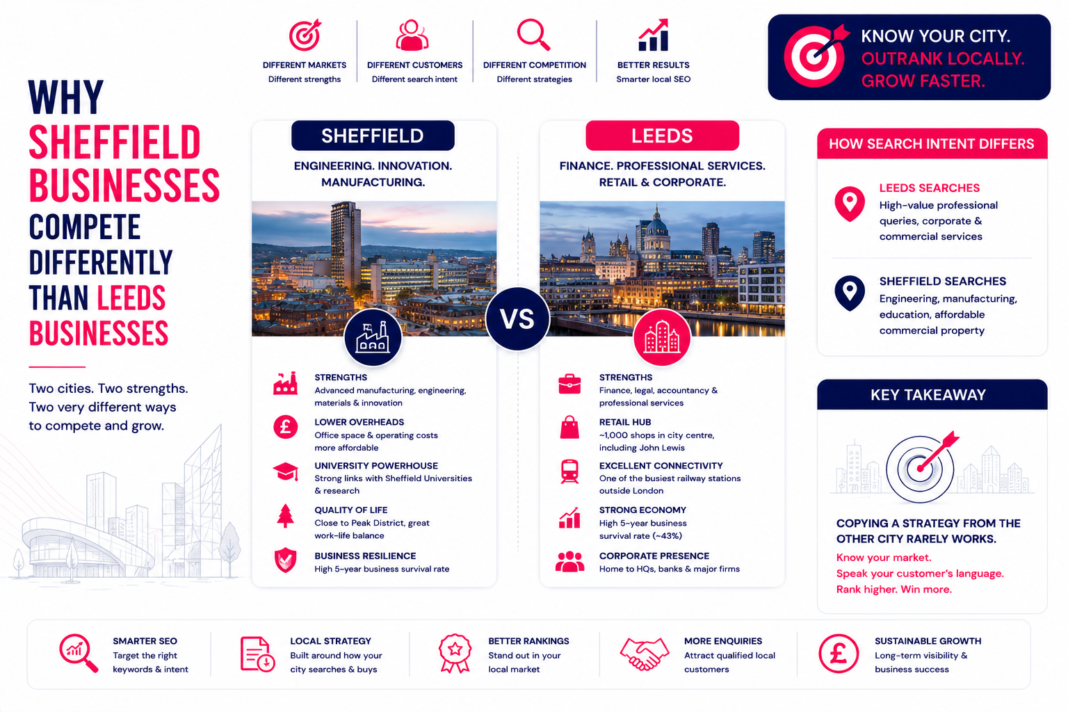
Ask anyone in Yorkshire which city is better for business and you will start an argument. Leeds people will point to the financial district, the legal quarter, the rapid employment growth. Sheffield people will tell you about the Advanced Manufacturing Research Centre, the low cost base, the universities churning out engineers. Both are right about their own city. What they often do not explain is why the difference between the two actually matters for any business trying to compete, grow, or get found in either one.
The thirty-five miles between the two cities conceals a significant divergence in economy, business culture, competition density, and the way customers search for services. For a business operating in Sheffield, understanding that it is not competing in the same environment as Leeds — even for broadly similar services — is more useful than treating the two cities as interchangeable.
The Economy Underneath the Two Cities
Leeds built its modern economy on financial and professional services. The city has a higher concentration of employment in financial intermediation than Sheffield — a structural difference that has compounded over several decades since the de-industrialisation of the 1980s pushed both cities to reinvent themselves. Leeds went earlier and more decisively toward services. It became the largest financial centre outside London, with KPMG, Deloitte, Eversheds Sutherland, Addleshaw Goddard and several major banks all running significant regional operations there.
Sheffield took a different path. Rather than pivoting hard to professional services, it doubled down on what it already knew — engineering and manufacturing — and upgraded them. The Advanced Manufacturing Research Centre, launched in partnership with the University of Sheffield and Boeing, became one of the most significant advanced engineering facilities in Europe. The city is now home to the UK’s Nuclear Advanced Manufacturing Research Centre and several aerospace-grade precision manufacturers. Its designation as the UK’s advanced manufacturing capital is not marketing copy — it reflects a genuine cluster of high-value technical businesses that exists nowhere else in the country at the same concentration.
EY’s 2025 regional forecast for Yorkshire and the Humber projected Leeds with the highest overall growth rate in the region at 1.4% annual employment growth, while Sheffield was forecast at 1.1% — in line with the national rate and ahead of most other Yorkshire cities. The gap is not dramatic, but it reflects a structural difference in the speed of the two economies: Leeds has more large corporate employers and a faster-growing professional services sector; Sheffield has a more stable, more manufacturing-weighted base that grows at a steadier but less cyclical pace.
What This Means for Competition
The practical consequence of these different economies is that the competitive landscape for businesses in each city is significantly different — even if the type of business appears the same on the surface.
A solicitors firm in Leeds is competing directly against regional offices of national and international law firms, well-resourced legal services businesses, and comparison platforms that deploy significant SEO budgets. The bar for visibility, both in traditional search and increasingly in AI-generated recommendations, is set by sophisticated, well-funded competitors.
A solicitors firm in Sheffield is operating in a market that still has substantial national-firm presence in the commercial and corporate space, but where local and regional firms retain much stronger positioning in family law, employment, conveyancing, and personal injury. The competition for these practice areas is intense but more locally bounded — the firm is more likely to be competing against other Sheffield firms than against a national brand with a regional office.
This same pattern plays out across most professional services, retail, healthcare, and trade sectors. Leeds competes harder, at higher cost, against better-resourced opponents. Sheffield competes within a more locally grounded market where established local reputation and community presence carry more relative weight.
Search Competition in Each City
The difference in competitive density has a direct effect on the cost and difficulty of digital visibility in each city.
For almost any competitive service category in Leeds — financial advice, legal services, accountancy, estate agents, recruitment — the local search market is contested by national brands with significant marketing budgets alongside local firms. A well-established local estate agent competing for “estate agents Leeds” in the Google Local Pack is competing not only against other independent Leeds agents but against Connells, Hunters, Purplebricks, and several national online-only platforms — all of whom have stronger domain authority and, in many cases, dedicated SEO teams.
Sheffield’s local search environment is contested but more achievable for independent businesses. The same estate agency category, competing for “estate agents Sheffield,” encounters significantly fewer national brand players with Sheffield-specific local presence. A local independent with a well-maintained Google Business Profile, consistent review flow, and a properly optimised website can reach and hold a Local Pack position with less investment than would be required in Leeds for the same outcome.
A useful framing: Sheffield generally rewards local rootedness — a business that is genuinely embedded in the city, with local mentions, community presence, and consistent local reputation, tends to have a competitive advantage over a national business with a Sheffield address. In Leeds, that advantage is smaller because national brands are more deeply embedded locally.
The Manufacturing-Services Divide and What It Means for B2B
For B2B businesses — accountants, IT support, marketing agencies, HR consultants, legal firms, commercial property advisers — the two cities offer genuinely different customer bases, not just different versions of the same customer.
In Sheffield, a meaningful share of B2B clients are businesses in advanced manufacturing, engineering, aerospace supply chain, and the materials science sector. These businesses have specific needs — specialised R&D tax credit advice, ISO certification support, export compliance, supply chain legal work — that B2B service providers in Leeds rarely encounter at the same concentration. A Sheffield accountancy firm that develops real expertise in the R&D tax landscape for manufacturing businesses is building a moat that does not translate easily to a Leeds competitor who has never worked deeply with that sector.
In Leeds, the dominant B2B client base is professional services businesses serving other professional services businesses — the city’s financial and legal core generating substantial demand for accountancy, property, HR, and marketing services that are in turn provided by other Leeds-based firms. This creates a dense service ecosystem that is highly competitive precisely because everybody is selling to everybody else and barriers to entry are lower than in specialised manufacturing contexts.
Talent, Costs, and the Startup Environment
The Co-operative Bank’s 2026 analysis of UK cities for business growth ranked Sheffield third overall among major UK cities — ahead of Leeds — citing its 7.3% salary growth, 3.4% unemployment rate, and energy costs of 23.86p per kWh as particularly favourable for startups and growing businesses. Leeds, while growing faster in absolute economic terms, has a higher cost base for premises and a more competitive labour market in professional services roles, which drives up salary expectations.
For a startup or early-stage business choosing between the two cities, this creates a meaningful trade-off. Leeds provides a larger, more fluid professional talent pool and better-established corporate networks. Sheffield provides a lower cost base, a strong engineering and technical talent pipeline from its two universities, and a business community that is genuinely collaborative in a way that larger, faster-paced cities often are not.
The Heart of the City II development — a £480 million mixed-use regeneration scheme that has reshaped Sheffield city centre over the past five years — has improved the city’s commercial property offer considerably, narrowing the gap with Leeds on the quality of available office space. The scheme has also attracted more national and international businesses to Sheffield city centre, which means the competition landscape is shifting: the Sheffield of 2026 is meaningfully more competitive in the commercial property and professional services space than it was in 2019.
Which City Is “Better” for Business?
The honest answer is that neither city is universally better. They serve different business types well.
| Factor | Sheffield | Leeds |
| Economy type | Advanced manufacturing, engineering, creative, digital | Financial services, legal, professional services, tech |
| Search competition | Moderate — more achievable for independent businesses | High — national brands compete directly in local results |
| B2B opportunity | Strong in manufacturing, technical, engineering services | Strong in professional services, finance, property |
| Cost base | Lower — particularly premises and salaries | Higher — reflects financial sector concentration |
| Growth rate (2025–28) | 1.5% annual GVA (EY) | Outpacing national average — 1.4%+ employment growth |
| Brand competition | Lower national brand density in local markets | Higher — national firms more deeply embedded locally |
A business that thrives on local rootedness, specialist technical expertise, and a lower cost base will generally find Sheffield the more advantageous environment. A business that needs to access deep professional services networks, large corporate clients, or a wider, more liquid labour market will generally find Leeds more suitable.
For businesses operating in both cities — particularly digital and professional services firms — the practical implication is that the same SEO and marketing approach cannot be applied uniformly. Leeds requires more investment to achieve comparable Local Pack positioning. Sheffield rewards local credibility signals that Leeds competitors may not prioritise as highly. Treating them as one Yorkshire market rather than two distinct competitive environments is the mistake that tends to leave businesses underperforming in at least one of them.