


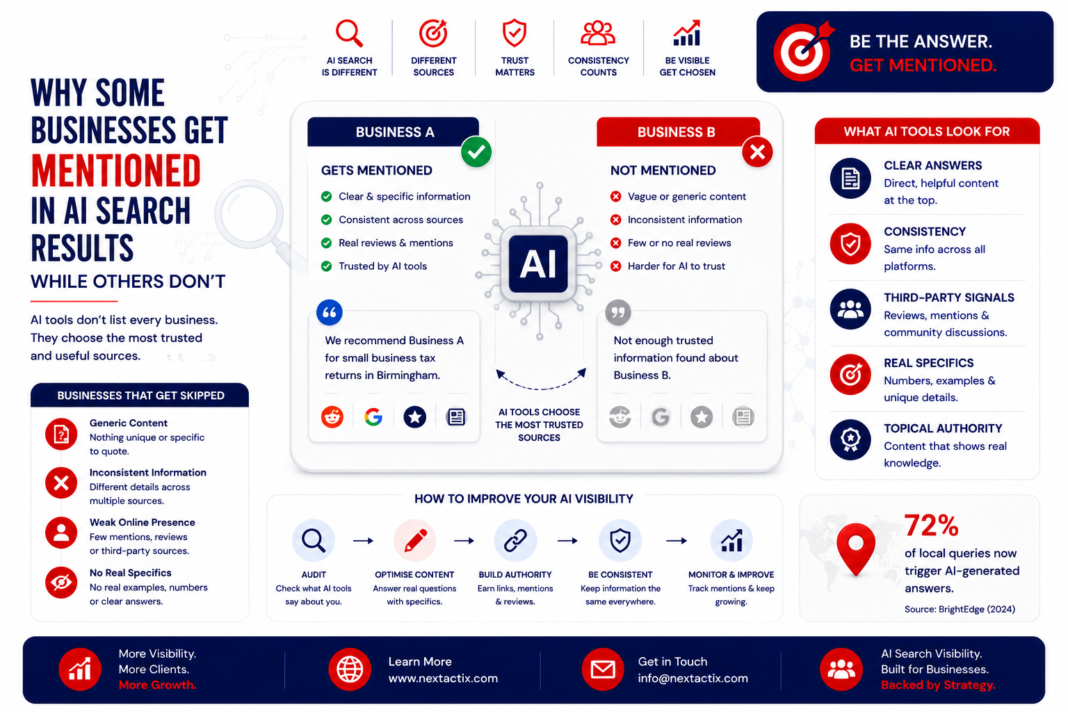
Two accountants, both based in the same part of the city, both with decent websites and a handful of good reviews. Ask ChatGPT to recommend one for a small business tax return and it names one of them confidently. Ask again a different way and it names the other. Ask about the first accountant directly and the AI system seems to know almost nothing about them beyond their name and address.
This happens constantly, and it confuses a lot of business owners who’ve spent years getting comfortable with how Google rankings work, because the logic behind it is genuinely different.
It isn’t a ranking. It’s a selection.
Google’s results page is fundamentally a list — everyone gets a position, even if it’s page nine. An AI-generated answer isn’t a list at all. It’s a short, synthesised response built from a handful of sources the system decided were worth pulling from, out of everything it could have chosen. A business that would have ranked reasonably well on Google can simply not appear in that response at all, because the system never selected it as one of the handful of sources worth citing.
That distinction matters more than most of the advice circulating about “AI SEO” tends to admit. This isn’t a new ranking factor bolted onto the old one. It’s closer to being shortlisted for a recommendation than being placed on a numbered list.
Different AI systems are looking for different things
One of the more surprising findings from research into how these systems actually pull their answers together is how little overlap there is between them. Several independent analyses this year, looking at large volumes of real citations, found that only around one in ten domains cited by ChatGPT were also cited by Perplexity for similar queries. That’s not a small gap — it means a business can be genuinely well set up for one AI system and functionally invisible to another, at the same time.
The reason seems to come down to each system sourcing information differently. Perplexity, which searches the live web for most of its answers, leans more heavily on forums, community discussion, and recent, specific content — a business being actively discussed on Reddit or an industry forum shows up in its citations far more than you’d expect. Google’s AI Overviews draw heavily on Google’s own index and, for local queries, on Google Business Profile data specifically. ChatGPT tends to lean on what could loosely be called consensus — broad agreement across many third-party sources, directories, and reference sites, rather than a single strong claim from a business’s own website.
None of this means a business needs a different website for each AI system. It does mean that a strategy built purely around a company’s own site — however well written — is missing a meaningful part of the picture, because a fair share of these citations come from places the business doesn’t directly control.
What the cited pages tend to have in common
Setting aside the differences between platforms, a few patterns show up repeatedly in research on what gets pulled into an AI-generated answer. Content that states a clear, specific answer early — in the first paragraph or two, rather than buried after a long introduction — appears to be quoted more often, because these systems are often working from the opening section of a page rather than reading the whole thing the way a person would.
Specificity beats polish. A page that includes a real, checkable detail — a number, a named process, a genuine example — gives an AI system something concrete to lift and attribute. A page that’s well designed and confidently worded but light on actual detail gives it nothing to work with, no matter how professional it looks.
And consistency across sources seems to matter more than any single source being impressive. A business described the same way — the same specialisms, the same area served, the same core facts — across its own site, its directory listings, and its reviews is easier for an AI system to trust than one with a beautifully written website that contradicts what its Google profile or its reviews actually say.
The businesses that get skipped, and why
The businesses that consistently don’t show up in AI-generated answers tend to share a specific problem, and it’s rarely a technical one. Their content is accurate but generic — it could describe almost any business in their industry, with the city name swapped in. There’s nothing in it an AI system could quote that would distinguish this business from ten others offering the same service.
The second common pattern is inconsistency rather than absence. The business exists in plenty of places — a website, a Google profile, a few directories — but the details don’t quite match. Different service descriptions, different specialisms mentioned in different places, an outdated address on one listing. None of that would necessarily confuse a human reader who found the business through one channel. It does appear to reduce how confidently an AI system will cite a source when its own cross-referencing turns up contradictions.
What actually seems to help
None of this is really a trick to learn. It’s closer to being genuinely specific and genuinely consistent, applied more rigorously than most businesses bother to. Writing content that states a clear, direct answer early, rather than working up to it. Including real, checkable specifics rather than confident-sounding generalities. Making sure the same core facts about the business — what it does, where it operates, what makes it different — are stated the same way everywhere it appears online, not just on the homepage.
It’s also worth treating this as an ongoing thing to check rather than a project with an end date. Because different AI systems draw on different sources and update at different speeds, a business’s visibility inside these answers can shift without any obvious cause — which makes it worth periodically just asking the AI systems directly what they know, the way that locksmith did by accident. It’s a genuinely useful, free way to see the gap between how a business believes it’s presenting itself and what these systems have actually picked up.
The two accountants from the start of this article aren’t a mystery once you look closely. The one who gets mentioned writes specifically about the kinds of returns they handle, states their fee structure plainly, and has reviews that mention actual services by name. The other has a perfectly good, perfectly generic website that says almost the same thing every other local accountant’s website says. To a human reader browsing casually, that difference might not register. To a system built to find something specific enough to repeat, it’s the whole story.