


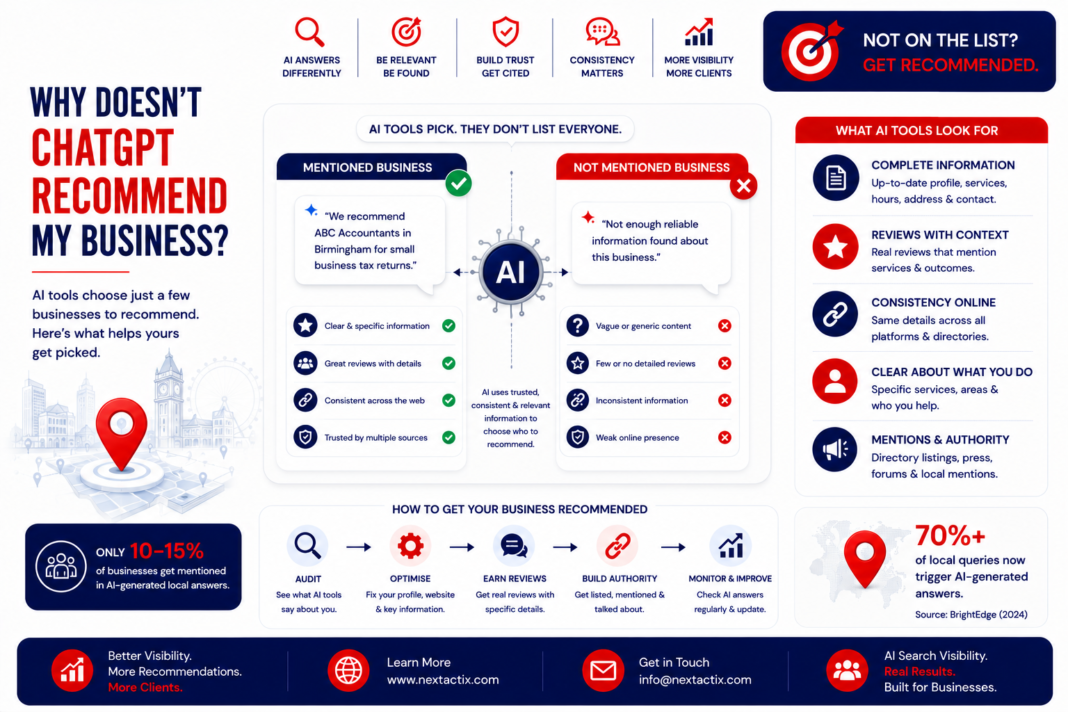
A business owner types their own company name into ChatGPT out of curiosity, half expecting a tidy summary of what they do. What comes back is either vague, wrong in a small but telling way, or worse — a confident recommendation for the competitor two streets over instead.
This has become a common enough moment that it’s worth walking through properly: what’s actually happening when this occurs, why it’s not really about your Google ranking, and what genuinely seems to help.
Google gives everyone a spot. ChatGPT doesn’t.
The core difference is easy to state and easy to underestimate. A Google search returns a page of results — everyone gets a position, even a bad one. Ask ChatGPT the same kind of question and it typically returns one to three names, presented as an answer rather than a list. There’s no page ten to fall back on. You’re either one of the names it picked, or you’re not part of the conversation at all.
Several analyses published this year looking at real-world AI recommendation behaviour have found the same broad pattern: a large majority of local businesses simply never get recommended by name, and the selection isn’t close to random. It correlates with specific, checkable things about how a business presents itself — not with size, and not directly with how well that business ranks on Google.
That last part is the one that trips people up. A business can be genuinely well optimised for Google — good rankings, solid local pack presence — and still be functionally invisible to ChatGPT, because the two systems aren’t drawing on the same evidence in the same way.
Where ChatGPT actually gets its information
ChatGPT isn’t crawling the live web the way Google does every time someone asks it a question. Depending on the version and whether web browsing is switched on, it’s working from some mix of its training data — a broad snapshot of the internet up to a certain point — and, when browsing is active, real-time web results. That combination means a business’s own website is only part of the picture. Reviews, directory listings, mentions in local press, and how a business is discussed on third-party sites all feed into what the model actually knows.
This is why a beautifully written “About Us” page, on its own, rarely fixes the problem. If the rest of the web doesn’t back up what that page claims — or worse, if it says something slightly different — the model has conflicting signals to work with, and conflicting signals tend to get resolved by picking the source that looks more consistent, not the one that looks best.
The three things that seem to matter most
Setting aside the more speculative advice circulating under the “AI SEO” banner, a few things show up consistently across the businesses that do get recommended.
The first is completeness on the basics — a fully filled-out Google Business Profile, correct categories, an accurate service area, and a website that clearly states what the business does and where. This sounds almost too simple to matter, but a genuinely surprising number of local businesses have a Google profile that’s years out of date or missing half its fields, and that gap shows up directly in how confidently an AI system can describe them.
The second is review language, not just review volume or star rating. A model trying to describe a business leans on specific, descriptive detail wherever it can find it — reviews that mention an actual service, a specific problem solved, or a particular product, rather than reviews that just say the experience was good. Forty generic five-star reviews give a language model far less to work with than fifteen reviews that each mention something concrete.
The third, and probably the most overlooked, is consistency across every place a business is mentioned online. The same core facts — what the business does, where it operates, what it specialises in — stated the same way on the website, the Google profile, directory listings, and anywhere else the business appears. Small contradictions between these sources don’t necessarily confuse a person browsing casually, but they appear to genuinely reduce how confidently an AI system will vouch for a business when it’s cross-referencing multiple sources to decide who to recommend.
A simple way to actually see the problem
Most of this stays abstract until a business owner does the obvious thing and just asks. Open ChatGPT, Gemini, and Perplexity separately and ask each one the exact question a customer might ask — “who’s a good [service] near [area]” — and look carefully at what comes back. Note who gets mentioned, how they’re described, and whether any of it is wrong. Then ask directly what the AI system knows about your own business specifically.
This exercise tends to be more useful than any generic checklist, because it shows the actual gap rather than a theoretical one. A business might discover the AI system has an outdated address, describes a service the business stopped offering years ago, or simply has nothing specific to say at all — which is usually the more common and more fixable problem.
What we’d actually suggest doing
None of this really calls for a separate strategy bolted onto normal marketing. It’s closer to doing the fundamentals more thoroughly than most competitors bother to. Get the Google Business Profile genuinely complete, not just created. Encourage reviews that mention something specific rather than generic praise. Make sure the same facts about the business are stated consistently everywhere it appears, and correct the places where they’re not. Where a business has real, checkable specifics worth mentioning — a specialism, a genuine track record, a detail that distinguishes it from the business next door — put that in writing clearly, rather than leaving it to word of mouth.
It’s also worth treating this as something to check periodically rather than fix once. AI systems update at different speeds and pull from different sources, so a business’s visibility inside these answers can shift without any obvious external cause. The businesses that stay visible tend to be the ones that noticed the gap early and kept their information genuinely current — not the ones chasing a one-off trick that happened to work for someone else’s business in someone else’s industry.