


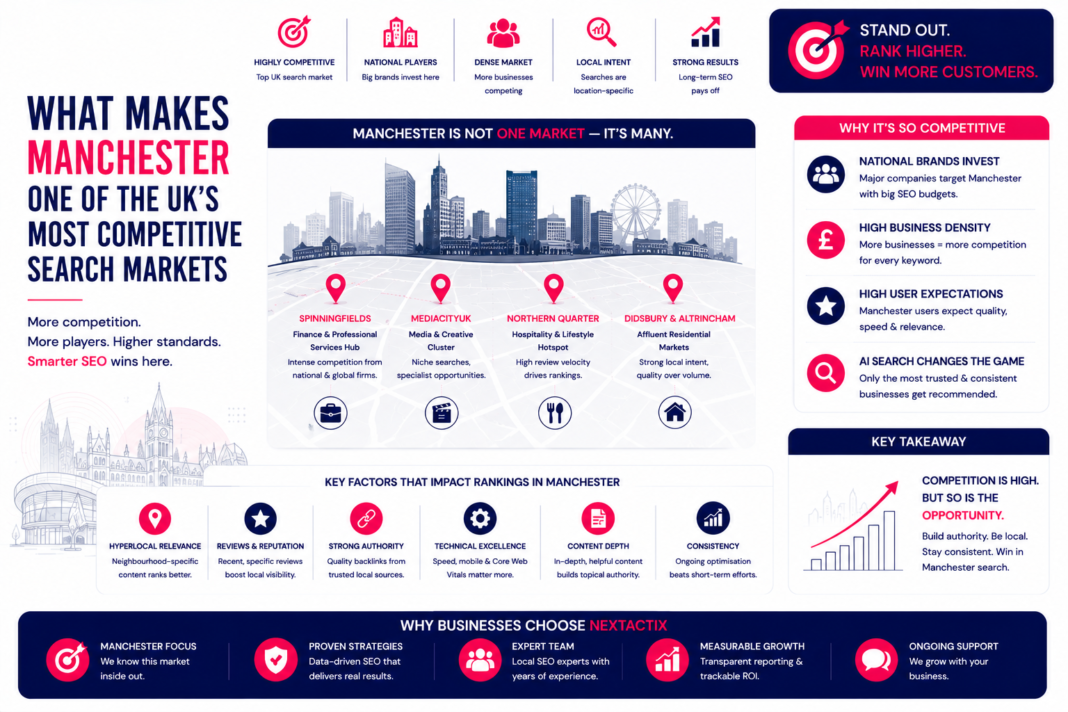
A restaurant owner in the Northern Quarter once described trying to rank on Google in Manchester as “shouting in a room where everyone else is also shouting, and half of them have microphones.” The metaphor is more accurate than it sounds. Manchester is not just a competitive local search market — it is competitive in a specific, layered way that catches a lot of businesses off guard because the competition does not always come from where they expect.
Understanding what makes Manchester’s search market work the way it does is useful not just for businesses already operating there, but for any business considering expanding into the North West, relocating a regional office, or trying to understand why their Manchester SEO campaign is moving more slowly than they expected based on results elsewhere.
Manchester’s Specific Competitive Structure
Manchester is the UK’s third-largest economy and the dominant commercial centre of the North. That status has a direct consequence for its search landscape: when businesses describe Manchester as their Northern hub, they commit real resources — including SEO budgets — to competing locally. This means the field of competitors in a Manchester Local Pack for almost any competitive service category is not just local firms but national and international businesses with significant marketing infrastructure.
The xsquareseo analysis published in 2026 found over 1,100 registered SEO companies operating across Greater Manchester on Clutch alone. That is not evidence of how good local SEO is — it is evidence of how much demand there is, driven by how many businesses are struggling to achieve organic visibility in a market where competition density is genuinely high.
SEO consultant analysis from nurulnahid.com, published April 2026, made the competitive reality explicit: “Manchester is the UK’s second most competitive major-city SEO market after London. For some sectors — financial services in Spinningfields, hospitality in the Northern Quarter, retail adjacent to the Arndale — the competition approaches London-level density. National brands with Manchester offices deploy significant SEO budgets.” The same analysis estimated that a business reaching a stable Local Pack position in Bristol in three months might take five to seven months in Manchester city centre for the same outcome.
It Is Not One Market — It Is Several
What makes Manchester particularly interesting, and particularly challenging, is that the city’s different neighbourhoods have genuinely distinct competitive dynamics rather than being one uniform search environment.
Spinningfields and the financial district
Spinningfields is where KPMG, PwC, Eversheds, DLA Piper, Weightmans, and several major financial institutions run their Manchester operations. For professional services firms — legal, financial, HR, recruitment — trying to rank locally for Spinningfields-adjacent searches, the competition includes these national firms’ national SEO budgets applied to their Manchester offices. A local Manchester accountancy firm competing for “accountants Manchester city centre” or “corporate law firm Manchester” is competing against organisations that will outspend it on content and link acquisition almost indefinitely. The only realistic path to visibility in this space for a smaller local firm is extreme topical specificity — being the recognisable expert in one narrow area rather than competing generically across a practice area.
MediaCityUK and the Salford creative cluster
The BBC’s relocation to Salford and ITV Studios’ presence at MediaCityUK have created a genuine creative and media business cluster with its own search dynamics. Production companies, creative agencies, post-production houses, and tech businesses that serve the media sector are all competing for visibility in a relatively tight geographic cluster with a very specific client base. The search volume here is lower than in Spinningfields, but so is the competition outside the directly media-adjacent categories, making it one of the more achievable environments within Greater Manchester for smaller specialist firms.
The Northern Quarter and Ancoats
Hospitality in Manchester’s Northern Quarter and the adjacent Ancoats neighbourhood is possibly the most intense restaurant and bar SEO environment in any UK city outside London. The density of well-regarded, independently owned, food-forward venues competing for a relatively finite pool of “best restaurants Manchester” and “brunch Manchester” searches has driven intense competition for the same Local Pack positions. In this environment, reviews are the decisive factor — not just in volume but in recency and specificity. A venue with 400 reviews from two years ago will often lose Local Pack position to one with 150 reviews from the past six months, because Google reads consistent recent review activity as a signal of ongoing relevance.
Why National Brands Change the Equation
In most UK cities outside London, the Local Pack for a given service category is primarily contested between local businesses. Manchester is different: in a wide range of categories, the Local Pack is actively contested between local independents and national chains with Manchester-specific SEO investment.
Booking.com’s Manchester operation, Manchester Airport Group, the major hotel chains with city-centre properties, Connells and Countrywide in the estate agent market, AXA and Aviva in financial services — these are not passive participants in Manchester search. They run active local SEO programmes that a small local business cannot match on budget alone.
The practical implication is that local businesses competing in Manchester for categories where national brands have significant local presence need to compete on signals that national brands struggle to replicate: hyperlocal community presence, genuine local reviews mentioning Manchester-specific detail, content that demonstrates on-the-ground Manchester knowledge rather than a regional template.
Where local businesses win: National brands optimise nationally with local variations. A genuinely local Manchester business can outcompete them on the signals Google uses to assess local authenticity — mentions in local press, engagement from Manchester-area users, hyperspecific local content, and the kind of consistent community reviews that a national brand collecting generic five-star feedback cannot easily replicate.
AI Search and Manchester
Manchester’s competitive density extends into AI-generated search results. When someone asks ChatGPT or uses Google’s AI Overviews to find a solicitor, accountant, or restaurant in Manchester, the AI system faces the same problem the user would face on a traditional results page: a large number of apparently credible options to synthesise into a recommendation.
The businesses getting cited in AI answers for Manchester searches tend to share common characteristics: consistent entity information across multiple credible platforms, a strong review footprint that includes specific mentions of the area they serve, and content that is structured clearly enough for an AI system to extract a confident recommendation from. Generic content that merely includes “Manchester” in the right places performs poorly — specificity about neighbourhood, specialism, and client type performs significantly better.
Semrush’s 2026 research found that NAP inconsistencies across three or more citation sources exclude businesses from Google AI Mode local answers 74% of the time. In a market as competitive as Manchester, where the difference between appearing in an AI Overview and not appearing could represent a meaningful volume of potential clients, this is one of the most impactful technical fixes available — and one of the most commonly neglected.
What Manchester SEO Actually Requires
Given all of the above, what does competing effectively in Manchester’s search market actually involve? A few honest observations:
More time and patience than comparable UK cities. A Local Pack position achievable in four months in Nottingham or Bristol realistically takes longer in central Manchester for the same business type, because the number and quality of competitors is higher. Setting realistic timelines from the outset — rather than comparing progress to results in smaller markets — is important for any business or agency managing expectations in this environment.
Neighbourhood specificity. Content and profile optimisation that speaks to a specific area of Greater Manchester — Ancoats, Salford, Didsbury, Altrincham — often outperforms generic Manchester-wide content, because the local pack radius for mobile searches in a dense urban environment is small, and because specificity improves relevance scores.
Review velocity as a sustained priority. In Manchester’s hospitality sector particularly, review velocity — the rate at which new reviews are coming in, not just the total — is a decisive ranking factor that most businesses underinvest in after an initial burst of activity. Maintaining a consistent flow of new, specific, recent reviews is worth more in this market than almost any technical SEO fix.
Domain-level authority building. For professional services firms competing in Spinningfields-adjacent categories, the long-term path to visibility requires building genuine domain authority through quality content and earned mentions — not a one-time setup and maintenance. The businesses with stable, long-term positions in Manchester’s most competitive categories are almost universally the ones who have published useful, specific content consistently over several years.