


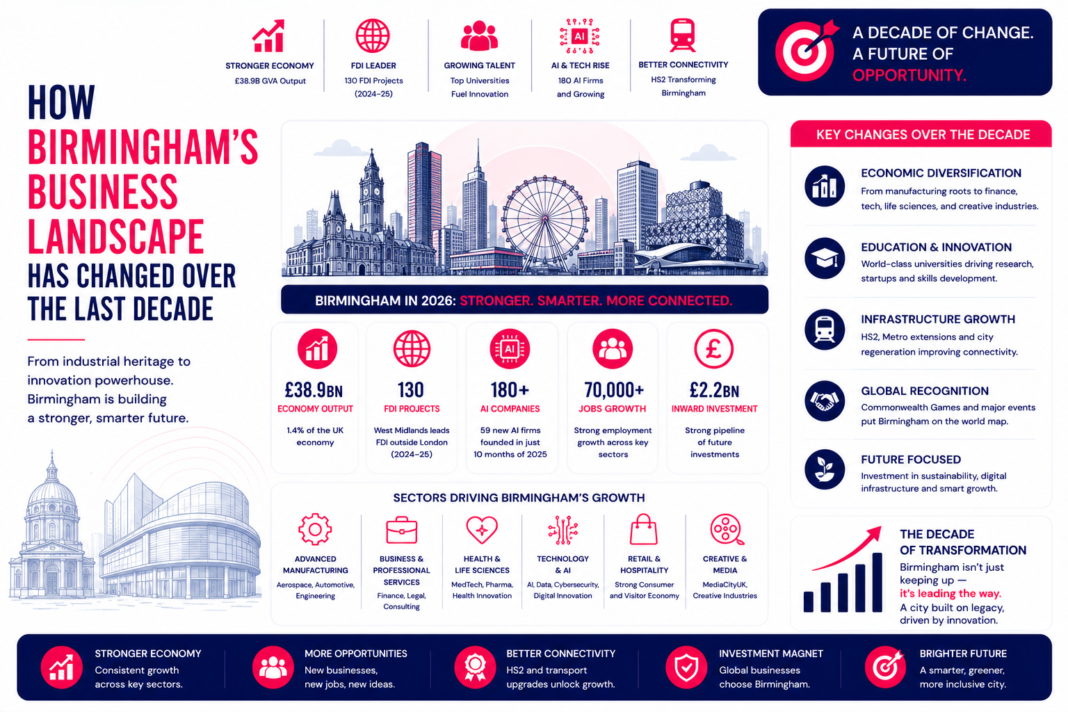
In 2015, the most common short description of Birmingham’s business scene was that it was trying. Trying to diversify away from the manufacturing base that had defined it for a century, trying to compete with Manchester for Northern and Midlands businesses, trying to establish itself as a destination for financial and professional services that would have historically defaulted to London.
In 2026, the trying has, by most measurable accounts, become doing. Birmingham has had a transformative decade — not uniformly and not without real problems, but structurally and significantly. The city that hosted the Commonwealth Games in 2022, that now leads the UK outside London for foreign direct investment, that is growing an AI and life sciences cluster on top of its established automotive and aerospace base, is a genuinely different business environment from the one a decade ago. Understanding what changed, and what it means for businesses operating there or considering it, is worth more than either the boosterish optimism of council economic reports or the reflexive scepticism that writing off Midlands cities has become something of a default.
The Structural Shift in What Birmingham’s Economy Does
Birmingham’s economy has an output of £38.9 billion — approximately 1.4% of the UK’s total economy, according to Birmingham City Council’s own economic data. Its main contributors are business, financial and professional services (£12.4 billion GVA), public services (£10.3 billion), and retail (£3 billion). Both finance and public services are more concentrated in Birmingham’s economy than in England as a whole, which would not have been true a generation ago.
A decade ago, the anxiety was whether Birmingham could make this transition at all. Today the question has shifted to whether the city can manage its growth well — a meaningfully different problem to have. The West Midlands now leads FDI outside London, attracting 130 foreign direct investment projects in 2024 to 2025, according to the 2025 Birmingham Economic Review produced by City-REDI at the University of Birmingham. That figure represents a sustained pipeline of international businesses choosing Birmingham as their UK base — not a London office with a Midlands token presence, but a genuine operational centre.
The Commonwealth Games and What They Left Behind
The 2022 Commonwealth Games in Birmingham were not just a sporting event. They were the largest single public relations exercise the city has ever had, delivering sustained global television coverage, a requirement to improve transport and public space infrastructure on a fixed deadline, and an influx of international visitors who left with impressions of the city that differed considerably from the outdated narratives that had followed Birmingham around for decades.
The economic legacy is more mixed than the event itself. The Games required significant public investment and accelerated several infrastructure projects, but the direct economic return has been debated. What is clearer is the intangible benefit: Birmingham entered a different tier of international awareness after 2022, particularly among businesses in Commonwealth member countries considering UK market entry. The number of Birmingham-based professional services firms reporting international client relationships — particularly from South and Southeast Asia, Africa, and the Caribbean — has grown in ways that anecdotally track the Games’ coverage of the city.
The European Athletics Championships in 2026 extends this visibility further. With over 86,000 tickets sold ahead of the event according to City-REDI’s 2025 review, the city is establishing a pattern of major events that keep it visible on an international stage in ways that compound rather than being one-off.
The AI and Digital Cluster That Most People Have Not Noticed Yet
Perhaps the most significant and least-discussed economic shift in Birmingham over the past decade is the emergence of a genuine AI and technology business cluster. The region now hosts around 180 AI firms — representing 1.8% of the UK total — with 59 of them established in just the first ten months of 2025, according to City-REDI’s economic review. The cluster is growing faster than the city’s infrastructure to support it, which creates both opportunity and friction.
The Birmingham Economic Review 2025 was direct about the tensions: digital skills shortages and limited data infrastructure remain genuine barriers, while the university base — the University of Birmingham, Aston University, Birmingham City University, and several others — continues to produce talent that is then competed for by London and Manchester employers. Graduate retention has improved from its historic lows but remains a challenge that the city has not fully solved.
What the cluster demonstrates, however, is that Birmingham is no longer purely dependent on its manufacturing heritage for economic identity. Advanced manufacturing — particularly in aerospace, automotive, and medical devices — remains important and continues to evolve. But alongside it, a digital and AI economy is taking shape that looks less like an appendage to the old economy and more like a parallel structure with its own momentum.
HS2 and the Infrastructure Story
It is impossible to write about Birmingham’s business transformation without acknowledging HS2 — and equally impossible to write about it without noting the complications. The project, which will dramatically reduce journey times between Birmingham and London when Phase 1 opens, has been subject to delays, cost escalations, and significant political controversy. Phase 2, which would have extended the line northward, was cancelled.
For Birmingham, however, the relevant fact is that Curzon Street station — which will be the Birmingham terminus of the new high-speed line — is under construction, and the surrounding Eastside area of Birmingham is being actively developed as a consequence. The Curzon Street area has attracted commercial property investment on the basis of the anticipated connectivity improvement. Businesses making long-term location decisions about Birmingham are doing so with the knowledge that London journey times will shorten significantly, which changes the calculus for firms that need to maintain both a Midlands presence and regular London access.
What Changed in the Business Competition Landscape
For businesses actually competing in Birmingham — not just headquartered there but winning clients there — the change over a decade has been significant in specific ways.
The professional services market has become considerably more contested. A decade ago, Birmingham’s top-tier legal and financial work was heavily concentrated among a small number of established firms. Today, national and international firms have significantly deeper Birmingham presences, and the client expectation for national-quality professional services at Midlands pricing has become a permanent feature of the market rather than an occasional negotiating position.
The retail and hospitality landscape has been dramatically reshaped by a combination of redevelopment and the national trends affecting high street retail everywhere. Birmingham’s Grand Central development and the Bullring’s continued evolution have maintained the city centre’s retail offer, but the composition has shifted toward experience, food, and entertainment in ways that mirror most UK cities but at a larger scale.
The digital and creative sector has grown to the point where it is now a meaningful source of demand for other professional services — legal, financial, property, and HR firms serving the creative and tech community have developed as a distinct sub-market that barely existed in Birmingham a decade ago.
| Sector | Birmingham 2015 | Birmingham 2026 |
| Advanced manufacturing | Core sector, restructuring under pressure | Stabilised and upgraded — aerospace, medical devices, EV supply chain |
| Professional services | Strong but dominated by established local firms | Increasingly contested with national/international firm expansion |
| Digital and AI | Emerging, limited cluster | 180 AI firms; 59 new in first 10 months of 2025 |
| Retail and hospitality | Grand Central era beginning | Experience-led shift complete; city centre offer mature |
| International investment | Below London, competing with Manchester | UK leader for FDI outside London — 130 projects in 2024/25 |
What This Means for Businesses Operating in Birmingham Today
The competitive environment for a Birmingham business in 2026 is genuinely more challenging than it was a decade ago, in most sectors. The influx of national professional services firms, the growth of the digital economy creating new competitors for talent and clients, and the general improvement in Birmingham’s business image attracting more outside competition have all raised the bar for visibility and differentiation.
The opportunity is also genuinely better. A city that leads UK FDI outside London is a city attracting businesses that need local partners — legal advisers, accountants, HR firms, marketing agencies, property consultants — who understand the local market. A city growing an AI cluster on top of its manufacturing base is producing new categories of client that did not exist here a decade ago. A city hosting major international events with global television coverage is a city building awareness among international buyers who might previously have assumed they needed a London partner for UK market entry.
The businesses best positioned in Birmingham today are the ones that understood the transition was coming earlier than most and invested accordingly — in their online presence, in their sector expertise, in their ability to serve an increasingly international and diverse client base. The ones that are finding it hardest are those that treated Birmingham’s traditionally more insular, relationship-driven business culture as a permanent feature rather than something that was already changing around them.