


A cleaning company based in Oadby had invested in SEO for about a year. By the time they came to review it properly, they were ranking on the first page for several terms they cared about — “end of tenancy cleaning Leicester,” “domestic cleaners Oadby,” a couple of others. The rankings were real. The enquiries were not matching them.
When they looked at what was actually happening between someone landing on their website and either getting in touch or leaving, the problem became obvious. The page was ranking. But the phone number was buried at the bottom. There were no reviews visible on the site. The homepage loaded slowly on a mobile. A visitor with a genuine need for a cleaner would land, scan, see nothing immediately reassuring, and leave.
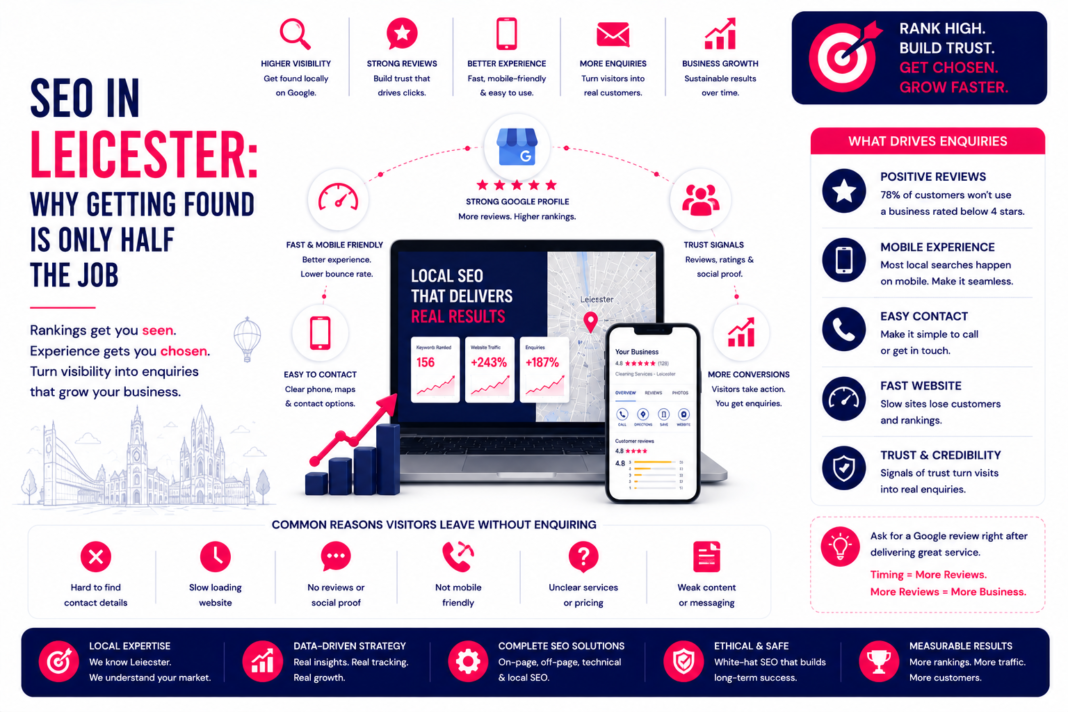
This is the gap that sits between visibility and enquiries, and it is one of the most common and most underdiscussed problems in local SEO for Leicester businesses. Getting found is genuinely difficult and genuinely worth working on. But it is the first half of the job, not the whole thing.
Leicester’s Search Market and Why Competition Is Unusually Diverse
Leicester’s business market has specific characteristics that affect how this gap plays out. The city is one of the most ethnically and commercially diverse in the UK, with a business community that spans South Asian retail and manufacturing, a significant creative and digital sector, a strong professional services cluster around the city centre, and a large trade and construction market across Leicester and Leicestershire.
That diversity creates a search environment where the competition for any given term can come from unexpected directions. A plumber in Clarendon Park is competing not just against other local plumbers but against national comparison platforms, warranty service providers, and occasionally national firms that have invested in Leicester-specific content. A Leicester restaurant is competing against apps, review aggregators, and AI-generated answers that summarise the “best” options before the user clicks anything.
In this environment, simply appearing in search results — even at position one — is a smaller proportion of the battle than it used to be. What happens at the moment of encounter between your result and the potential customer has become equally important.
The Review Gap — What Most Leicester Businesses Are Missing
BrightLocal’s 2026 Local Consumer Review Survey found that 78% of consumers would not consider using a local business with a rating below four stars on Google. In Leicester’s highly competitive categories — food and drink, professional services, trades, and healthcare — this means that a business ranking in position one with a 3.6-star rating on its Google Business Profile is, in practice, losing a large share of its potential enquiries to competitors ranked below it but rated higher.
Reviews affect local search in two ways. They are a ranking signal — more reviews, more recent reviews, and higher average ratings all contribute to how prominently Google places a business in map results. But they also affect what happens after the ranking is achieved, because a potential customer looking at three map listings will almost always click the one with the highest rating and the most recent reviews, regardless of which sits in which map position.
Many Leicester businesses have reviews — some have quite a few — but relatively few have a consistent, ongoing strategy for generating them. A burst of reviews when a business first sets up its Google profile, followed by a long quiet period, creates a pattern that both Google and potential customers read as a signal of declining engagement. A steady flow of recent reviews — a few per month, spread naturally across the year — communicates something different: a business that is actively serving customers and consistently earning their positive feedback.
A practical point: The best time to ask a satisfied customer for a Google review is immediately after the service is complete and their satisfaction is at its highest. A direct link to your Google review page, sent by text or email within an hour of completing a job, converts at a far higher rate than a generic “please leave us a review” note at the bottom of an invoice.
Website Experience — What Visitors Actually Encounter
Search engine rankings are assessed by Google’s crawlers. Enquiry decisions are made by humans who have landed on your page after clicking a search result or a map listing. These two audiences have different requirements, and many websites optimise for the crawler while giving insufficient attention to the human.
Several things consistently suppress enquiry conversion on Leicester business websites that are otherwise ranking reasonably well:
Contact information that is hard to find quickly
A potential customer who arrives on a mobile phone from a search result has already decided they are interested — otherwise they would not have clicked. The moment they are looking for a phone number or contact form and cannot find it within a few seconds is the moment they go back to the search results and try the next option. Phone number in the header, a simple contact form on or near the homepage, and a clear call to action that tells the visitor what to do next — these are basic but they are missing from a surprising number of Leicester business websites.
Slow loading speed on mobile
Google’s Core Web Vitals data consistently shows that mobile page loading speed is one of the clearest predictors of whether a visitor stays or leaves. A page that takes more than three seconds to become usable on a mobile network loses a significant proportion of its visitors before they have seen any content at all. Most businesses do not know their own page loading speed because they check their website on a fast office connection, which is not how the majority of their potential customers are encountering it.
No visible trust signals
Potential customers making a decision about whether to contact a Leicester business they have found in search are looking for reassurance that the business is legitimate, competent, and positively experienced by people like them. Logos of professional memberships, review platform ratings, named staff members with photographs, and examples of previous work all contribute to this reassurance. A clean, professional but anonymous website — no faces, no reviews, no credentials — gives a visitor nothing to hold on to.
Google Business Profile — The Listing Most Businesses Underestimate
For many Leicester businesses in service sectors, more potential customers arrive via the Google Business Profile — the map listing with the star rating, phone number, photos, and business hours — than via the website at all. A customer searching “electrician near me” on their phone and seeing three map results will often call directly from the map listing without ever visiting a website.
This makes the Google Business Profile one of the most commercially important digital assets a Leicester business has, and one of the most underinvested. The difference between a profile that generates direct calls and enquiries and one that generates almost none is usually a matter of completeness and freshness, not technical complexity.
A well-maintained profile has accurate, complete opening hours including Bank Holidays and any special closures. It has a specific primary category that accurately represents the main service offered rather than a generic business type. It has recent photographs — not stock images but actual photographs of the business, its work, and the people who do it. It has responses to reviews, including negative ones, written in a way that demonstrates the business takes customer feedback seriously. And it has a consistent flow of new reviews rather than a cluster from one period followed by silence.
According to BrightLocal, a business with a fully optimised Google Business Profile receives significantly more direction requests, phone calls, and website clicks than a comparable business with a minimal profile. In Leicester’s competitive local market, where the map pack is often the first thing a potential customer sees, the profile is the ranking that matters.
Content — Answering the Questions Customers Are Actually Asking
One of the more useful shifts in how to think about local SEO content for Leicester businesses is to move away from the idea of “keyword content” — pages written to target a phrase — and toward the idea of answer content — pages that genuinely address the questions potential customers are actually asking before they decide to contact a business.
A Leicester solicitor’s website that has a page answering “how long does a house purchase take in Leicester” is providing real value to someone in the research phase of buying a property. That page serves two purposes simultaneously: it ranks for search terms people use during that research phase, and it demonstrates expertise to a visitor who is evaluating whether to trust the firm with their conveyancing. The page is not promotional but it is converting — because genuine usefulness converts.
The content that performs this way for Leicester businesses is almost always specific: specific to the service, specific to the location, and specific to the real situations and concerns the business’s customers bring to it. Generic content about “what is conveyancing” does not serve a Leicester audience as well as content about “what to expect when buying a terrace in Clarendon Park.” The local specificity is not keyword stuffing — it is genuine relevance.
The Full Picture of Local Visibility
What connects all of these elements — reviews, website experience, Google Business Profile, and content — is that they are all part of what a potential Leicester customer encounters when they find a business through search. SEO gets them to the point of encounter. Everything else determines what happens there.
The businesses generating the most consistent enquiry volume from search in Leicester are not necessarily the ones with the highest rankings or the largest websites. They are the ones that have understood the full journey — from search result to satisfied enquiry — and have invested in each stage of it rather than assuming that the ranking does all the work.
| Stage | What affects it | Common gap for Leicester businesses |
| Discovery | Rankings, Local Pack position, AI Overviews | Inconsistent NAP data; weak Google Business Profile category |
| First impression | Listing appearance, star rating, review count and recency | Old or few reviews; missing photos; incomplete profile |
| Website arrival | Page speed, mobile experience, contact clarity | Slow load; phone number not immediately visible; no trust signals |
| Trust assessment | Reviews, credentials, named staff, examples of work | Anonymous website; no professional memberships visible |
| Enquiry | Contact form ease, call to action clarity, response speed | Buried contact options; no clear next step; slow response times |
Each row in that table is a place where a potential customer can be lost — not because they did not find the business, but because something in the experience gave them a reason not to follow through. Fixing the whole chain, not just the discovery stage, is what turns SEO investment into actual business growth.