


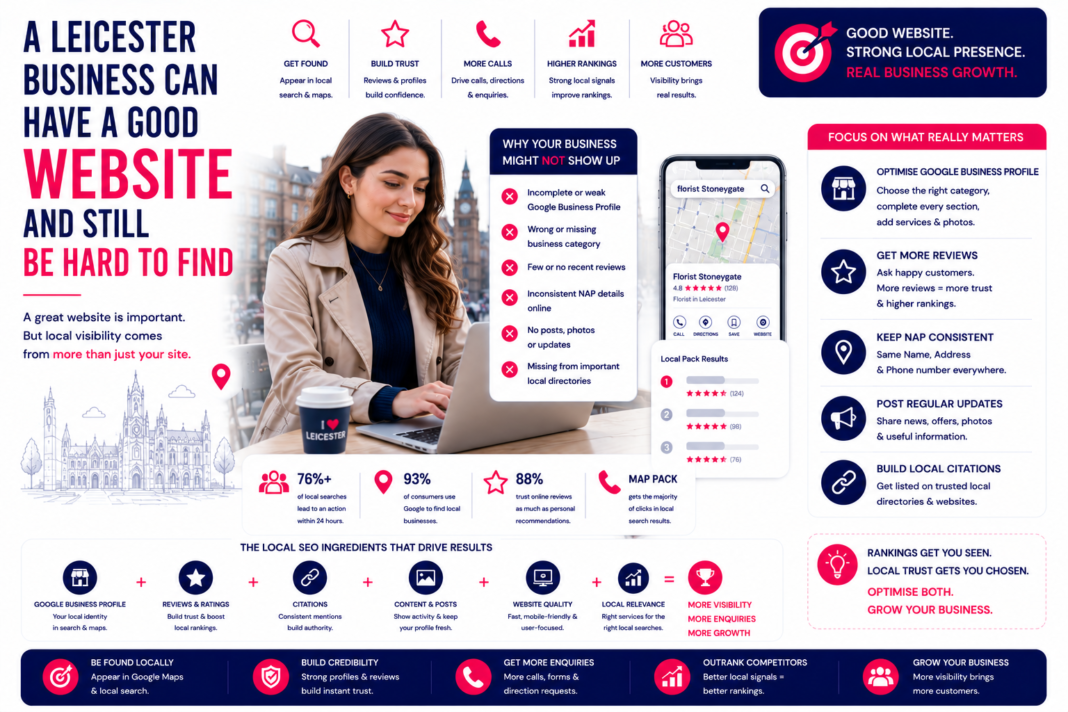
A florist in Stoneygate spent a fair amount getting their website built properly. The designer was good. The photographs were professional. The site looked clean on mobile, loaded quickly, and described the services clearly. Six months after launch, a friend who was looking for a florist for a wedding in Leicester found them by accident — by typing the business name directly. She had searched “florist Stoneygate” and “wedding florist Leicester” and the business had not appeared at all.
The website was good. The business was invisible.
This situation is more common than most people realise, and the reason for it is not mysterious once you understand how local search actually works. A professional website is one input into local search visibility. It is not, by itself, sufficient — and for local searches specifically, it is not even the most important input.
Why a Good Website Is Not Enough for Local Search
Search engine optimisation splits broadly into two categories: traditional organic SEO, which determines where your website pages rank in a list of search results, and local SEO, which determines whether your business appears in the map results — the three listings with star ratings and phone numbers that appear at the top of most local service searches.
For most Leicester businesses looking for local customers — trades, professional services, retail, food, healthcare — the map results are more commercially valuable than the organic list below them. Research from SEOScaleUp shows that over 76% of people who conduct a local search visit or contact the business within 24 hours. The majority of that action comes from the map pack rather than the organic results. A business with a beautifully built website that does not appear in the map pack for its key local searches is missing the most commercially important real estate in local search.
The map pack is governed primarily by Google Business Profile signals — not website quality. A business with a comprehensive, well-maintained Google Business Profile and a modest website will frequently outrank a business with an exceptional website and a neglected profile. This surprises many business owners who have invested significantly in their site and expect it to do more of the work.
The Google Business Profile — The Most Important Thing Most Leicester Businesses Underuse
Google Business Profile is a free tool that every Leicester business with a physical location or a service area should be using actively. It is where your star rating lives. It is where your photos appear. It is what displays your opening hours and phone number in a map result. It is what drives directions requests and direct phone calls from Google Maps.
Most Leicester businesses have a Google Business Profile because Google often creates one automatically from information it finds elsewhere. But there is a significant difference between a profile that exists and one that is working.
Primary category — the most consequential single choice
The primary category you select on your Google Business Profile is the strongest signal of what your business does. Google uses it to match your listing against relevant searches. A Leicester heating engineer who has set their primary category as “Contractor” will not appear for searches for “boiler repair Leicester” as readily as one who has set it as “Heating Contractor” or “Plumber.” The distinction sounds small but the ranking impact is significant. Most businesses set this once during profile creation and never revisit it.
Completeness matters more than most businesses realise
A fully completed profile — all sections filled in, attributes selected, products or services added where relevant, business hours accurate including Bank Holidays — consistently outperforms a partially completed one for equivalent businesses in the same area. Google uses the completeness of your profile as a signal of how seriously you are managing your online presence, which feeds into the prominence score that contributes to local ranking decisions.
Posts, photos and updates keep the profile alive
A Google Business Profile with its last update from two years ago is telling both Google and potential customers the same thing: nobody is actively minding this business online. Regular posts — about seasonal offers, recent projects, team news, or useful information relevant to your service area — signal ongoing activity. Recent photographs of your work, your premises, and your team are among the most direct trust signals available to a Leicester customer evaluating whether to call.
Citations — Why What Other Sites Say About You Matters
In local search, a citation is any mention of your business name, address, and phone number on another website. Directory listings, industry membership pages, local press mentions, and Chamber of Commerce entries all count. The quantity and consistency of these citations across the web is one of the factors that contributes to how prominently Google places your business in local results.
For Leicester businesses, the most relevant citation sources are the ones that appear credible to Google and that local customers actually use. Yell.com, Thomson Local, Bing Places, Apple Maps, and any industry-specific directory relevant to your sector are the baseline. For a Leicester healthcare provider, NHS Choices and relevant clinical directories matter. For a legal firm, the Law Society’s Find a Solicitor. For a trade, Checkatrade or Rated People.
The consistency of these citations is as important as their existence. If your business is listed as “Smith Electrical Services” on your Google Business Profile, “Smith Electrical” on Yell, and “Smith Electrical Ltd” on your website, Google sees three slightly different entries and cannot be fully confident they all refer to the same business. This inconsistency — known as NAP inconsistency (Name, Address, Phone number) — quietly suppresses local rankings for many Leicester businesses that do not know it is happening.
How to check: Search your exact business name in Google and look at what comes up beyond your own website and Google listing. If the details differ between sources, or if there are old listings from previous addresses or phone numbers, these are citations worth cleaning up. Tools like BrightLocal or Moz Local can automate an audit across multiple directories simultaneously.
Technical Basics That Search Engines Still Need
Even with all the above in order, a website with serious technical problems can underperform in local search. Not the kind of problems that require a developer to spend weeks fixing, but the kind that often go unnoticed because they are not visible to someone browsing the site casually.
Mobile performance
Google evaluates pages using mobile-first indexing — meaning the version of your site it primarily assesses is the mobile version, regardless of whether most of your own traffic comes from desktop. A site that looks fine on a desktop but has layout problems, slow loading, or poor usability on a phone is being assessed on its weakest version. Given that the majority of local searches happen on mobile devices, this also directly affects how visitors experience the site after clicking through.
Page speed
Google’s Core Web Vitals measure three aspects of page loading experience: how quickly the main content appears, how stable the layout is as it loads, and how quickly the page responds to user interaction. A page that scores poorly on these metrics is disadvantaged in ranking assessments and loses visitors before they have engaged with any content. Most Leicester business websites have not been tested against these metrics and many have straightforward issues — unoptimised images being the most common — that can be addressed without significant cost.
Content that search engines can actually read
Some websites are built in ways that present beautifully to a human visitor but are largely opaque to search engine crawlers. A site built primarily using JavaScript frameworks that render content in the browser rather than in the page source, or a site that contains most of its key content in images rather than text, may look complete to a visitor but give a crawler almost nothing to read and index. If your site was built with a heavy emphasis on visual design and the developer was not specifically considering SEO, this is worth checking.
Content — Saying the Right Things in the Right Way
A website that is technically sound, properly cited, and backed by a strong Google Business Profile still needs content that addresses what potential Leicester customers are actually searching for. This is where many “good” websites fall down — they describe the business rather than serving the visitor.
Consider the difference between a Leicester accountancy firm’s website that says “we provide a full range of accounting services for businesses of all sizes” versus one that says “we work with Leicester small businesses on bookkeeping, VAT returns, and year-end accounts, with particular experience in the retail and hospitality sectors.” The second is more specific, more searchable, and more useful to a potential client evaluating whether the firm is right for them.
Specificity serves two purposes simultaneously. It makes content more relevant to specific searches — someone looking for an accountant with hospitality experience will respond to the second description where they would pass over the first. And it demonstrates the kind of genuine expertise and local knowledge that Google’s quality assessment looks for, particularly in professional service categories where Google applies higher standards to what it ranks.
The content that consistently performs best for Leicester local businesses is content that answers the real questions potential customers are asking. Not “what is conveyancing” but “how long does conveyancing take for a terrace in Leicester.” Not “our cleaning services” but “end of tenancy cleaning in Leicester — what is typically included and what landlords require.” These pages serve a potential customer in the research phase and rank for the search terms they use during that research.
Putting It Together — Why Visibility Is a System, Not a Single Fix
The florist from the beginning of this article had a good website but was missing most of the other elements: her Google Business Profile category was set to “Florist” rather than “Wedding Florist,” she had six Google reviews and the last was from eight months ago, her business was listed on Yell under a slightly different name than on her website, and her site had no pages specifically addressing wedding floristry in Leicester or nearby areas.
None of these gaps were expensive to identify. None of them were technically complex to fix. Together they were making a business with a professional, well-designed website effectively invisible to the people most likely to hire them.
Local search visibility is a system of connected signals, not a single element that can be perfected and then left alone. Google Business Profile, citations, reviews, website content, and technical health all contribute, and weakness in any one of them can suppress the benefit of strength in the others. A Leicester business that invests in all of them — not enormously in any one, but consistently across all — builds a local presence that compounds over time and becomes increasingly difficult for competitors to displace.