


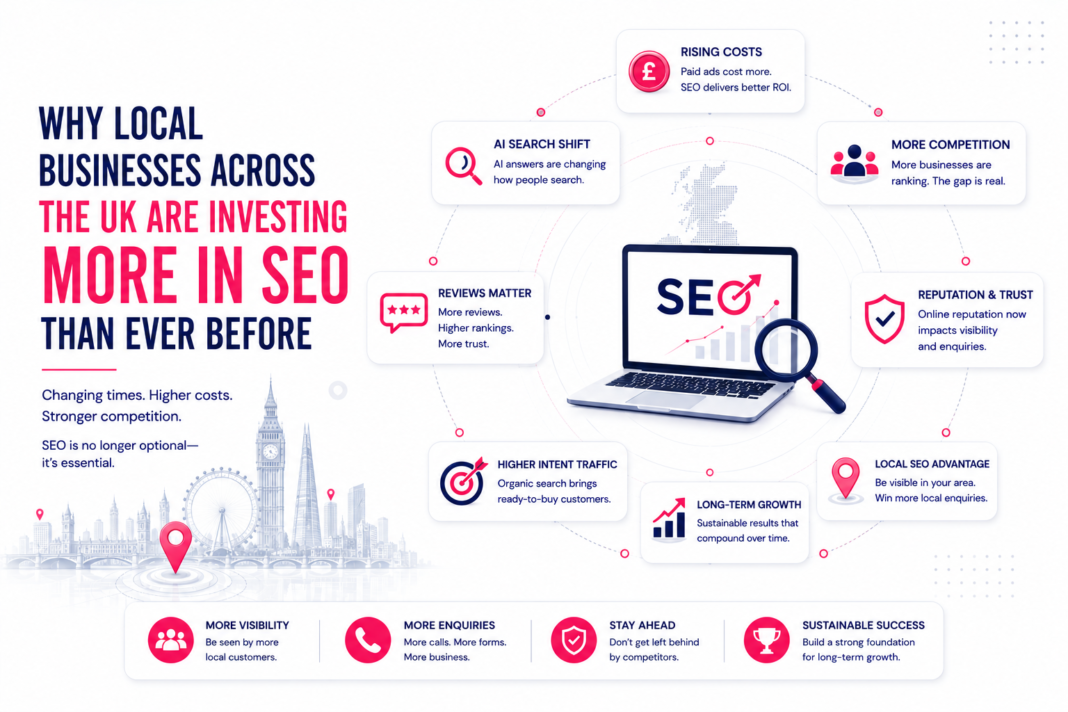
A few years ago, the argument for investing in SEO was largely about opportunity — get found online, grow your visibility, beat competitors who have not got there yet. That argument still holds, but it is no longer the whole picture. The more pressing reason many UK businesses are increasing their SEO spending right now is closer to necessity than opportunity. Several forces have converged at once, and the businesses feeling them most directly are the ones responding most decisively.
This piece explains what those forces actually are — not in vague terms about “digital transformation” but in the specific, concrete pressures affecting trades, professional services, healthcare, and retail businesses across the UK in 2026.
Paid Advertising Has Become Significantly More Expensive
For most local businesses, Google Ads used to be the alternative to SEO — a faster way to get in front of people searching for your services. The economics of that calculation have shifted considerably.
Cost-per-click for competitive local service terms in the UK has risen sharply over the past two to three years. A solicitor in Manchester paying for clicks on “family lawyer Manchester” is competing against other local firms, national comparison platforms, and legal aid services all bidding simultaneously. The same dynamic applies to tradespeople, healthcare providers, financial advisers, and estate agents in most major UK cities.
SEO, by contrast, does not charge per click. A well-ranking page delivers enquiries without a cost attached to each one. The investment is in getting the page to rank — through content, technical work, and off-page signals — and then in maintaining that position over time. For businesses where paid traffic has become prohibitively expensive or unpredictably competitive, organic rankings represent a form of media that, once earned, does not require continuous spending to maintain.
AI Search Is Disrupting the Old Click Patterns
Google’s AI Overviews and competing tools like ChatGPT, Perplexity, and Gemini have changed the journey many potential customers take before contacting a business. Some searches that used to produce a list of results now produce an AI-generated answer that meets the user’s need without requiring them to click anywhere.
This cuts in two directions. On one hand, informational content — the kind of content that used to pull in consistent blog traffic — now competes with AI-generated summaries and often loses clicks. Businesses that were relying on high-traffic informational articles for their ScEO results are seeing those results soften.
On the other hand, businesses appearing inside AI-generated answers — cited as the source of a recommendation or a fact — are gaining a form of visibility that traditional ranked links never provided. A local accountancy firm in Bristol that appears in ChatGPT’s answer when someone asks “which accounting firms in Bristol are good for small businesses” is reaching a potential client who never opened a search results page at all.
Navigating this shift requires a more sophisticated SEO approach than businesses needed two years ago — which is part of why spending on professional SEO advice is increasing. The work has genuinely got more complex.
Local Competition Has Intensified
For most of the past decade, SEO was primarily dominated by businesses in larger cities with dedicated marketing teams. A small independent plumber in Sheffield or a single-location café in York could get away with minimal online optimisation and still pick up local customers through word of mouth and basic directory listings.
That window has largely closed. BrightLocal’s 2026 data found that 84% of UK adults search for local business information online every single week. Even for services that seem inherently local and recommendation-driven, the decision about which business to actually contact increasingly begins with an online search. The trades and professional services businesses that invested in local SEO three or four years ago are now significantly ahead of late adopters in many local markets, and the gap compounds.
Businesses that are investing now are partly catching up and partly trying to protect their existing position before it erodes further. Both motivations are driving spending in the same direction.
Review Culture Has Made Reputation Management Inseparable From SEO
Ten years ago, a business with a strong word-of-mouth reputation could maintain it without much active effort. That is no longer realistic in most sectors. Reviews are now the primary trust signal for a significant majority of local customers, and the volume, recency, and consistency of a business’s reviews directly affect its local search ranking.
Research published by SEOScaleUp for the UK market found that a business with a 4.5-star average earns up to 25% more clicks than a comparable one rated 3.5 stars. That is not a marginal difference — it represents roughly a quarter of potential enquiries being redirected to a competitor based on review performance alone.
Managing reviews — encouraging satisfied customers to leave them, responding to negative ones thoughtfully, maintaining a consistent flow rather than a one-time burst — has become part of what SEO services cover for local businesses. It was not always framed that way, but the ranking implications are real and measurable.
The UK’s Particular Competitive Structure Amplifies the Stakes
The UK has several characteristics that make local SEO stakes particularly high compared to some other markets. Urban density means that many service businesses are competing in smaller geographic areas with more direct competitors than equivalent businesses in less densely populated countries. The UK’s strong comparison culture — price comparison sites, professional review platforms like Trustpilot and Which? — means that customers are more likely to research before committing, which extends the period during which search visibility matters.
The financial services sector has faced a specific additional pressure: regulatory changes that limited the supply of third-party bought leads for mortgage brokers, insurance advisers, and financial planners have pushed a significant number of these businesses toward owned, organic lead generation as the more reliable long-term alternative. Businesses in these sectors that built strong SEO before the regulatory shift were in a considerably better position than those relying primarily on lead aggregators.
Organic Search Still Delivers the Highest-Intent Traffic
Among all digital channels, organic search consistently produces the traffic most likely to convert into actual customer enquiries, because the user has already demonstrated intent — they searched for something specific, which means they have already started the buying process.
Social media traffic tends to arrive cold: the user was not looking for your service when they encountered your content. Paid ads can intercept intent but cost per click. Organic search reaches someone who is already in the decision process. For service businesses where the average customer value is significant — a dental practice, a law firm, a building contractor — the quality of that intent matters considerably more than the volume of traffic.
BrightEdge’s 2025 research found that organic search drives 53.3% of all website traffic globally. For UK businesses trying to allocate limited marketing budget across multiple channels, that proportion makes a compelling case for where to invest first.
What This Means for Businesses That Have Not Invested Yet
The honest answer is that the gap between businesses with established organic visibility and those without it is widening rather than narrowing. The businesses investing heavily in SEO right now are not primarily doing so because they believe it is guaranteed to work — they are doing so because they can see what is happening to their competitors who invested earlier and have stronger local positions as a result.
The good news for late movers is that the gap is not insurmountable, particularly in local markets where a relatively small number of well-executed fundamentals can still produce meaningful ranking improvements within a realistic timeframe. The not-so-good news is that every month of delay allows established competitors to extend their lead further, and catching up takes proportionally more effort the longer it is left.
The investment case for SEO among UK local businesses in 2026 is ultimately straightforward: the cost of not appearing in local search results is paid in enquiries going to competitors who do.