


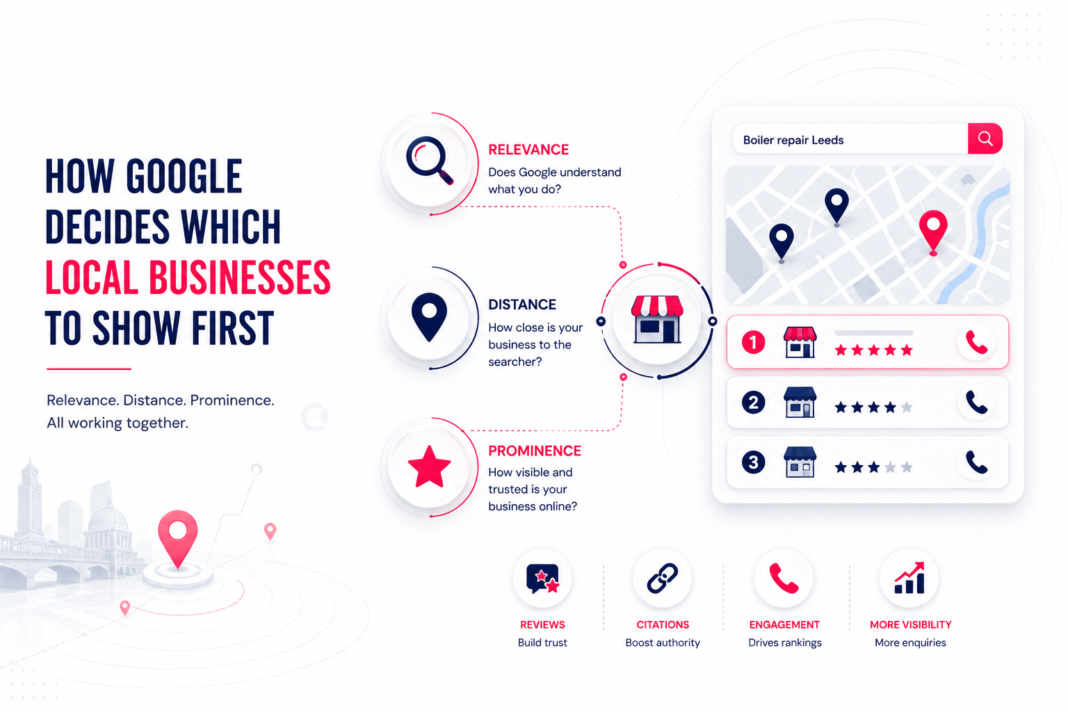
A heating engineer in Leeds got curious one afternoon and searched for his own business. He typed in the kind of phrase his customers would use — something like “boiler repair Leeds” — and found three competitors above him in the map results. None of them had been trading longer than him. Two had fewer reviews. One had a website that looked like it had not been updated since 2019.
He was not imagining this. What he was missing was an understanding of how Google actually evaluates and ranks local businesses — and it is not simply a matter of who has been around longest, who has the fanciest website, or even who is closest to the person searching.
This article explains the real logic behind Google’s local ranking decisions, why it produces results that sometimes seem counterintuitive, and what the factors that actually move the needle look like in practice.
The Three Factors Google Uses — and Why All Three Have to Work Together
Google’s own documentation is unusually transparent on this. For local search, the algorithm weighs three main factors: Relevance, Distance, and Prominence. Most businesses focus on one or two and then wonder why results are inconsistent.
Relevance — does Google understand what you do?
Relevance is about how clearly Google can match your business to a search. If someone searches “emergency plumber Nottingham,” Google needs to be confident that your business offers emergency plumbing in or near Nottingham. It is not enough to have the word “plumber” somewhere on your website — the signal needs to be consistent and specific across your Google Business Profile, your website content, your business categories, and the way other sites describe you.
This is why the primary category on your Google Business Profile matters more than most business owners realise. A business registered as “Heating Contractor” will be evaluated differently from one registered as “Plumber” for the same search, even if both businesses do identical work.
Distance — close helps, but it is not the whole story
Distance is exactly what it sounds like: how far is your business from the person searching? When a location is not specified in the search, Google uses the searcher’s device location to estimate the most relevant results.
The important thing to understand here is that distance is one factor in a weighted combination — not a veto. A business that is two miles further away but significantly more prominent and better matched to the query will often outrank a closer business that has not invested in its online presence. This is the part that surprises most business owners: proximity can be outweighed. The Leeds heating engineer mentioned above was being beaten not because his competitors were closer, but because they had stronger signals on the other two factors.
Prominence — how visible and trusted is your business across the web?
Prominence is the broadest of the three factors and the one with the most moving parts. It covers how well-known and trusted your business appears to be, based on signals from across the internet, not just your own website.
Reviews are the most visible part of this. The quantity, recency, and quality of Google reviews all contribute, and research from BrightLocal’s 2026 consumer survey found that 78% of consumers would not consider a business rated below four stars. A business with 40 recent reviews averaging 4.6 stars will generally outperform a longer-established competitor with 12 older reviews averaging 3.9, even if that competitor has a technically superior website.
But prominence also includes your presence in relevant local directories, mentions on local news sites or community platforms, the quality and relevance of links pointing to your website, and how active and complete your Google Business Profile appears to be.
The Part Most Guides Leave Out: Behavioural Signals
Google does not just look at what you have set up — it also observes what happens when people encounter your business in search results. Clicks, calls directly from the map listing, requests for directions, and the rate at which people choose your result over the ones next to it all feed back into Google’s understanding of whether your business genuinely serves searchers well.
This creates an interesting dynamic. A business that appears in map results but rarely gets clicked, called, or navigated to will gradually lose ground to one that generates consistent engagement, even if both have comparable profile setups. It also means that a newly listed but immediately popular business — one that receives strong early engagement because its quality is genuinely high — can climb rankings faster than you might expect.
The practical implication: Asking satisfied customers to leave a Google review immediately after a job is not just a trust signal for future customers. It is an active ranking signal that contributes to your prominence score month by month. Consistency over time matters more than a burst of reviews followed by a long silence.
What the Local Pack Actually Is and Why It Matters So Much
When you search for a local service on Google, you typically see a map with three businesses highlighted before you reach the regular website results. This is the Local Pack, sometimes called the 3-Pack, and research consistently shows it captures the large majority of clicks for local queries.
For most service businesses in the UK, appearing in the Local Pack for relevant searches is worth more in real enquiries than any other single SEO achievement. A business in position one of the map pack for “electrician Sheffield” will receive significantly more contact than a business ranking first in the organic results below the map, because the map results come with a visible star rating, a click-to-call button, and directions — everything a customer needs to act immediately without visiting a website at all.
According to data compiled by SEOScaleUp covering UK local search behaviour, 76% of people who search “near me” visit or contact the business within 24 hours. The Local Pack is where that behaviour starts.
How AI Search Is Changing Local Results
Google’s AI Overviews have changed local search, but not uniformly. Based on current tracking data from Studio 36 Digital’s 2026 UK local SEO research, AI Overviews appear far more often on informational local queries — “what should I look for in a plumber” or “how much does boiler servicing cost in the UK” — than on direct service queries — “plumber near me” or “boiler service Leeds.”
For transactional local searches, the map pack remains the dominant result, and Google appears to have made a deliberate decision to keep those results human-curated rather than AI-summarised. But informational queries in professional services and healthcare are increasingly answered by AI Overviews before the user ever sees a business listing.
This creates an opportunity for businesses willing to publish genuinely useful, clearly written content about their service area and the questions their customers commonly ask. A plumbing business that answers “how do I know if I need an emergency plumber” in a well-structured page with proper schema markup is building AI citation potential alongside its map pack presence. The two reinforce each other rather than competing.
What This Looks Like in Practice for a UK Business
Take a dental practice in Birmingham as an example. The practice owner assumes that the dental surgery two streets away will always outrank them for nearby searches because of proximity. Based on what we know about how Google weights its factors, this is not necessarily true.
If the practice has a fully completed and regularly updated Google Business Profile — correct opening hours including Bank Holidays, recent photographs of the surgery and team, 60 reviews averaging 4.7 stars, with thoughtful responses from the practice to each one — it is building prominence signals that can outweigh the proximity advantage of the closer competitor. If the practice website also loads quickly on mobile, names the dentists with their qualifications, and includes content that addresses common patient questions, the relevance and website quality signals compound further.
The closer surgery, if it has a half-completed profile, 15 reviews from three years ago, and a website that barely functions on a phone, is not capitalising on its proximity advantage. Google is not obligated to send patients to the nearest business — it is trying to send them to the best-matched, most trustworthy result within a reasonable distance.
| Factor | What Google looks at | Common gap for UK businesses |
| Relevance | Business profile categories, website content, service descriptions | Wrong primary category; vague service descriptions; inconsistent NAP |
| Distance | Device location vs. business address or service area | Service area not set up for mobile-based searchers |
| Prominence | Reviews, directory citations, website authority, engagement signals | Old or sparse reviews; incomplete profiles; no local citations |
| Behavioural | Click rate, call rate, directions requested, profile views | Low engagement from poor photo quality or missing contact buttons |
The Consistency Problem
One of the most common and most avoidable local ranking issues in the UK is inconsistent business information across different platforms. If your business is listed as “Smith Plumbing Ltd” on your Google Business Profile, “Smith Plumbing” on Yell, and “Smith’s Plumbing Services” on your website, Google sees three separate, slightly different entities rather than one clearly established business.
This inconsistency — often called NAP inconsistency, for Name, Address, Phone — reduces the confidence Google can assign to your business, which directly affects the prominence score. Fixing it costs nothing except time and can produce visible movement in local rankings within a few weeks of being corrected across the main directories.
The most relevant directories for UK businesses to get right first are: Google Business Profile, Bing Places, Apple Maps, Yell.com, Thomson Local, and any industry-specific directories relevant to your sector. For a solicitor, that includes the Law Society’s Find a Solicitor. For a healthcare provider, it includes NHS Choices where applicable and relevant clinical directories.
The Long Game
Google’s local ranking system rewards consistency and genuine quality over time. A business that builds its review count steadily, keeps its profile updated, publishes useful local content, and maintains consistent information across the web will generally improve its local ranking position over months, not just weeks. The heating engineer who started this article took about four months to move into the Local Pack consistently for his main search terms after addressing these fundamentals — not because any single change was dramatic, but because the signals accumulated and reinforced each other.
There are no shortcuts that reliably work without risk. Paid services that promise instant Local Pack placement are either purchasing signals Google’s systems are designed to detect and discount, or they are making promises they cannot keep. The businesses with stable, long-term Local Pack presence are almost always the ones that have done the foundational work properly and kept doing it consistently.