


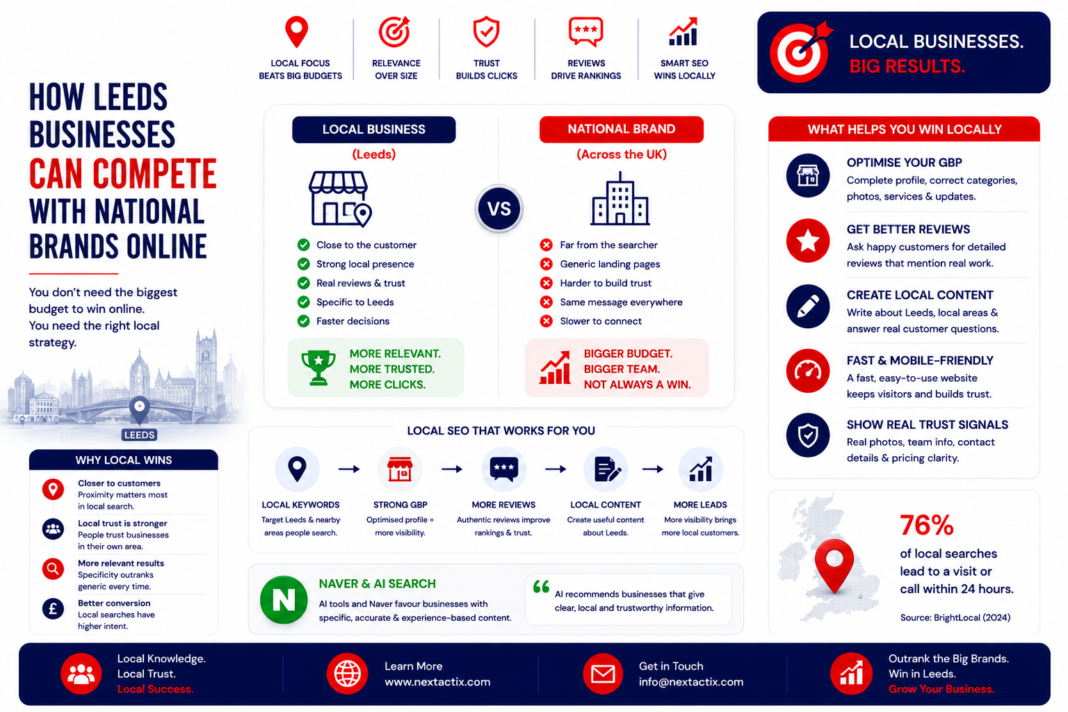
A independent kitchen fitter in Headingley and a national chain both show up when someone in Leeds searches “kitchen fitters near me.” The national brand has a marketing team, a much bigger budget, and a website built by people who do this full time. On paper, that should be an easy win for them.
It isn’t always, and the reason is worth understanding properly, because it changes where a smaller Leeds business should actually be spending its time and money.
Search doesn’t reward the biggest budget, it rewards the closest match
Google’s local results work differently from its general results. When someone searches for something with clear local intent — “near me,” a specific area of Leeds, or a service that’s obviously tied to a location — proximity and relevance carry real weight, often more than raw brand size. A national chain with a call centre and a generic regional page simply doesn’t match that kind of search as well as a business that’s actually based two streets away and has said so clearly.
This is the opening a lot of Leeds businesses don’t fully use. A national brand can’t easily replicate a genuinely local Google Business Profile, real local reviews, or specific, area-aware content, because doing that properly for every town and city they operate in isn’t practical at their scale. That gap is exactly where a smaller business can compete on equal terms, sometimes better than equal.
The Google Business Profile is doing more work than most owners realise
For local searches, the profile itself is often the first, and sometimes the only, thing a customer sees before deciding who to call. A profile that’s fully filled in — accurate categories, a proper services list, current opening hours, real photos of the actual premises or team — tends to outperform a thinner one, even when the thinner one belongs to a much bigger company.
Reviews matter here too, and not just the star rating. Reviews that mention something specific — an actual job done, a particular product, a genuine detail — carry more weight with both customers and search engines than a stack of generic five-star ratings. A Leeds business asking a happy customer to mention what was actually done, rather than just how they felt about the experience, tends to build a much more useful set of reviews over time.
Why hyper-local content beats a bigger, more generic page
A national brand’s Leeds page is often a template with the city name dropped in — the same paragraph that appears on their Manchester page and their Bristol page, lightly adjusted. That’s not a criticism, it’s just how operating in dozens of cities forces a business to work. It’s also a genuine weakness a local competitor can exploit.
Content that’s actually specific to Leeds — mentioning real areas like Chapel Allerton, Roundhay, or the city centre by name, referencing genuine local detail, answering questions a Leeds customer would actually have — reads as more trustworthy and tends to perform better in search than a page that could belong to any UK city. This isn’t about stuffing “Leeds” into every sentence. It’s about writing like someone who genuinely knows the area, because that’s usually true, and it shows.
Speed and trust decide what happens after someone clicks
None of the above matters much if the website itself is slow or hard to use once someone actually lands on it. A national brand usually has the technical resources to keep its site fast and well-maintained. A smaller Leeds business can match that without a big team, but it does need to treat the basics — page speed, a mobile-friendly layout, clear contact details — as a genuine priority rather than an afterthought.
Trust signals matter just as much here. A visible phone number, real photos rather than stock imagery, honest pricing information where possible, and evidence of actual completed work all help a visitor feel confident enough to get in touch. A big brand’s polish can sometimes work against it here — a page that feels corporate and generic can actually read as less trustworthy than a smaller, more personal one that clearly belongs to a real local business.
AI search is changing the picture again, and mostly in favour of specificity
More people are now asking AI tools directly for a recommendation — “who’s a good kitchen fitter in Leeds” — rather than searching and comparing several websites themselves. These systems tend to reward the same things that help with traditional local search: specific, accurate, consistent information about a business, rather than generic brand messaging. A national chain’s broad, corporate content often gives an AI system very little concrete detail to work with. A Leeds business that’s been specific about what it does, where it operates, and what makes its approach different has a genuinely better shot at being the one that gets named.
What this actually looks like in practice
None of this requires outspending a national competitor, which was never realistic to begin with. It means being more complete on the Google Business Profile than a bigger, less locally-focused rival usually bothers to be. It means writing content that could only have been written by someone who actually knows Leeds, rather than a template with the city name swapped in. It means keeping the website fast and genuinely easy to use, and building up reviews that say something specific rather than something generic.
A Leeds business doing all of that consistently isn’t just competing with the national brands search-wise. In a lot of cases, for the exact searches that matter most — the ones from someone nearby, ready to actually make contact — it’s already ahead.