


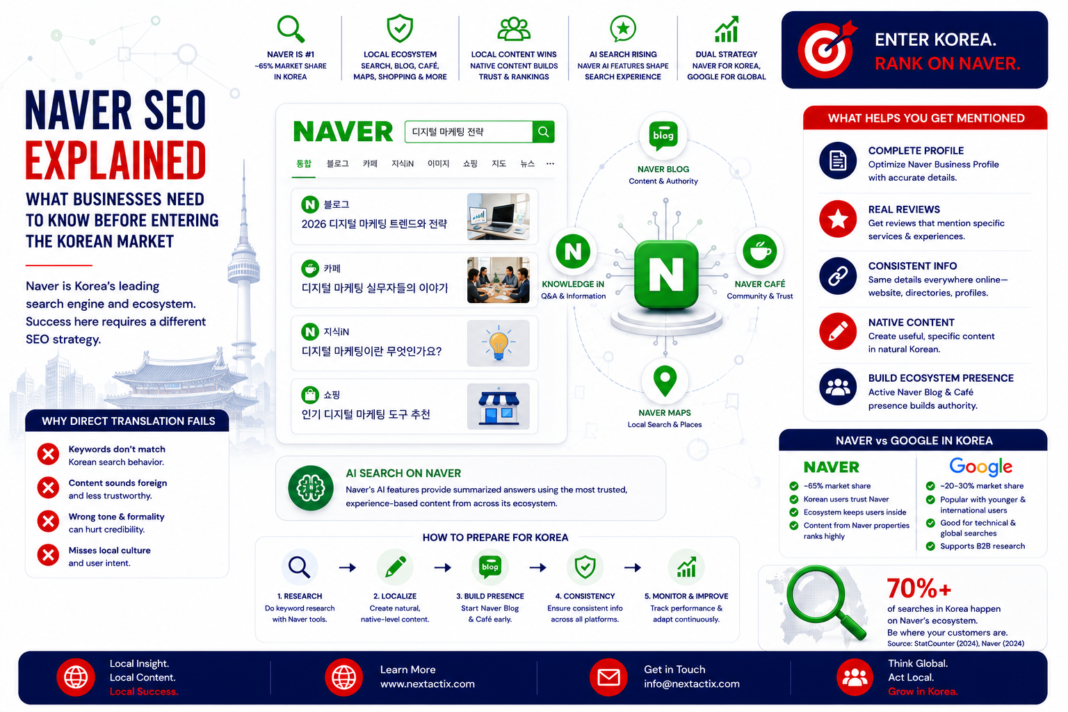
A company preparing to enter the Korean market will usually get its translation right, its pricing right, maybe even its packaging right for local expectations. Then it launches, points its existing SEO strategy at the new market, and waits for the traffic that worked everywhere else to show up. It doesn’t, and the reason is almost always the same: the strategy was built for Google, and Google is not where most of Korea is searching.
This is worth understanding properly before any budget gets committed, because it changes what “market entry” actually needs to include.
Naver, not Google, is the market
Naver holds somewhere in the region of two-thirds of Korea’s search market, depending on which measurement you trust, with Google taking a real but distinctly secondary share, concentrated more among younger, tech-savvy users and people researching Korea from outside the country. That gap hasn’t been closing the way it has in most other markets over the past decade, and there’s a structural reason for it: Naver isn’t just a search engine competing on relevance. It’s a closed ecosystem — search, blogs, community cafés, a shopping platform, a Q&A service, maps, and news — all built to keep users inside Naver’s own properties rather than sending them out to the open web.
That matters immediately for anyone planning market entry, because it means visibility isn’t just about a website ranking well. Naver’s results page draws heavily from its own content — Naver Blog posts, Café discussions, user reviews — often ahead of a brand’s official website, even for searches involving the brand’s own name. A company that only builds and optimises a website, the way it would for a Google-first market, is missing most of the actual playing field.
Why direct translation quietly sabotages everything
The most common and most avoidable mistake in Korean market entry is treating localisation as a translation task. Korean search behaviour doesn’t map cleanly onto a literal translation of an English keyword, and content that reads as translated — even when grammatically correct — tends to be read by Korean users as foreign and slightly untrustworthy, an effect that seems to be more pronounced among older demographics but isn’t limited to them.
This shows up in small but consequential ways. A term like “디지털 마케팅” is a direct translation of “digital marketing,” but it’s not necessarily the phrase Korean users actually search — genuine keyword research inside Naver’s own tools, done by someone fluent in how Koreans actually phrase things, tends to surface different and sometimes surprising alternatives. The same applies to tone: Korean has multiple levels of formality, and getting that register wrong across a website or a Naver Blog can read as either stiff or oddly casual in a way that undermines trust before a single product feature gets mentioned.
The Naver Blog and Café problem most companies don’t see coming
A foreign company can build a technically excellent website and still struggle in Naver’s results, because Naver’s own content — Blog posts and Café discussion in particular — carries real weight in its ranking system, sometimes outranking a brand’s official page entirely. This isn’t optional infrastructure. For most categories, an active, genuinely useful Naver Blog presence is closer to a requirement than a nice-to-have.
Naver’s blog-ranking system also rewards topical consistency over time — an account that sticks to a clear subject area and posts regularly builds credibility within that category in a way a scattered, occasional presence doesn’t. That has a direct implication for planning: a Naver Blog strategy needs lead time. A brand that starts building this presence the same month it launches in Korea is starting later than it should.
AI search has arrived in Korea too, and it changes what content needs to do
Naver has been rolling out its own AI-generated search features — an AI-powered results layer that synthesises an answer from across Naver’s ecosystem, appearing for a meaningful share of informational searches. Naver has said directly that these AI features favour specific, first-hand, experience-based content — genuine detail about taste, atmosphere, how a product actually performed — over generic, promotional copy.
For a foreign brand, that’s a useful signal about what to actually write, not just where to publish it. Generic product description translated into competent Korean gives Naver’s AI features very little to work with. Specific, honest, experience-led content — a real account of how a product performs, written in natural Korean by someone who’s actually used it — is a much stronger candidate for being surfaced, whether that’s on the brand’s own site or in the Naver ecosystem content that supports it.
Google still has a role, just a narrower one
None of this means abandoning Google entirely. It still captures real search volume from younger, more international-facing Korean users, from Android and Google-integrated devices, and from anyone outside Korea researching the market. For B2B specifically, buyers in Korea are often reported to research more thoroughly before making contact than buyers in some Western markets — several searches and comparisons across platforms before ever filling in a contact form — which means a reasonably strong Google presence still supports part of that research journey, even if it isn’t the primary channel for domestic Korean consumers.
The practical takeaway is a dual-platform approach rather than a Naver-only or Google-only one: Naver for the bulk of domestic Korean search behaviour and ecosystem trust-building, Google for the international-facing and more technical audience layered on top.
What “ready to enter” actually looks like
A company genuinely prepared for the Korean market, rather than just translated for it, tends to have a few things in place before launch rather than scrambling for them afterward: keyword research done inside Naver’s own tools rather than translated from an English list, a Naver Blog and Café presence that’s been building for a few months rather than starting from zero at launch, content written in natural, native-level Korean rather than accurate-but-stiff translation, and a plan for how the brand will actually be discussed and reviewed within Naver’s community platforms, not just how it will appear on its own site.
None of this is exotic. It’s largely the same discipline that makes any market entry work — genuine local knowledge, applied consistently, with enough lead time to build real presence rather than a rushed one. Korea’s search ecosystem is just different enough from most Western markets that skipping this step is one of the most common and most expensive mistakes a otherwise well-prepared company can make.