


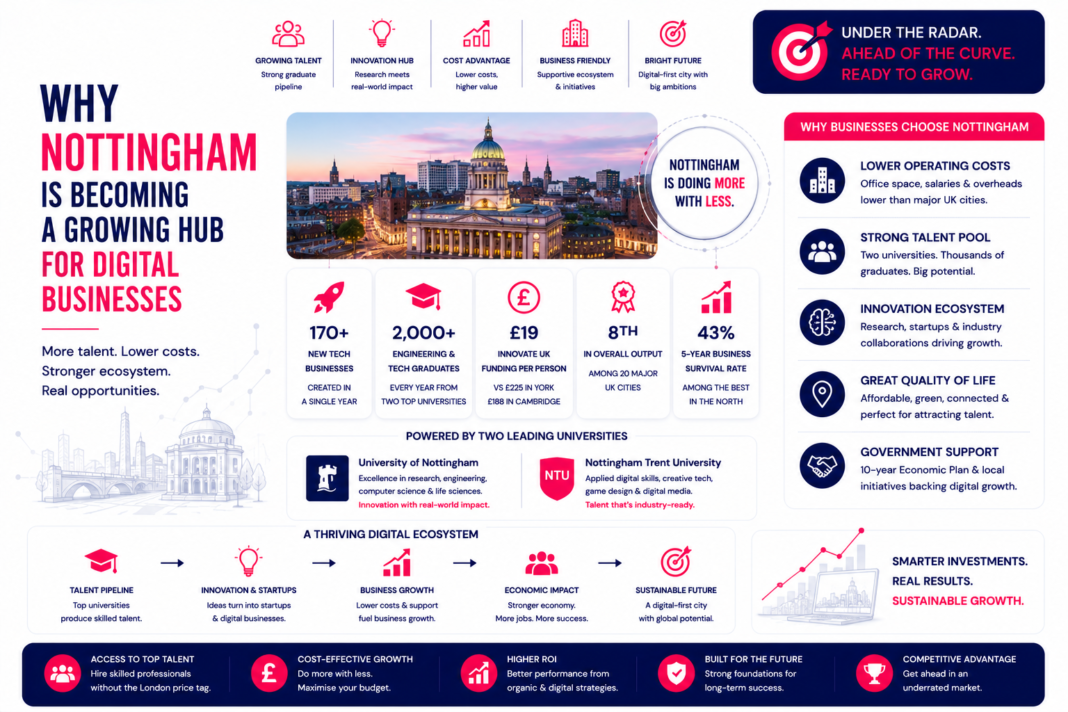
The research was commissioned to make a comparison, and the comparison turned out to be embarrassing — just not for Nottingham. Built in Notts analysed twenty major UK cities across startup creation, graduate output, and Innovate UK funding. Nottingham came eighth in overall output. It came somewhere near the bottom for funding received per head. The city was producing tech businesses and digital talent at a rate that outpaced cities with significantly more public investment and significantly more national recognition.
The headline from the analysis, published in December 2025, summed it up: Nottingham received £6.1 million in Innovate UK technology funding in 2024 to 2025 — £19 per person. York, a much smaller city, received £45 million — over £225 per person. Cambridge received £188 per person. Nottingham was doing more with less, by a margin that suggested the limitation was not talent or ambition but visibility and the funding that tends to follow visibility.
That gap between what Nottingham is actually producing and what it is publicly credited for is the central story of the city’s digital economy right now. Understanding it properly is useful for any digital business considering Nottingham, any business already there wondering why the city gets overlooked, and any observer trying to understand the UK’s tech geography beyond the usual London-Cambridge-Manchester triangle.
What Nottingham’s Digital Economy Actually Looks Like
Nottingham saw 170 new tech businesses formed in a single year, according to Built in Notts’ research. The city produces more than 2,000 engineering and technology graduates annually from the University of Nottingham and Nottingham Trent University — a combined pipeline that few cities outside the traditional tech hubs can match in pure volume.
The University of Nottingham’s innovation ecosystem, including its Institute for Advanced Manufacturing and its health technology research, provides a feeder into medtech, pharmaceutical technology, and precision engineering businesses that give Nottingham’s digital sector a practical, applied orientation rather than the software-only focus of some other regional hubs. Nottingham Trent University contributes particularly strong creative technology, game design, and digital media graduates — directly feeding the city’s creative digital businesses.
Nottingham City Council launched a ten-year Economic Plan in June 2026, explicitly identifying Creative and Digital alongside Life Sciences as two of the city’s primary growth sectors for the coming decade. The plan is backed by the Nottingham Growth Board, a partnership of businesses, educational institutions, and the public sector — a coalition that has been building momentum for several years through programmes like the Nottingham Accelerator, which by late 2025 had engaged 235 businesses with digital transformation support and had delivered AI-focused workshops covering ChatGPT for business, AI search engine impact, and AI-powered website development.
The Two Universities and Why They Matter for the Digital Economy
A digital business ecosystem needs two things from universities: talent in sufficient volume, and research that connects to commercial application. Nottingham has both, though this is not always reflected in how the city is discussed nationally.
The University of Nottingham is a Russell Group research university with internationally recognised strength in computer science, engineering, and life sciences. Its graduates consistently rank among the most sought-after by employers in technical fields. The university’s physical location within the city — rather than on a separate campus isolated from the business district — means the relationship between the institution and the commercial economy is more integrated than in some comparable cities.
Nottingham Trent University has positioned itself strongly in applied digital skills — creative technology, game design, digital media, and business technology — producing graduates who are job-ready in ways that more theoretically oriented programmes sometimes do not. Several of Nottingham’s most established digital agencies were founded by NTU graduates, and the university has a strong record of supporting student and graduate entrepreneurship.
Together, the two universities produce a talent pipeline that significantly exceeds what Nottingham’s current business base can absorb. Some of that excess talent moves to London, Manchester, and Birmingham. But a meaningful and growing proportion stays, attracted by the city’s cost base, its quality of life, and an improving set of career opportunities within Nottingham itself.
Cost of Business — The Underrated Competitive Advantage
For any digital business choosing where to operate, the economics of office space and senior talent are significant. Nottingham’s cost advantage over London is obvious and large. Its cost advantage over Manchester and Leeds is less discussed but equally real.
Commercial property in Nottingham city centre is available at a significant discount to Manchester, Leeds, and Birmingham equivalents for comparable quality. Senior developer, designer, and digital strategist salaries in Nottingham sit below Manchester and Leeds rates for equivalent seniority, without the same attrition risk that London creates for most digital businesses. For a digital agency, a software development company, or a technology-led professional services firm, the ability to build a senior team at lower cost — while still accessing genuine graduate talent from two strong universities — is a meaningful and sustainable competitive advantage.
The Nottingham Accelerator programme, which ran until March 2026 with £124,982 of UK Shared Prosperity Fund backing, has been actively supporting local businesses in adopting digital tools, AI platforms, and technology-driven processes. Growth vouchers of up to £2,000 were available for specialist consultancy and training. The programme demonstrates that public sector awareness of Nottingham’s digital economy has grown — even if national funding bodies have not yet caught up with the city’s output.
The Gap Between Output and Recognition
The most frustrating aspect of Nottingham’s digital economy, for those who work in it, is the persistent gap between what the city produces and how it is perceived nationally. Cities that receive more Innovate UK funding per capita tend to attract more venture capital, more national media coverage, more industry events, and more senior executives willing to relocate — each of which compounds the advantage of the original funding.
Nottingham does not consistently appear in the national tech press’s coverage of UK startup ecosystems. It is rarely featured in “best cities for tech businesses” roundups. This is partly a self-reinforcing problem: less coverage means less awareness means less investment means less coverage. But it is also simply inaccurate as a reflection of the city’s actual productive output.
The businesses that have recognised the gap — and used it to their advantage — are the ones that have built strong digital operations in Nottingham while their competitors were paying London or Manchester prices for the same talent. A digital marketing agency in Nottingham can hire a senior SEO specialist or content strategist at rates that would not secure equivalent talent in Manchester, while producing work for clients who may never know or care where the team is based.
What Changed Recently and What It Signals
The launch of Nottingham’s ten-year Economic Plan in June 2026 is significant not for what it promises — economic plans are common and often aspirational — but for what it reveals about how the city’s institutional leadership now understands its own strengths. Digital and creative are explicitly named as priority sectors, not as aspirational additions to the existing economy but as genuine current strengths that the plan aims to sustain and grow.
The involvement of businesses and educational institutions in the Nottingham Growth Board — rather than relying purely on public sector direction — suggests a maturity in the city’s approach to economic development that was less evident a decade ago. Cities that manage this kind of public-private-university coordination effectively tend to produce more durable digital ecosystems than those driven by either pure public investment or pure market forces.
Nottingham is also benefiting, somewhat unexpectedly, from the growth of remote and hybrid working as a default mode for digital businesses. A city that previously lost digital talent to London because career opportunities required physical presence there has gained something back from the normalisation of distributed teams. Nottingham-based digital professionals can now work for London, Manchester, or international clients without leaving the city — and an increasing number of them are doing exactly that.
For Digital Businesses Considering Nottingham
The practical case for a digital business choosing Nottingham is not that it is the most celebrated UK tech hub — it is clearly not. The case is that it is producing exceptional talent relative to its size and recognition, at a cost base that larger cities cannot match, in a city that is actively investing in its digital infrastructure and has identified digital as a core priority for the next decade.
The risks are real: talent retention remains a challenge, public investment lags the city’s output, and the national tech community underestimates the city consistently enough that client acquisition from outside the region requires more active effort. But for a business that prioritises quality, sustainability, and cost efficiency over the brand association of a more prestigious postcode, Nottingham’s digital economy in 2026 offers something genuinely valuable — a productive, underhyped environment that rewards businesses willing to look past the headline rankings.