

If you run a small business in the UK and you have been trying to make sense of ‘AI SEO,’ you have almost certainly noticed that most of what is written about it assumes you have a marketing team, a dedicated content person, and the kind of budget that gets reviewed in board meetings. None of that is particularly useful if you are running a five-person operation in Sheffield or a salon in Leeds trying to keep the appointment book full.
So here is the honest version. Some things about search have genuinely changed. Some things have not changed at all, no matter what the terminology around them has. And there is a short list of things a small UK business can actually do — without a specialist or a significant budget — that will make a measurable difference.
The Part That Has Actually Changed
When someone searches Google now, they often see a written summary at the very top of the page — above the blue links, above the map results, above everything. That is Google’s AI Overview, and it is generated by AI pulling together information from across the web to answer the question directly. A growing number of people also skip Google entirely and ask ChatGPT or Perplexity something like ‘best electrician in Nottingham’ or ‘which accountant should I use in Sheffield as a sole trader.’
That second layer — the AI-generated answer, rather than the list of website links — is what ‘AI SEO‘ refers to. Being cited in those answers, or being the source they draw from, is now a meaningful piece of how customers find businesses.
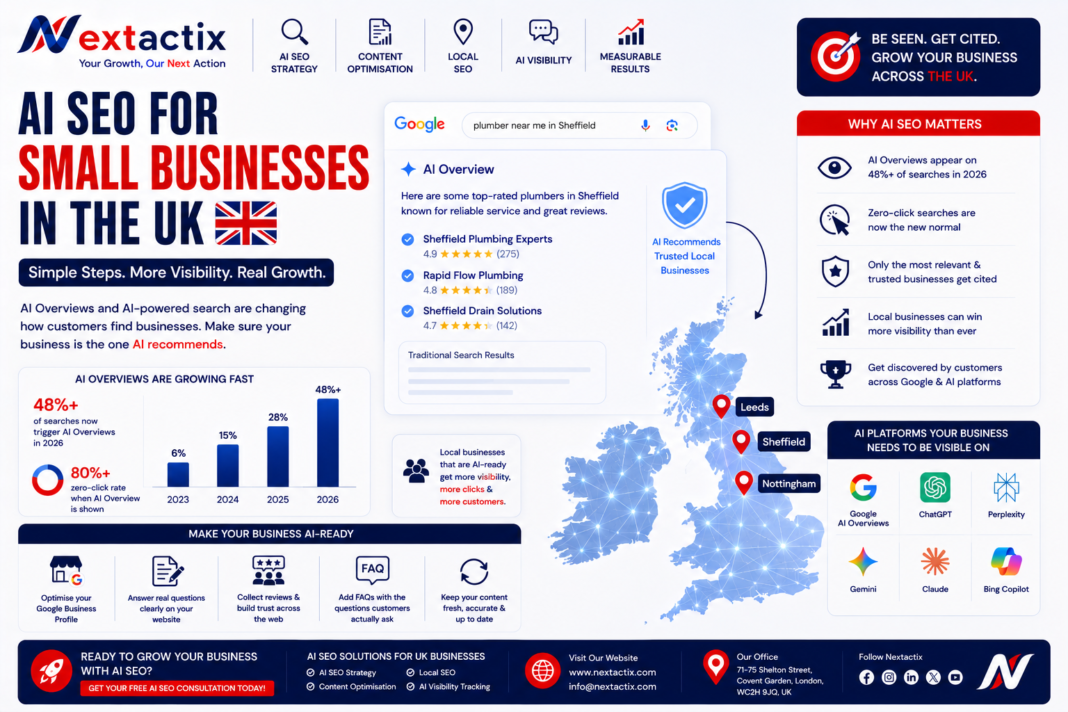
The scale of this shift is real. In the UK, 21 million people were actively using AI tools by late 2025. Google’s AI Overviews now appear on roughly 68% of local-intent searches. When an AI Overview shows up for a search, click-through rates to the first organic result drop by around 58%. But here is the other side of that statistic: businesses that are cited within the AI answer see 35% more clicks than those that are not mentioned at all. Being the source Google quotes is now more valuable than being ranked number one underneath it.
The Part That Has Not Changed
Underneath all of this, the fundamentals have not moved. Google still evaluates local businesses on three things: how relevant you are to what was searched, how close you are to the person searching, and how prominent your business appears across the web. Those last two have always been true, and AI has not rewritten them.
The Local Pack — the three businesses shown with a map at the top of local searches — still appears on around 93% of searches with local intent. If your business serves a specific area, that map block is still your most visible digital real estate, and your Google Business Profile is still what controls it. Nothing about AI search has changed that.
For local service businesses — trades, clinics, salons, solicitors, accountants — the map pack and your Google Business Profile are still doing more work than almost anything else. AI has added a new layer on top, not replaced what was already there.
Why Small Businesses Are Behind, and Why That Is an Opportunity
There is a gap worth being honest about. British Chambers of Commerce data shows UK SME AI adoption climbing from 23% in 2023 to roughly 54% by mid-2026. But that aggregate figure hides a lot: the adoption is concentrated in larger firms. Sole traders sit closer to 9%, and most small businesses are still operating as if the search landscape has not fundamentally shifted.
That gap is simultaneously a problem and an opportunity. The problem is obvious. The opportunity is that the businesses in your area that move now — before this becomes table stakes — get to build positions that are genuinely hard for competitors who start later to overturn. AI visibility, like traditional SEO, compounds over time. Early movers accumulate the mention history, the review density, and the entity authority that AI systems use to decide who to recommend. That foundation cannot be bought later at the same price.
What Actually Moves the Needle for a Small UK Business
Everything that follows assumes you have limited time and no dedicated marketing person. These are ordered by impact per hour of effort, not by comprehensiveness.
Your Google Business Profile is doing more work than your website
Over 80% of local searches end without a visit to any website at all. The person saw what they needed in the map result — the phone number, the hours, the reviews — and made their decision. That means your Google Business Profile is, in practical terms, the most important digital asset your business has for local discovery, and it feeds both the map pack and local AI Overviews.
A profile set up once and never touched is not doing its job. The businesses leading local search in 2026 are treating their Business Profile as a live channel — adding photos from real jobs, posting short updates, and keeping every detail accurate including service areas, not just your home city. If you serve customers in surrounding towns or postcodes, list them. Google uses that to match you to searches in those areas.
Write your website pages the way you would answer a customer
This is the single most important thing you can do for AI search visibility without knowing any technical terms. AI systems — Google’s AI Overviews, ChatGPT, Perplexity — are looking for clear, specific answers to real questions. If your website has a page that directly answers ‘how much does a boiler service cost in Leeds’ or ‘what does a conveyancing solicitor charge in Sheffield,’ and it answers it at the top of the page in plain English, you are doing what matters most in AI SEO without it being called that.
The content that gets cited in AI answers shares one characteristic more than any other: it is specific and quotable. Generic descriptions — ‘we offer a full range of professional services tailored to your needs’ — give an AI system nothing it can extract. Specific answers — ‘a standard boiler service in Leeds typically costs between £80 and £120, depending on boiler age and make’ — are the kind of sentences that end up inside AI answers.
Reviews need to be collected actively, not passively
SOCi’s research found that ChatGPT typically recommends businesses that average 4.3 stars, and that businesses answering reviews promptly had significantly higher AI recommendation rates. Batteries Plus Bulbs had a 38.4% likelihood of being recommended by Gemini — driven largely by responding to 98.3% of their reviews within less than a day.
Most small businesses wait for reviews to come in. The businesses pulling ahead are asking for them systematically — at the moment the job is completed, while the customer is still in front of you or while the experience is fresh. A review that describes the specific service, mentions the location, and names the outcome is worth considerably more than a generic five-star rating, both for trust and for AI visibility.
A FAQ section is worth more than a blog calendar
Many small business owners get told to start a blog. That advice is not wrong exactly, but it often leads to sporadic posts that trail off after three months. A FAQ section on your key service pages — real questions in your customers’ actual words — is lower effort, higher impact, and more durable.
‘Do you offer same-day callouts in Nottingham?’ ‘Is the initial quote free?’ ‘Do you carry out work in Arnold and Beeston, or just the city centre?’ These questions match exactly what people type and speak into search. They also match exactly how AI systems structure their understanding of what your business does. A single afternoon building a proper FAQ section on your two or three most important pages does more sustained work than a monthly blog that nobody maintains.
Being mentioned beyond your own website matters more than it used to
AI systems treat your own website differently from independent sources. Research from AirOps found that 85% of brand mentions in AI-generated answers come from third-party pages, not brand-owned content. What other people say about your business — in directory listings, review platforms, local news mentions, trade association sites — is weighted significantly higher than what you say about yourself.
For a small business, this does not mean a complex PR campaign. It means ensuring your details are accurate and consistent on Trustpilot, Checkatrade, your local chamber of commerce directory, any trade association site relevant to your industry, and any local business directory that ranks for searches in your area. Inconsistent details — different phone numbers, old trading names still live on a directory — suppress both local rankings and AI confidence in recommending you.
One Honest Note on Budget
You can make meaningful progress on almost everything above without spending money. Setting up your Business Profile properly, writing clearer service pages, asking customers for reviews — none of that requires an agency.
Where professional help earns its cost is in the pieces that take real time: building a website that is genuinely fast and well-structured in the first place, producing consistent content, and the technical layer — schema markup, Core Web Vitals, structured data — that helps both Google and AI systems process your site correctly. The technical side is also the easiest place to accidentally do nothing useful while feeling like you are doing something. If that is where your time is going, an audit before spending more of it is a worthwhile investment.
The basics, done properly and kept current, are still what separates the businesses ranking and getting recommended from those that are not. The AI layer has added a new destination for customers to arrive from — it has not replaced the work underneath it.
If you want to know where you currently stand — in Google local results, in AI Overviews, and in how ChatGPT describes your business — NextActix offers a free AI visibility audit that maps all of this for your specific business and location.