


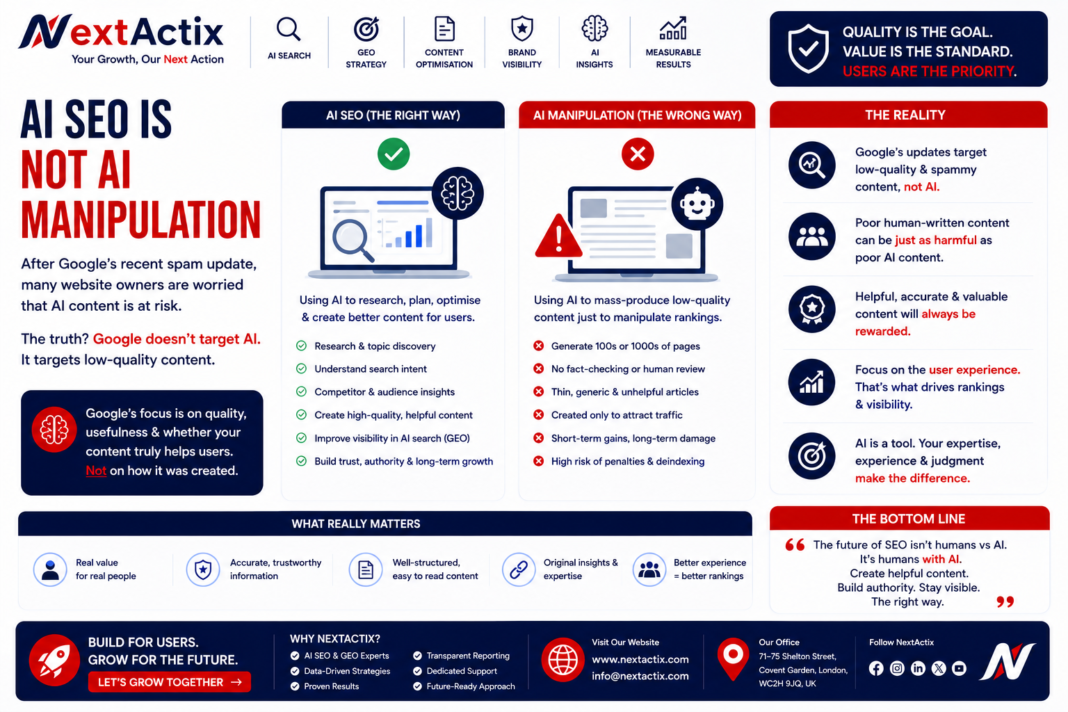
After Google’s recent spam update, many website owners started asking the same question: “Is Google targeting AI content?” The short answer is no.
At NextActix, we have seen this concern grow rapidly over the last few months. Many business owners believe that using AI for content creation or SEO automatically puts their website at risk. In reality, Google is not focused on whether AI was used. Google’s focus is on quality, usefulness, and whether the content genuinely helps users.
A lot of confusion exists because people often mix AI SEO with AI manipulation. While the two terms sound similar, they are completely different. AI SEO is about using artificial intelligence to improve content, understand search behavior, and create a better experience for users. AI manipulation is about trying to game search engines with low-quality content created only to gain rankings.
The difference is important because AI has become a normal part of digital marketing. Businesses use AI for research, topic discovery, content planning, competitor analysis, and audience insights. Many SEO professionals also use AI to understand search intent and identify questions that people are asking online. More recently, businesses have started using AI for GEO, or Generative Engine Optimization, which focuses on improving visibility in AI-powered search experiences such as AI Overviews, ChatGPT, Gemini, and other generative search platforms.
None of these activities are considered spam. They are simply modern ways of understanding what users want and creating content that answers those needs.
The problem begins when people try to use AI as a shortcut. Instead of using it to improve content, they use it to produce hundreds or even thousands of pages with little thought or review. These websites often publish articles automatically, without checking facts, adding expertise, or ensuring the information is actually useful. The content may look impressive because it is long, but when readers reach the end, they often realize they learned very little.
This is where AI manipulation starts.
The goal of these websites is not to educate users or solve problems. Their goal is to attract search traffic as quickly as possible. Search engines have always tried to reduce the visibility of this type of content. Years ago, the same thing happened with article spinning software, keyword stuffing, and other shortcuts. Today, some people are simply using AI to achieve the same result.
That is why recent Google updates should not be viewed as attacks on AI. Search engines are trying to remove low-quality content regardless of how it was created. A poorly written article created by a human can be just as unhelpful as a poorly generated AI article.
What matters is the final experience for the user.
If someone lands on your page and finds accurate information, useful insights, and answers to their questions, then the content is doing its job. Search engines want to reward websites that create that kind of experience. Whether AI helped with research, outlining, or drafting is far less important than the quality of the final result.
This is also why businesses should not panic every time Google releases a spam update. Many website owners immediately assume they need to remove AI-assisted content from their websites. In most cases, that is unnecessary. The better approach is to review the content honestly and ask whether it provides real value. If it does, there is little reason to worry.
The future of SEO is not about humans competing against AI. The future is about humans working with AI more effectively. AI can process information quickly and help identify opportunities, but expertise, experience, and judgment still come from people. The strongest content combines both.
As AI-powered search continues to grow, businesses will need to think beyond traditional rankings. Visibility inside AI search results, citations in AI-generated answers, and GEO strategies will become increasingly important. However, the foundation remains the same as it has always been: create trustworthy content that helps real people.
AI SEO is not AI manipulation. One focuses on helping users and building long-term authority. The other focuses on shortcuts and temporary gains. Search engines are becoming better every year at understanding the difference, which is why businesses that prioritize quality will continue to succeed regardless of how search technology evolves.