


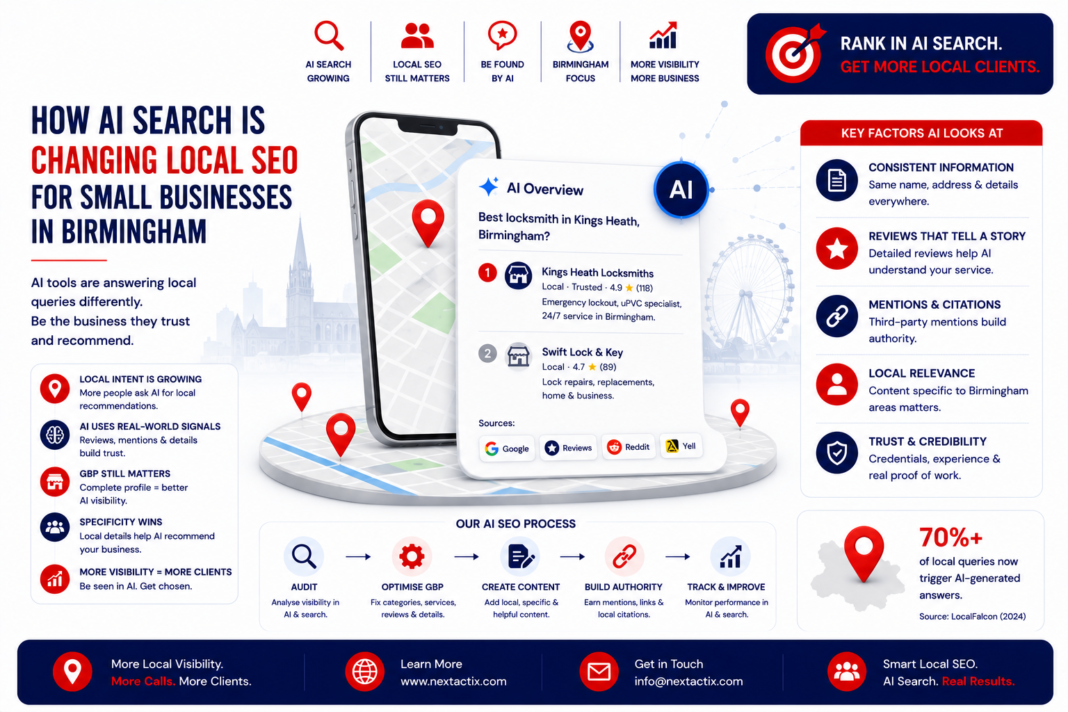
A locksmith in Kings Heath recently told us something that’s stuck around in our heads for a few weeks now. He’d checked his rankings — page one, third position for “locksmith Birmingham” — and then, almost as an afterthought, asked ChatGPT the same question on his phone. His business wasn’t mentioned at all. Two competitors were, neither of which outranks him on Google.
That gap is becoming common enough that it’s worth explaining properly, rather than treating it as a strange edge case.
Two different systems, answering the same question differently
Google’s traditional results and an AI-generated answer aren’t the same contest, even when they’re triggered by the same search. A local pack ranking depends heavily on proximity, review volume, and a well-set-up Google Business Profile. An AI system — whether that’s Google’s own AI Overview, ChatGPT, or Perplexity — is doing something closer to reading a handful of sources and deciding which business genuinely deserves to be named, based on how clearly and specifically that business describes itself across the web.
Those aren’t the same job, and doing well at one doesn’t guarantee doing well at the other. Several large-scale studies published this year looking at real AI citations found that the large majority of pages cited inside an AI answer never appeared in Google’s own top ten results for the same search. That’s a genuinely uncomfortable finding for a business that’s spent years chasing a Google ranking as the whole strategy.
For Birmingham specifically, this matters more than it might in a less locally fragmented city. Local queries are now reported to trigger an AI-generated answer a large majority of the time — meaning a search like “plumber near Moseley” is increasingly likely to get answered directly on the results page, sometimes without a single blue link appearing above the fold.
Why this hits small businesses differently than big ones
A national brand with a large, consistent web presence — reviews across a dozen platforms, press mentions, a Wikipedia page, a well-structured site — has a natural advantage in this kind of environment. An AI system cross-references sources, and a business that’s described consistently and specifically in many places is simply easier to trust and cite than one that only exists on its own website.
That sounds like bad news for a small, independent Birmingham business, and in one sense it is — the businesses with the least time to spend on this are the ones who now need to think about it. But there’s a genuine silver lining buried in how these systems actually work. They tend to reward specificity over size. A goldsmith in the Jewellery Quarter who writes clearly about what they actually make, what a bespoke commission involves, and how their pricing works has something an AI system can extract and quote confidently. A large national jewellery chain’s generic “About Us” page often doesn’t. Specific, honest, detailed information beats size and budget more often in this environment than it does in traditional Google rankings.
What Birmingham’s local structure means in practice
Birmingham doesn’t behave like one search market, and that matters just as much for AI search as it does for Google. Colmore Business District, the Jewellery Quarter, Digbeth and Solihull are genuinely different commercial areas with different buyer expectations, and an AI system answering a locally-flavoured question is drawing on whatever specific detail it can find about that exact area.
A commercial solicitor writing generically about “law firm services in Birmingham” gives an AI system very little to distinguish them with. A commercial solicitor who writes specifically about lease negotiations for tenants around Colmore Row, mentions the kind of buildings involved, and explains what typically goes wrong in that process, gives the same system something concrete to cite. The difference isn’t really about SEO tactics — it’s about whether the content actually contains information worth repeating.
Solihull adds its own wrinkle here too. It’s a separate metropolitan borough, not a Birmingham suburb, and Google has always treated it that way in local search. AI systems drawing on Google’s own local data inherit that same distinction — a business that’s vague about whether it serves Birmingham, Solihull, or both tends to get skipped over in favour of one that’s stated it plainly.
Google Business Profile still matters — maybe more than before
It would be easy to assume that AI search makes the traditional local SEO checklist less important. The opposite seems closer to true, at least for now. Google’s own AI Overviews draw heavily on Google Business Profile data for local queries, which means an incomplete, outdated, or vaguely categorised profile doesn’t just cost a business local pack visibility — it can make that business invisible to Google’s AI-generated answers too.
The category selected for a Google Business Profile, the specific services listed, the accuracy of the service area, and the detail in customer reviews all appear to feed into how confidently an AI system will describe and recommend that business. A generic category like “shop” tells an AI system almost nothing. A specific one, paired with a services list that actually names what’s offered, gives it something to work with.
The review problem nobody quite expected
Reviews have always mattered for local SEO, but the way they’re now being used is slightly different. It’s not just the star rating or the review count anymore — AI systems appear to read the actual text of reviews, looking for specific mentions of services, problems solved, or details a generic review wouldn’t include. Forty reviews that all say “great service, highly recommend” give an AI system far less to work with than fifteen reviews that mention specific jobs, specific products, or specific outcomes.
This is a genuinely actionable thing a small Birmingham business can do without much cost: when asking a happy customer for a review, asking them to mention what was actually done, rather than just how they felt about it, produces exactly the kind of specific, citable detail these systems seem to respond to.
What we’d actually suggest doing about it
None of this calls for abandoning the local SEO fundamentals that have worked for years — a fast, well-structured website, a properly filled-out Google Business Profile, and consistent business details across every platform still matter, arguably more than ever, because AI systems cross-reference exactly those signals when deciding what to trust.
What’s genuinely new is the need to write with real specificity about the actual district a business operates in, the actual services it offers, and the actual detail that makes it different from the business two streets over. Generic content was always a weak strategy. In an environment where an AI system is actively looking for something worth quoting, it’s now a much more visible one.
The locksmith in Kings Heath, as it turned out, had a Google Business Profile listed under a broad “locksmith” category with no service list filled in, and a website that mentioned Birmingham twenty times without once mentioning Kings Heath by name. That’s not a mysterious algorithm problem. It’s a business that, from an AI system’s point of view, hadn’t really said anything specific enough to repeat.