


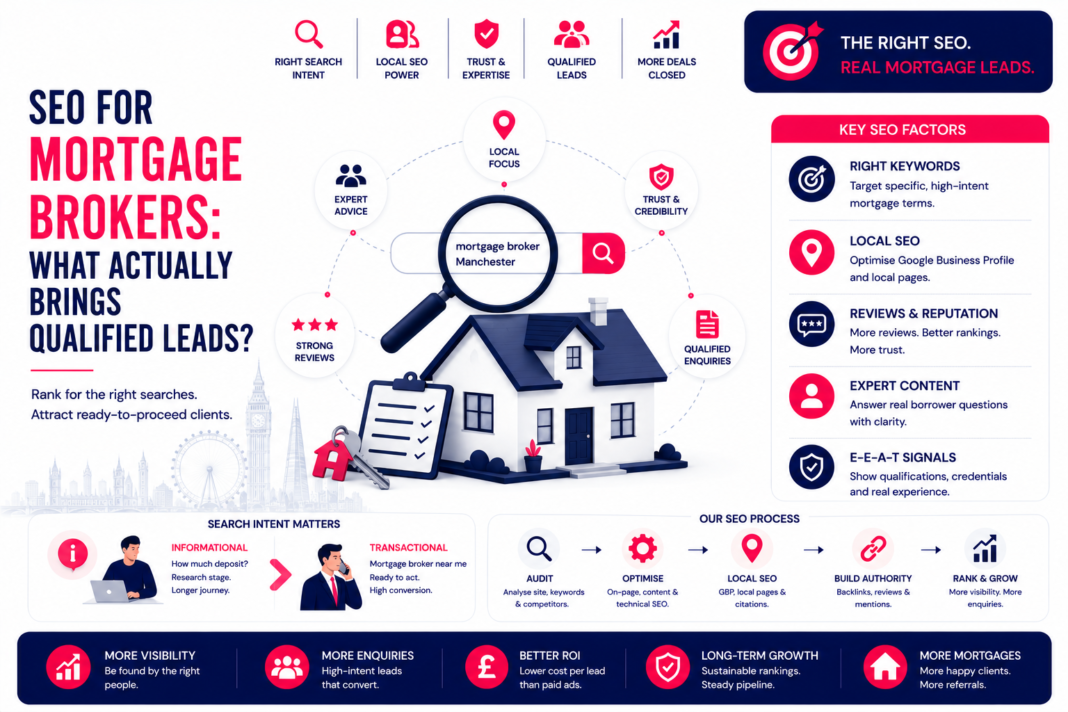
A mortgage broker in Birmingham had a website ranking on the first page of Google for several terms she had worked hard to build. Traffic was reasonable. Enquiries were not. Most of the people landing on her site were researching mortgages in a general way — browsing, comparing, working out what they could afford — rather than actively looking for a broker to speak to.
She was not failing at SEO. She was succeeding at the wrong kind of SEO. The traffic she had earned was real, but the intent behind it was informational rather than transactional. The people visiting her site were not ready to speak to anyone yet. The leads she actually wanted — borrowers with a property in mind, ready to proceed, needing advice specific to their situation — were searching for different things entirely.
This distinction between traffic and qualified leads is the most important thing to understand about SEO for mortgage brokers, and it is the thing most guides on the subject skip past in their rush to discuss keyword volumes and backlink strategies.
The Search Intent Split That Determines Everything
People searching for mortgage help are at completely different stages of their decision when they type different phrases into Google. Understanding this split is the foundation of any SEO strategy that actually produces enquiries rather than just visits.
A first-time buyer typing “how much deposit do I need for a mortgage in the UK” is at the research stage. They may be months away from speaking to a broker. Ranking well for that search will bring visitors who may become clients eventually, but the conversion journey is long and uncertain. The page that serves them well is an educational guide, not a contact form.
The same buyer, six months later, typing “mortgage broker Manchester first-time buyer” or “fee-free mortgage adviser near me” is ready to speak to someone today. Ranking well for those searches produces enquiries almost immediately, because the intent is specific and the user has already decided they want professional advice. The page that serves them is a clear, direct service page with an easy way to make contact.
Both types of search matter — but they matter differently and require different content to serve them. Brokers who build only educational content get traffic without leads. Brokers who build only service pages miss the research-phase visitors who eventually become the most loyal clients because they discovered the broker early in their journey.
Which Keywords Actually Produce Enquiries
The terms that produce qualified leads for mortgage brokers are almost always specific, situational, and local. Generic terms like “mortgage advice” or “best mortgage rates” are dominated by price comparison sites, national broker platforms, and major financial institutions that have the domain authority and content scale to compete for those terms. An independent broker or small brokerage trying to rank for these broad terms is usually competing on very unfavourable ground.
The searches where independent brokers can genuinely compete — and often win — are the ones that combine a specific situation with a location. A few examples of the kind of query worth targeting:
“Self-employed mortgage broker Sheffield” — someone with non-standard income who knows they need specialist advice and wants a local broker who understands their situation.
“Mortgage adviser for buy-to-let Leeds” — a landlord looking for specific buy-to-let expertise, not a generalist.
“First-time buyer mortgage help Birmingham, no deposit” — a very specific situation that a national platform’s generic content may not address clearly.
These searches are lower in volume than broad terms, but they produce a much higher rate of genuine enquiries because the person typing them knows exactly what they need and is looking for someone who can help with their specific situation. A broker who becomes the obvious local authority for two or three of these specific situations will generate more qualified leads than one trying to rank for everything.
Why the YMYL Classification Changes the Rules for Mortgage SEO
Google classifies mortgage and financial advice content as YMYL — Your Money or Your Life — meaning content where bad or inaccurate advice could materially harm the reader. For this category, Google applies stricter quality standards, and the E-E-A-T framework (Experience, Expertise, Authoritativeness, Trustworthiness) is assessed more rigorously.
In practice, this means a mortgage broker’s website needs to demonstrate real expertise clearly rather than just describing itself as expert. Named advisers with their CeMAP qualifications referenced, FCA registration visible and linkable, genuine client testimonials rather than generic praise, and content that demonstrates real understanding of the mortgage process — these signals matter more in the YMYL classification than they would for a low-stakes business type.
The brokers ranking well for mortgage advice terms in competitive UK cities are almost universally the ones with strong named-adviser profiles on their websites, clear regulatory credentials, and content that reads as genuinely knowledgeable rather than generated from a template. Google’s quality raters, who manually assess pages as part of the algorithm training process, are specifically instructed to evaluate whether financial content meets a high bar for expertise and trustworthiness.
A specific point worth acting on: If your website lists advisers without naming them, without referencing their qualifications, or with a vague “our team” page rather than individual profiles, fixing this is one of the highest-priority changes you can make for mortgage SEO. Named, qualified advisers are a direct E-E-A-T signal.
Local SEO Is the Highest-ROI Channel for Most Brokers
For the majority of independent mortgage brokers and small brokerage firms, the Google Business Profile is the most underinvested part of their online presence relative to its potential impact.
When someone in a specific location searches for “mortgage adviser near me” or “mortgage broker [city name],” the Local Pack — the map results at the top of Google — is typically the first result they engage with. A broker with a well-maintained, review-rich, fully completed Google Business Profile has a meaningful advantage here over a competitor with a strong website but a neglected profile.
The practical gap between most broker profiles and what a well-optimised one looks like is usually considerable. Most profiles have a name, address, phone number, and perhaps a handful of reviews. A well-maintained profile has regular photo updates, a detailed services description, posts about relevant topics (first-time buyer schemes, product launches, rate changes), responses to every review including negative ones, and a consistent flow of new reviews over time rather than a cluster from one point in history.
The FCA compliance consideration is real here — reviews and posts need to be monitored to ensure they do not make statements that breach financial promotions rules. But compliance is manageable, and it does not prevent building a strong profile within the rules. Brokers who use compliance concerns as a reason to avoid investing in their local presence are generally handing that ground to competitors who have found ways to work within the rules effectively.
The Content That Actually Works
Mortgage broker websites with the strongest organic lead generation tend to have content built around situations rather than products. An article about “what counts as income when applying for a mortgage if you’re self-employed” serves a very specific need and will rank for a range of long-tail searches from exactly the type of borrower a specialist broker would want to attract.
This type of situational content — addressing the specific complications, common questions, and misconceptions that borrowers in particular circumstances have — builds several things simultaneously: relevant traffic from people in the situation being described, demonstration of expertise that satisfies Google’s E-E-A-T requirements, and the kind of genuinely useful content that AI tools like ChatGPT and Google AI Overviews are increasingly likely to cite.
Semrush’s 2025 SERP tracking found that AI Overviews appear on roughly 47% of mortgage-related search queries. For brokers, this means content structured to answer specific questions directly — with the answer in the first sentence, supported by accurate information, properly marked up with schema — is increasingly appearing inside AI-generated answers, not just in ranked results. The brokers who will dominate mortgage search over the next few years are the ones building content that works for both the traditional results page and AI-generated answers simultaneously.
What Wastes Time in Mortgage Broker SEO
A few approaches consume significant time or money while producing minimal qualified leads, and they are worth naming directly.
Targeting generic high-volume mortgage terms — “mortgage rates,” “mortgage calculator,” “best mortgage” — against national comparison platforms and major lenders is almost always a losing proposition for an independent broker. The domain authority gap is too large and the search intent too broad. The traffic that does arrive from these terms converts poorly because the user is comparison shopping at scale rather than looking for a specific adviser.
Producing large volumes of thin, templated content — “mortgage advice in [city]” landing pages with minimal real differences between them — has become less effective as Google has become better at detecting and discounting near-duplicate content. These pages used to work. They work considerably less well now, and Google’s helpful content updates have specifically targeted this pattern.
Buying links from directories or link services without considering the relevance and quality of the source remains a risk in the YMYL category specifically. Google’s link spam updates have hit mortgage and financial services sites harder than many other categories precisely because the YMYL classification means quality raters pay closer attention to these pages. Earned, relevant links from genuinely useful sources — mortgage comparison media, property news sites, local business directories — carry far more value and far less risk than purchased link volume.
How to Think About the Timeline
New broker websites in competitive markets should expect three to six months of foundational work before meaningful organic lead generation begins. Established sites with existing content and some authority can see results from targeted improvements more quickly — sometimes within six to eight weeks for specific search terms, particularly local ones.
The Birmingham broker mentioned at the start did not need to rebuild her website or start from scratch. She needed to reorient her content strategy toward the specific, situational, local searches her ideal clients were actually making, build out her adviser profiles with proper credentials and qualifications referenced, and shift her Google Business Profile from an afterthought to an actively managed asset. Within about four months, her enquiry rate from organic search had improved noticeably, driven by a smaller volume of much higher-quality visits rather than more traffic from broadly relevant but unconverted searchers.
The measure of successful mortgage broker SEO is not traffic — it is how many people who land on the site actually make contact. Keeping that outcome clearly in view, rather than chasing rankings as an end in themselves, is what separates the brokers getting real results from those with impressive dashboards and underwhelming enquiry books.