

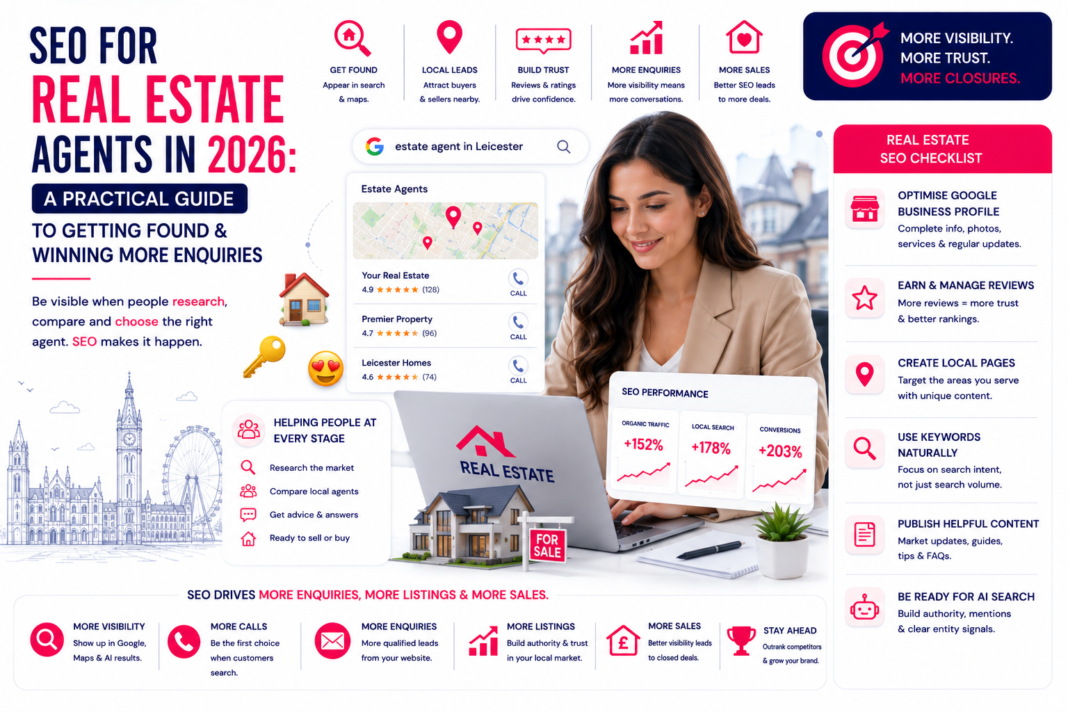
Real estate is a local business, but the way people find local agents has changed.
A person looking to sell a house may ask a friend for a recommendation, browse a property portal or search Google for an estate agent nearby. Increasingly, they may also use an AI search tool to compare agencies, understand an area or ask which companies are worth considering.
That means having a website is no longer enough.
Your real estate business needs to be visible when people are researching the market, comparing their options and finally looking for someone to contact.
This is where SEO comes in.
A good real estate SEO strategy is not simply about getting a website onto the first page for one keyword. It is about building visibility across Google Search, Google Maps, local searches and newer AI-driven search experiences, while making the website useful enough that visitors actually take the next step.
This guide explains what that involves and where a real estate business should focus its attention.
Why SEO matters so much for real estate businesses
Real estate companies have an advantage that many other businesses do not: there is a huge amount of search activity around their services.
People search for estate agents, property values, neighbourhoods, house prices, buying advice, selling costs, mortgages, commercial property and countless other questions before they ever speak to an agent.
The challenge is that most businesses only optimise for the final search.
They want to rank for terms such as:
- estate agent in Manchester
- estate agents near me
- property agent Liverpool
- real estate agency Birmingham
- sell my house Leicester
These searches are valuable, but they are only one part of the customer’s journey.
Someone might first search:
How much is my house worth?
Then:
What makes a house sell quickly?
Then:
Best areas to live in Birmingham
And eventually:
Estate agents in Birmingham
A business that only targets the last search is missing several opportunities to become visible earlier.
SEO can help with several parts of the buying or selling journey
People researching the market
They may not be ready to contact an agent yet, but they are beginning to understand their options.
People comparing local agencies
These visitors are closer to making a decision and often look at reviews, services, experience and local knowledge.
People ready to enquire
These are the searches with stronger commercial intent, such as finding an agent, arranging a valuation or getting help selling the property.
The goal is not to turn every search into a lead. The goal is to make sure your business is visible at the right moments.
Start with local SEO
For a real estate business, location matters enormously.
Someone searching for an estate agent in Liverpool usually does not want a company based hundreds of miles away. They want someone who understands the local market, neighbourhoods and property types.
That makes local SEO one of the most important parts of a real estate marketing strategy.
Your Google Business Profile matters
Your Google Business Profile is often one of the first places a potential customer sees your business.
It can appear when someone searches for your company, searches for a local service or looks at businesses through Google Maps.
A neglected profile can make an otherwise good business look inactive.
Make sure your profile contains accurate information about:
- Business name
- Address
- Phone number
- Website
- Opening hours
- Business category
- Services
- Photos
- Reviews
Keep the information consistent with your website and other important business listings.
Regular updates can also help show that the business is active. Depending on the agency, this might include market updates, recently sold properties, new listings, local information or company news.
Reviews are part of the decision-making process
Reviews do more than provide a star rating.
Someone choosing an estate agent is making a significant decision. They want evidence that the agency has worked with people like them and delivered a good experience.
A collection of genuine, detailed reviews can therefore support both visibility and conversion.
Instead of simply asking customers to leave a review, make the process easy and encourage honest feedback about their experience.
For example, a customer might naturally mention the area they were selling in, the type of property, communication, valuation advice, marketing, speed of the sale and overall service.
Never manufacture reviews or tell customers exactly what they should write. Genuine experiences are far more valuable than artificial keyword-filled reviews.
Build pages for the areas you actually serve
One of the biggest mistakes real estate businesses make is having one generic page that says they serve an entire city or region.
If your agency genuinely works across several areas, those areas deserve useful information of their own.
For example, an agency operating in Liverpool could potentially create useful local resources around Liverpool city centre, Aigburth, Allerton, Crosby, Formby, Woolton and surrounding areas.
But these should not simply be duplicate pages with the location name changed.
A useful local page should tell people something they actually want to know.
You might discuss local property types, typical buyer profiles, neighbourhood characteristics, transport links, schools and amenities where relevant, recent market trends, selling considerations and the agency’s experience in the area.
This gives the page a reason to exist beyond ranking for a location keyword.
Real estate websites need more than property listings
Property listings are obviously important, but they should not be the entire website.
Listings disappear when a property is sold or rented. Useful educational content can continue attracting people for months or years.
Consider the questions your customers ask before contacting you.
They might include:
- How do I know what my property is worth?
- How long does it take to sell a house?
- Should I renovate before selling?
- What makes a property attractive to buyers?
- How much does it cost to sell a house?
- What should I look for when buying a property?
- Is now a good time to sell?
- Which areas are becoming more popular?
- What should first-time buyers know?
These questions can become useful pages and articles.
The important point is to answer them properly rather than creating short articles simply because a keyword has search volume.
Search intent should decide what you create
Not every search requires the same type of page.
Consider these three searches:
“What is my house worth?”
This is largely informational. The person is looking for an answer.
“Estate agent in Leeds”
This has strong local and commercial intent. The person is likely looking for an agency.
“Book a property valuation Leeds”
This is much closer to an action.
Trying to answer all three with the same generic service page is unlikely to produce the best experience.
A stronger website gives each type of search an appropriate destination.
| Search type | Example | Suitable page |
| Informational | How is a house valued? | Guide/article |
| Local | Estate agent in Leeds | Local service page |
| Commercial | Best estate agents Leeds | Comparison/service content |
| Transactional | Book a property valuation | Conversion-focused landing page |
| Navigational | NextActix real estate SEO | Brand/service page |
Understanding intent also helps prevent different pages from competing against each other.
Keyword research is about customers, not keyword lists
Keyword research is useful, but it should not become the entire SEO strategy.
Start with the services and locations that actually matter to the business.
For a real estate agency, this could include:
- estate agent
- property valuation
- sell my house
- property management
- commercial property
- letting agent
- local estate agent
Then expand into the questions and longer searches surrounding those subjects.
Longer searches are particularly useful because they often reveal exactly what someone is trying to do.
For example:
how much does it cost to sell a house in Manchester
tells you considerably more about the user’s situation than simply:
house
The best keyword is not always the one with the largest search volume. A smaller search with clear commercial intent can be much more valuable to a local agency.
Your website needs a clear structure
A real estate website can become complicated very quickly.
There may be hundreds of property listings, multiple locations, services, agents, guides and market reports.
Without a sensible structure, important pages can become difficult for both users and search engines to discover.
A simple structure might look something like:
Homepage
→ Locations
→ Services
→ Property listings
→ Property guides
→ Local market information
→ About the agency
→ Contact
The exact structure will depend on the business, but the principle is simple: important pages should be easy to find and clearly connected to related content.
Internal links connect the whole website
Internal linking is often overlooked because it does not feel as exciting as building backlinks.
But it plays an important role in showing how different parts of your website relate to each other.
Suppose you publish an article about preparing a property for sale.
That article could naturally link to your property valuation service.
Another article about selling in a particular neighbourhood could link to the relevant local estate agent page.
A local service page could link to a market report.
This creates a path through the website:
Information → trust → service → enquiry
The links should be useful to the reader first. There is no need to add links to every possible page.
Technical SEO still matters
A great article cannot compensate for a website that is difficult to crawl, slow to load or full of technical problems.
Real estate websites can be particularly demanding because they often contain:
- Large property photographs
- Maps
- Search filters
- Property databases
- Third-party integrations
- Tracking scripts
- Multiple templates
- Frequently changing listings
Check the basics
- Page loading performance
- Mobile usability
- HTTPS
- Broken links
- 404 pages
- Redirects
- Canonical URLs
- Robots.txt
- XML sitemap
- Indexing
- Duplicate content
- Image sizes
- JavaScript issues
You don’t need to obsess over achieving a perfect technical score.
The goal is to make the website accessible, fast, understandable and reliable.
Property images can affect the experience too
Real estate websites depend heavily on photography.
Large, high-quality images are important for selling properties, but unnecessarily large files can slow the website down.
Images should therefore be prepared for the web rather than uploaded straight from a camera or phone.
Where appropriate:
- Use modern image formats
- Compress large files
- Use sensible dimensions
- Add descriptive alt text
- Avoid unnecessarily loading every image immediately
For example, an image filename such as:
modern-family-home-liverpool.webp
is more useful than:
IMG_8492.jpg
The same principle applies to alt text. Describe what the image actually shows rather than filling it with keywords.
Don’t forget structured data
Structured data gives search engines additional information about the content on a page.
For a real estate business, relevant structured data can help communicate information about the organisation, people, locations and other entities represented on the website.
It should be implemented carefully and only where the markup accurately represents the visible content.
Structured data is not a shortcut to rankings. It is part of making a website’s information easier for search engines to understand.
E-E-A-T matters in real estate
People are trusting an estate agent with decisions involving significant amounts of money.
That makes credibility particularly important.
Your website should make it easy for someone to understand:
- Who operates the business
- Where the business is based
- What experience the team has
- Which areas they serve
- What services they provide
- How customers can contact them
- What previous customers say
- Where information and market data comes from
An anonymous website filled with generic property advice is unlikely to create the same level of confidence as a website that clearly demonstrates real experience.
Original local knowledge is more valuable than generic content
This is one area where real estate companies have an advantage.
You know things about your market that a generic national website cannot easily reproduce.
You might know which areas attract particular buyers, how local property types differ, what sellers commonly get wrong, how demand has changed, which improvements help a property stand out, what buyers ask during viewings and how local property prices have moved.
That knowledge can become excellent content.
A useful local market report based on genuine information from your business can be considerably more valuable than another generic article explaining what SEO is.
This is also where a real estate website can begin to establish genuine topical authority.
What changes when people use AI to search?
Google is still central to online discovery, but search behaviour is expanding.
People increasingly use AI systems to ask questions, compare options and find information.
Instead of searching:
estate agents Birmingham
someone might ask:
Which estate agents in Birmingham specialise in selling family homes?
Or:
What should I look for when choosing an estate agent in Liverpool?
The answer may contain several companies, sources and recommendations.
That creates another reason to build a website that clearly explains who you are, what you do and where you operate.
AI visibility starts with good information
There is no magic paragraph that guarantees a business will appear in ChatGPT or another AI system.
The more practical approach is to make your website easy to understand and useful as a source.
That means:
Answer questions clearly
Don’t hide the actual answer underneath several paragraphs of introduction.
Keep information specific
“We provide excellent service” says very little. “We help homeowners sell residential properties across South Liverpool and provide valuations, marketing and sales support” communicates considerably more.
Use clear terminology
If the business is an estate agency, explain the services and locations consistently throughout the site.
Support important claims
Where you publish market statistics or other factual information, explain where the information comes from.
Build a recognisable business
AI visibility is not just about content on your own website. Your wider online presence matters too. Mentions, reviews, reputable directories, industry publications and other trusted sources can all contribute to how a business is represented online.
Backlinks still have a place in real estate SEO
Links from other websites can help search engines understand that your website is connected to other relevant sources.
But the quality and relevance of those links matter far more than simply collecting a large number.
For a local estate agency, a link from a respected local publication, a property organisation, a local business partner, a relevant industry website or a genuine community organisation can make much more sense than hundreds of links from unrelated websites.
Good link building usually comes from doing something worth mentioning.
That might be publishing useful local data, contributing expert commentary, creating a genuinely useful guide or building relationships with businesses that serve the same audience.
Avoid the temptation to buy hundreds of backlinks
There are still plenty of services promising hundreds or thousands of links for very little money.
That is rarely a sensible long-term strategy.
Links from irrelevant, low-quality or spam-filled websites can create a poor backlink profile and do little to establish genuine authority.
The aim should not be:
“How many websites can link to us?”
It should be:
“Which websites would make sense mentioning our business?”
That is a much healthier way to approach link building.
SEO and paid advertising do different jobs
SEO should not be treated as a replacement for every other marketing channel.
Google Ads can put a business in front of potential customers immediately.
SEO generally takes longer.
But the two can work together.
Paid search can help you understand which services and locations generate enquiries.
SEO can then build longer-term visibility around those areas.
The same applies to social media, email marketing, content and reputation building.
A strong real estate marketing strategy does not force every channel to work independently.
The channels should support one another.
What should a real estate SEO strategy actually include?
There is no single checklist that works for every agency, but a strong strategy will usually cover several areas.
Local visibility
- Google Business Profile
- Reviews
- Local citations
- Location pages
- Local content
- Consistent business information
Website and content
- Service pages
- Location pages
- Property information
- Buying and selling guides
- Market reports
- Helpful FAQs
- Strong internal linking
Technical foundation
- Crawling
- Indexing
- Site speed
- Mobile experience
- Images
- Structured data
- Broken links
- Redirects
- Sitemap
Authority
- Relevant backlinks
- Local publications
- Industry mentions
- Partnerships
- Digital PR
- Expert contributions
AI search visibility
- Clear business information
- Useful, well-structured answers
- Original expertise
- Supporting evidence
- Consistent brand information
- Strong third-party presence
These areas work together. Improving one while ignoring everything else usually produces a weaker result.
How long does real estate SEO take?
This is one of the first questions most businesses ask.
The honest answer is that there is no fixed timeline.
A new website in a competitive city may need considerably more time than an established agency with years of authority, existing backlinks and a strong local presence.
Results can also appear at different stages.
You might first see:
- More pages being indexed
- Impressions increasing in Search Console
- Long-tail rankings appearing
- More visitors from local searches
- Growth in Google Maps visibility
- More enquiries from organic traffic
- Increasing brand searches
The important thing is to measure progress beyond one keyword position.
What should a real estate business measure?
Ranking position is useful, but it should not be the only metric.
Look at:
Organic impressions
Are more people seeing the website in search?
Organic clicks
Are those impressions turning into visits?
Relevant search queries
Are you appearing for the searches that matter to the business?
Local visibility
Are you appearing for searches around your service areas?
Enquiries
Are visitors actually contacting the agency?
Phone calls and forms
Which pages and searches are generating leads?
Conversion rate
Are visitors taking meaningful actions?
Brand visibility
Are people searching for the business by name?
For an agency, ten relevant enquiries can be considerably more valuable than thousands of visitors who have no intention of using its services.
How much should a real estate business spend on SEO?
There is no universal SEO price.
A small local agency targeting one area has very different requirements from a large property company competing across several cities.
The cost depends on factors such as:
- Website size
- Competition
- Number of locations
- Current authority
- Technical condition
- Content requirements
- Link building
- Local SEO work
- Reporting and analysis
- Whether web development is also required
The right question is therefore not simply:
“How much does SEO cost?”
It is:
“What level of SEO work does this business need to compete for the searches that can generate profitable enquiries?”
That distinction can save a business from paying for work that has little connection to its actual goals.
A simple way to think about real estate SEO
A real estate business does not need to treat SEO as a collection of disconnected tasks.
Think of the website as the centre of a larger system.
Google Search helps people discover the business.
Google Maps and local SEO help people find the business in their area.
Useful content answers questions before they are ready to enquire.
Service and location pages capture stronger commercial searches.
Reviews and third-party mentions help build trust.
Technical SEO makes the website accessible and usable.
Backlinks and digital PR strengthen authority.
AI search optimisation helps the business become easier for modern answer engines to understand and potentially reference.
When these pieces work together, SEO becomes much more than trying to rank a page.
It becomes a way of building the business’s online presence.
Final thoughts
Real estate SEO is not about finding one keyword, publishing a few articles and waiting for Google to send enquiries.
The strongest results usually come from understanding how people actually choose an agent and building an online presence around that journey.
A seller might first look for advice. Then they may research their local market. After that, they might compare several agencies, read reviews and finally request a valuation.
Your website should be able to meet them at each stage.
That means useful information, strong local visibility, a technically sound website, clear service pages, genuine expertise and a reputation that extends beyond your own website.
Search is also becoming broader. Google remains important, while AI-powered search is creating another way for people to discover businesses and information.
For real estate companies, the opportunity is not to chase every new search platform.
It is to build something worth finding in the first place.
That is what a sustainable real estate SEO strategy should ultimately achieve: more visibility, more trust and more opportunities to turn online searches into real business.