


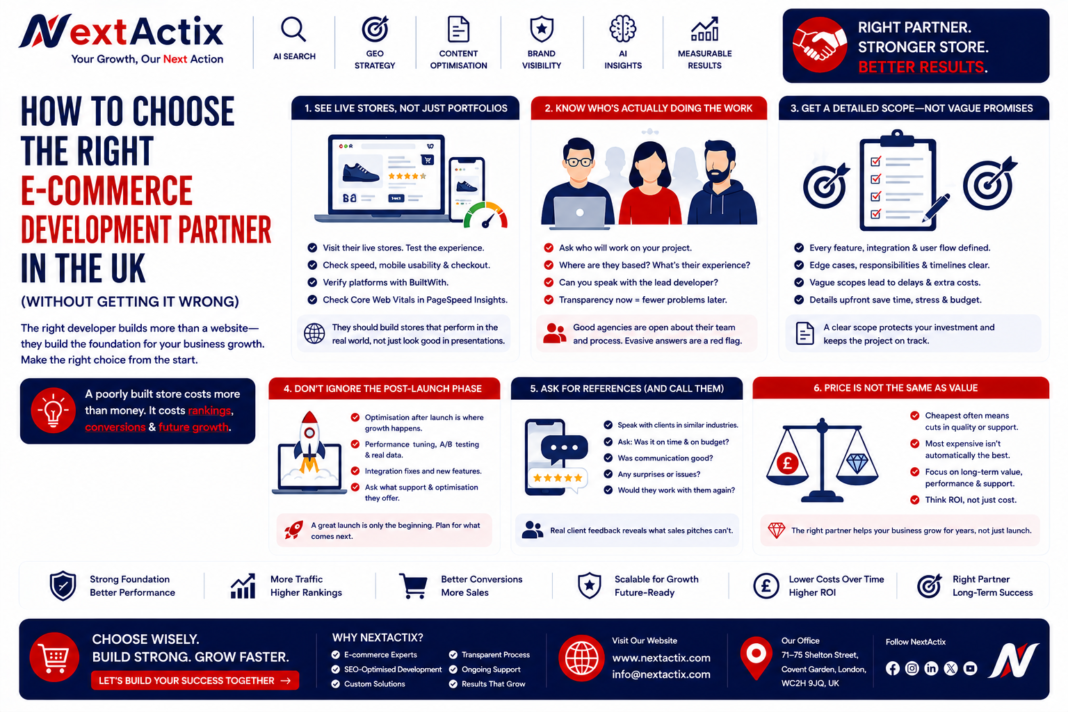
Choosing the wrong developer for your e-commerce project is one of the more expensive mistakes a business can make. Not just in the obvious sense — the wasted project budget — but in the downstream sense: a poorly built e-commerce website accumulates technical debt, ranks badly, converts poorly, and becomes progressively harder and more expensive to improve. By the time you realise the foundations were wrong, rebuilding is often cheaper than fixing.
This isn’t meant to be alarming. Most development agencies in the UK are competent and trustworthy. But the market is large and varied, and the criteria people typically use to choose a developer — price, portfolio aesthetics, and whether they seemed nice on the call — aren’t always the most useful signals. Here’s what to actually pay attention to.
Ask to See Stores That Are Actually Live
Any agency worth working with can show you a portfolio. The relevant question is whether you can see those stores live on the internet, right now, and whether they perform well as actual businesses. Visit the sites. Check how fast they load on your phone. Try adding something to the basket. See what the checkout experience is like.
You can also look up live stores in tools like BuiltWith to verify which platform they were built on, and tools like Google PageSpeed Insights to see their Core Web Vitals scores. A developer who claims to build high-performance e-commerce sites should have examples to prove it.
Understand Who’s Actually Doing the Work
UK digital agencies vary enormously in how they’re structured. Some have large in-house teams of developers, designers, and strategists. Others are essentially project managers who subcontract everything to overseas freelancers. Neither is inherently wrong — there are excellent subcontractors — but you should know which situation you’re in.
Ask directly: who will be working on my project, where are they based, what are their backgrounds, and can I speak with the lead developer before we start? Good agencies will welcome this. Agencies that are evasive about it are telling you something.
Scope Definition: The Most Important Document You’ll Sign
The quality of a project specification document is one of the most reliable predictors of project success. A detailed, clearly written scope document that defines every feature, every integration, every user flow, and every edge case dramatically reduces the likelihood of disputes, delays, and unexpected costs.
If an agency gives you a vague statement of work without specifics and says ‘we’ll figure out the details as we go’, that’s a red flag. Ambiguity in scope benefits the agency, not you. Push for specifics before you sign anything.
Don’t Underestimate the Post-Launch Phase
A lot of e-commerce projects are scoped and priced up to launch, with little thought given to what happens next. But the months after launch are often when the most important work happens: performance optimisation based on real user data, A/B testing of key pages, integration issues with third-party systems that only show up under real traffic, and the ongoing SEO and content work that builds organic visibility over time.
Before you start, make sure you understand what the agency offers post-launch, what it costs, and whether there’s a structured support and optimisation programme or whether you’ll be essentially on your own once the site goes live.
References Are Worth Asking For
It’s now relatively rare to ask for references in the digital agency world, possibly because everyone has been burned by the agency that prepares their reference clients in advance. But asking for references from clients whose projects are similar in size and complexity to yours — and actually calling them — is still one of the most useful pieces of due diligence you can do.
Ask those clients: did the project come in on time and budget? Was communication good? Were there surprises? Would they work with the agency again? Those four questions, answered honestly, will tell you a lot.
Price Is Not the Same as Value
This one cuts both ways. The cheapest quote is rarely the best option for a serious e-commerce project — the economics of development mean that unusually low prices almost always reflect something being cut (quality, experience, time, support). But the most expensive quote isn’t automatically the best either.
The right question isn’t ‘who is cheapest’ or ‘who is most expensive’ — it’s ‘which agency is most likely to build something that performs well and supports my business goals over the next several years.’ That question is harder to answer, but it’s the right one.
Take your time with this decision. A well-chosen development partner for your UK e-commerce project is one of the best investments your business can make. A poorly chosen one is one of the most expensive mistakes.