


Keyword: GEO generative engine optimisation Nottingham
There’s a new acronym in the world of search marketing: GEO. It stands for Generative Engine Optimisation, and it refers to the practice of optimising your content and online presence to appear in — or be cited by — AI-generated responses. Think of it as SEO, but for ChatGPT, Perplexity, Google’s AI Overviews, and the growing range of AI tools people use to research before they buy.
It’s early days. GEO isn’t a settled discipline with agreed best practices the way SEO is. But it’s real, it’s growing, and for businesses in Nottingham thinking about how customers will find them in three to five years, it’s worth understanding now rather than catching up later.
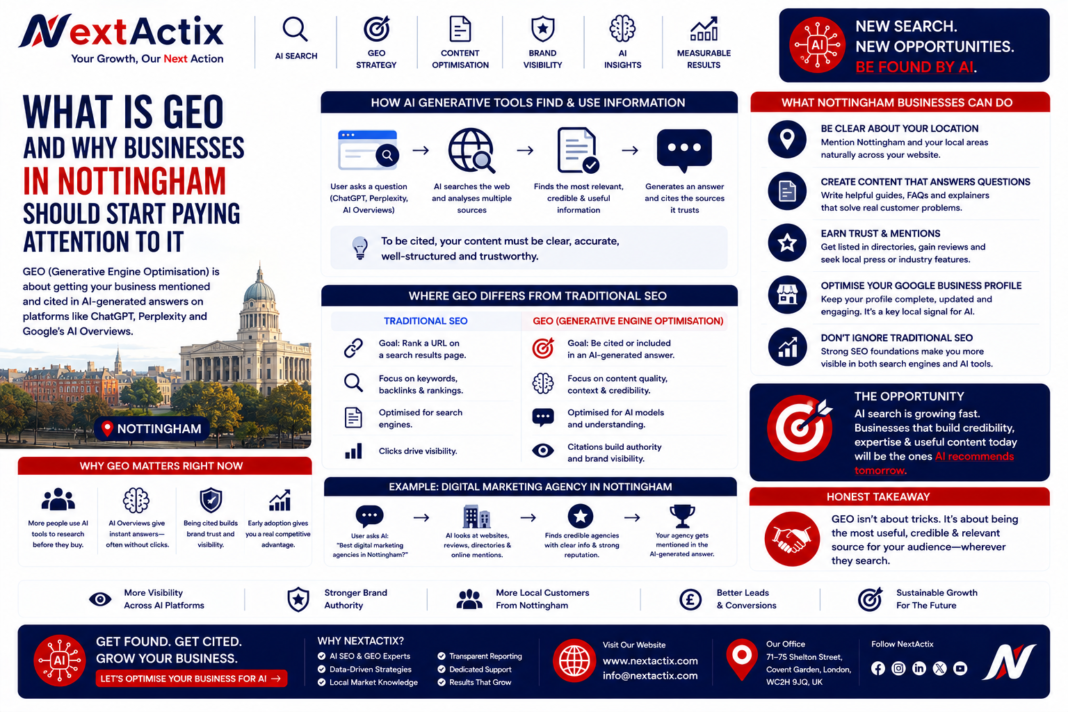
How Generative AI Finds and Uses Information
When you ask ChatGPT a question or use Perplexity to research something, the AI doesn’t search the web in the same way Google does. It draws on a combination of its training data (for ChatGPT, this is a snapshot of internet content up to its training cutoff) and, increasingly, live web browsing capabilities that pull current information from the web.
When an AI cites a source — which Perplexity does prominently, and which Google’s AI Overviews do to a lesser extent — it’s pulling from websites that have: been crawled and indexed, have clear and well-structured content, are considered trustworthy based on signals like backlinks and domain authority, and have content that directly addresses the query being asked.
This means that the factors that make you visible in AI-generated responses are not wildly different from the factors that make you rank well in traditional search. But there are some meaningful distinctions.
Where GEO Differs from Traditional SEO
In traditional SEO, you’re essentially trying to get a URL onto a results page. In GEO, you’re trying to get your content synthesised into an answer — which means the bar for content quality is higher. AI systems are better at identifying genuinely useful, accurate, well-explained content versus thin content that’s been optimised for keywords but doesn’t actually serve the reader particularly well.
Structure matters more. AI models parse content more effectively when it’s clearly organised — with good headings, direct answers to specific questions, and content that doesn’t bury the point. FAQ-style content, step-by-step explanations, and content with clear factual claims that can be verified tend to perform better in this context.
Citations and mentions matter differently. In traditional SEO, backlinks from external sites boost your rankings. In GEO, being mentioned by name in credible sources — press coverage, industry directories, review platforms — increases the likelihood that AI systems associate your business with expertise in your area. It’s a slightly different mechanism but a related one.
What This Looks Like for a Nottingham Business
Let’s say you run a digital marketing agency in Nottingham. Someone asks Perplexity: ‘What are the best digital marketing agencies in Nottingham?’ Perplexity will browse the web, look for directory listings, review platforms, local news mentions, and the agencies’ own websites to compile an answer.
If your website clearly states that you’re a Nottingham-based agency, has a well-maintained Google Business Profile, has reviews on Google and other platforms, and has some content that establishes your expertise — you have a decent chance of appearing in that answer. If your website is vague about location, has no reviews, and thin content, you’re probably not getting cited.
The same logic applies to any local business category. The AI is looking for the clearest, most credible, most relevant sources for the specific query. Being that source requires the same kind of credibility-building that good local SEO has always required — just applied consistently and with content quality as a genuine priority.
Practical Things Nottingham Businesses Can Do
GEO is still evolving, but here are some practical steps that are already worth taking:
- Be explicit about your location throughout your website. Not just in the footer — in your content, your about page, your service pages. AI systems need to know you’re in Nottingham to recommend you for Nottingham-specific queries.
- Invest in structured content that answers specific questions. Think about the questions your customers ask before hiring you, and write clear, honest answers to them. This is the content most likely to be cited.
- Build genuine external mentions. Get listed in local business directories, pursue press coverage in local outlets like the Nottingham Post, get featured on industry platforms. These external references make your business more visible to AI systems.
- Keep your Google Business Profile current. It’s still one of the most important local signals, and AI systems reference it when compiling local business information.
- Don’t neglect traditional SEO. GEO doesn’t replace SEO — it sits alongside it. The businesses best positioned for AI-driven search are also the ones with the strongest traditional SEO foundations.
The Honest Takeaway
GEO is a real trend, not just an industry buzzword. But for most Nottingham businesses, the practical implications are incremental rather than revolutionary. You don’t need to throw out your current digital marketing strategy. You need to make sure the content you produce is genuinely good, that your business’s credibility is evident both on and off your website, and that you’re structured to be found — whether that search is happening on Google, ChatGPT, or something that doesn’t exist yet.
The underlying principle — be the most useful, credible, relevant source for the people you want to reach — hasn’t changed. The channels through which that usefulness is discovered are just multiplying.