
Six months ago, a client asked us a simple question: “Why did my traffic drop 40% when my Google ranking didn’t change?”
The answer wasn’t a penalty. It wasn’t a competitor. It was an AI Overview sitting between his website and the customer, answering the question before anyone reached his page at all.
This is happening to thousands of businesses right now, and most of them don’t know why. This guide explains exactly what AI SEO is, why it’s different from the SEO you already know, and what the 2026 data says you actually need to do about it — no vague advice, no recycled 2023 content, just the current numbers and a clear plan.
What Is AI SEO?
AI SEO is the practice of optimising your website and content so that it gets found, understood, and recommended by AI-powered search systems — not just traditional Google search results, but Google’s AI Overviews, ChatGPT, Perplexity, Microsoft Copilot, and Gemini.
In plain English: AI SEO means writing and structuring your content so an AI can read it, trust it, and quote it back to a potential customer as the answer to their question.
This is genuinely different from classic SEO. Classic SEO was built around one goal — rank in the top 10 blue links so a human clicks through to your site. AI SEO has a second, equally important goal: get your business mentioned directly inside the answer, even if the person never clicks anywhere at all.
Both goals matter now. You can’t drop one for the other. But if you’re only doing the first one, you’re already behind, because the data shows the second one is where the growth is happening.
Why 2026 Is the Year This Stopped Being Optional
For the last two years, “AI is changing search” was a prediction. In 2026, it’s just a description of how search works. Here’s the data that proves it.
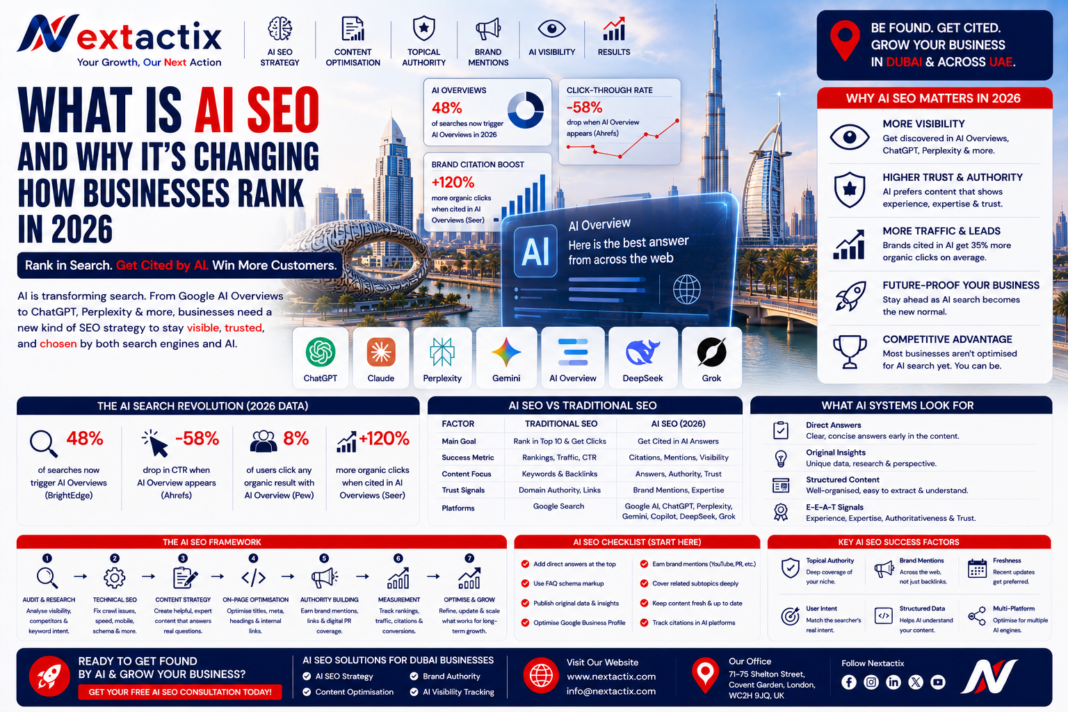
AI Overviews are now everywhere. Google’s AI Overviews appeared on roughly 6 to 7% of searches at the start of 2025. By February 2026, BrightEdge tracked AI Overviews on 48% of queries across monitored industries, an increase of 58% year on year. Some trackers put the global figure above 50%. In certain sectors — health, education, and research — AI Overviews now appear on roughly 80% of all queries.
Clicks to websites are genuinely collapsing. This is the part that should worry every business owner. Ahrefs data gathered in December 2025 found that the presence of an AI Overview on a search results page caused a 58% reduction in click-through rate for the page ranking in position one — the position every SEO strategy used to treat as the finish line. That’s not a typo. The #1 ranked page on Google is losing more than half its expected clicks when an AI Overview shows up above it.
Fewer people are even looking at the organic results at all. Pew Research Center, analysing 68,000 queries, found that when an AI Overview appears, only 8% of users click on any organic result. When there’s no AI Overview, that number is 15% — nearly double. A single feature on the search page cut click behaviour almost in half.
This isn’t only a Google problem. ChatGPT reached 800 million weekly active users as of October 2025, doubling from 400 million in February the same year, and AI tool adoption jumped from 14% to 29.2% in just six months. People aren’t only Googling things anymore — they’re asking ChatGPT, and increasingly Perplexity, directly.
But here’s the part most articles on this topic leave out — being cited is genuinely valuable. Despite all the bad news above, the businesses that do get mentioned inside an AI answer are doing better than ever. Brands that get cited inside an AI Overview see 35% more organic clicks and 91% more paid clicks than businesses sitting in position one underneath the AI answer. Separately, Seer Interactive’s April 2026 data found that brands cited inside AI Overviews see 120% more organic clicks per impression than brands that aren’t cited.
So the real story of 2026 isn’t “AI killed SEO.” It’s this: traffic has split into two groups — businesses the AI mentions by name, and everyone else. AI SEO is how you make sure you’re in the first group.
AI SEO vs Traditional SEO: What’s Actually Different
People often ask us if AI SEO replaces the SEO they’ve already invested in. It doesn’t — but it does change what “good” looks like. Here’s the honest comparison.
Ranking position matters less than it used to. This is the single biggest shift, and it’s not a small one. In mid-2025, around 76% of pages cited inside AI Overviews also ranked in the top 10 organic results for that same search. By early 2026, separate research from Ahrefs put that figure at roughly 38%, while BrightEdge data placed it even lower, at around 17%. Read that again — being in the top 10 used to almost guarantee an AI citation. Now it’s roughly a coin flip at best, and getting worse. Traditional ranking signals are losing their grip on what gets cited.
This is backed up by a separate, more technical study. An analysis of 15,847 AI Overview results found that traditional ranking correlation with citation dropped to r=0.18 in 2026, down from r=0.23 in 2024 and r=0.43 before AI Overviews existed at all. Meanwhile, 47% of cited content came from pages ranking below position 5 — and in some industries, domain authority showed a small negative correlation with getting cited. In other words, a huge, old, “authoritative” domain is no longer an automatic win, and a newer page with the right structure and the right answer can beat it.
What actually predicts a citation now is different. The same research identified the strongest single factor: “semantic completeness” — essentially, how fully and clearly a piece of content answers the question — correlated at r=0.87 with getting cited, and content scoring 8.5 or higher out of 10 on this measure was 4.2 times more likely to be pulled into an AI answer.
Brand mentions outside your own website now matter more than backlinks. This is the part that genuinely surprises most business owners, including ones who’ve been doing SEO for years. Ahrefs analysed 75,000 brands across ChatGPT, Google AI Mode, and AI Overviews and found that YouTube mentions were the single strongest correlating factor with AI visibility of anything measured — and that brand mentions across the web correlated roughly three times more strongly with AI visibility than backlinks did. The old game was “get other websites to link to you.” The new game is “get your brand name mentioned, consistently and accurately, everywhere — YouTube, Reddit, review sites, news coverage, forums — whether or not they link back.”
Freshness and structure matter more than they used to. 23% of content featured in AI Overviews was published or updated within the last 30 days, and research shows that 44.2% of all citations from AI systems come from the first 30% of a page’s content — meaning if you bury your answer under three paragraphs of introduction, the AI has often already moved on before it gets there.
Different AI platforms trust different sources. This is something almost no business accounts for, and it matters if you’re trying to show up everywhere, not just on Google. ChatGPT favours Wikipedia-style authoritative content, accounting for 47.9% of its top citations. Perplexity leans heavily on Reddit discussions, at 46.7%. Google’s AI Overviews balance professional content with social content more evenly. If your only strategy is “write a good blog post,” you’re optimising for one platform and ignoring the other two.
Here’s the comparison in simple terms:
| Traditional SEO | AI SEO | |
|---|---|---|
| Main goal | Rank in top 10, get the click | Get cited or mentioned in the AI’s actual answer |
| Best content format | Long-form, comprehensive | Direct answer first, then depth and structure |
| What builds trust | Backlinks, domain authority | Brand mentions across the web, YouTube, original data, verifiability |
| Where it shows up | Google search results page | Google AI Overviews, ChatGPT, Perplexity, Copilot, Gemini |
| How fresh it needs to be | Updated occasionally is fine | Recency is a measurable, growing factor |
The Four Things AI Systems Actually Look For
Across the research above, the same patterns keep showing up. If you want your content to be the one an AI quotes, it needs these four things:
It answers the specific question directly, early in the page — not after several paragraphs of throat-clearing and brand introduction. AI systems extract answers, they don’t read for atmosphere.
It includes original information that doesn’t exist anywhere else — your own data, your own survey, your own case results, your own numbers. Even a small-scale study, with as few as 100 respondents, can generate citations if the insight is genuinely useful and not available elsewhere.
It’s built for extraction — clear headings that match real questions, short direct answers near the top, bullet points where they genuinely help, and an FAQ section addressing the exact phrasing people search for.
It’s verifiable — real numbers, named sources, dates attached to claims, and nothing vague or unsupported. Research analysing more than 2,400 AI Overview citations found that pages with strong expertise and authority signals were cited 2.3 times more often than top-ranked pages that lacked them — regardless of their domain authority score.
A Practical Starting Checklist
If you’re starting from zero, here’s where the data says to focus first, in order of impact:
Make sure your page is actually reachable. This sounds basic, but it’s the most overlooked factor — pages need to return a clean response, load without login walls, and stay reachable to both AI training crawlers and real-time look-ups. If a bot can’t fetch your page, nothing else matters.
Put your direct answer in the first two or three sentences of every important page, then build out the depth afterwards.
Add an FAQ section using the exact questions your customers actually ask — not guesses, the real phrasing from your inbox, your calls, and your reviews.
Create one genuinely original piece of data per quarter — a small survey, a results breakdown from your own client work, a local market comparison. This single habit does more for AI citation than almost anything else on this list.
Build your brand’s footprint outside your own website — get mentioned on YouTube, in trade press, on relevant forums, and in reviews. Google now includes YouTube citations in close to 30% of AI Overviews, so a presence there is no longer optional for visibility, even if you’re not “a video brand.”
Cover the topic from multiple angles on one page, not just the headline keyword. An analysis of 10,000 keywords found a strong correlation between the number of related sub-questions a page also ranks for and its likelihood of being cited — pages covering both the main query and at least one related sub-query were 161% more likely to be cited, and this pattern accounted for more than half of all citations in the dataset.
Keep your most important pages updated. Stale, untouched pages are quietly losing ground to fresher competitors, even when the older page is otherwise stronger.
Is AI SEO Replacing Traditional SEO?
No — and you should be cautious of anyone telling you to abandon traditional SEO entirely. The data is clear that the two are layered, not separate. Strong technical SEO, fast load times, mobile usability, and clean site structure remain the foundation everything else is built on. AI systems still rely heavily on the same crawlable, well-organised web that Google has always needed.
What’s changed is that ranking well is no longer the finish line — it’s the entry ticket. The businesses winning in 2026 are the ones treating AI visibility as an additional layer on top of solid SEO, not a replacement for it.
The Bottom Line
AI SEO isn’t a trend you can wait out. The shift from “rank and get clicked” to “get cited and get chosen” is already well underway, and the gap between businesses that adapt and businesses that don’t is widening every quarter, not narrowing. The good news is that none of this requires starting from scratch — it requires building on the SEO fundamentals you already have, with a sharper focus on direct answers, original data, and a brand presence that extends well beyond your own website.
If you’re not sure where your business currently stands in AI search results, that’s usually the right place to start before making any changes.