


There’s a version of building an e-commerce website that goes like this: pick a platform, choose a theme, upload your products, and launch. And for some businesses, that’s genuinely enough — especially if you’re selling a handful of products to a niche audience that already knows who you are.
But for most UK businesses trying to build a serious online retail operation in 2026, the actual picture is a lot more complicated. The UK e-commerce market is mature, competitive, and increasingly dominated by large players with serious technology infrastructure. Building a website that can compete in that environment requires making the right decisions at the start — decisions that are much harder and more expensive to change later.
This is a practical guide to e-commerce website development in the UK, written for business owners who want to understand what really matters when building or rebuilding their online store.
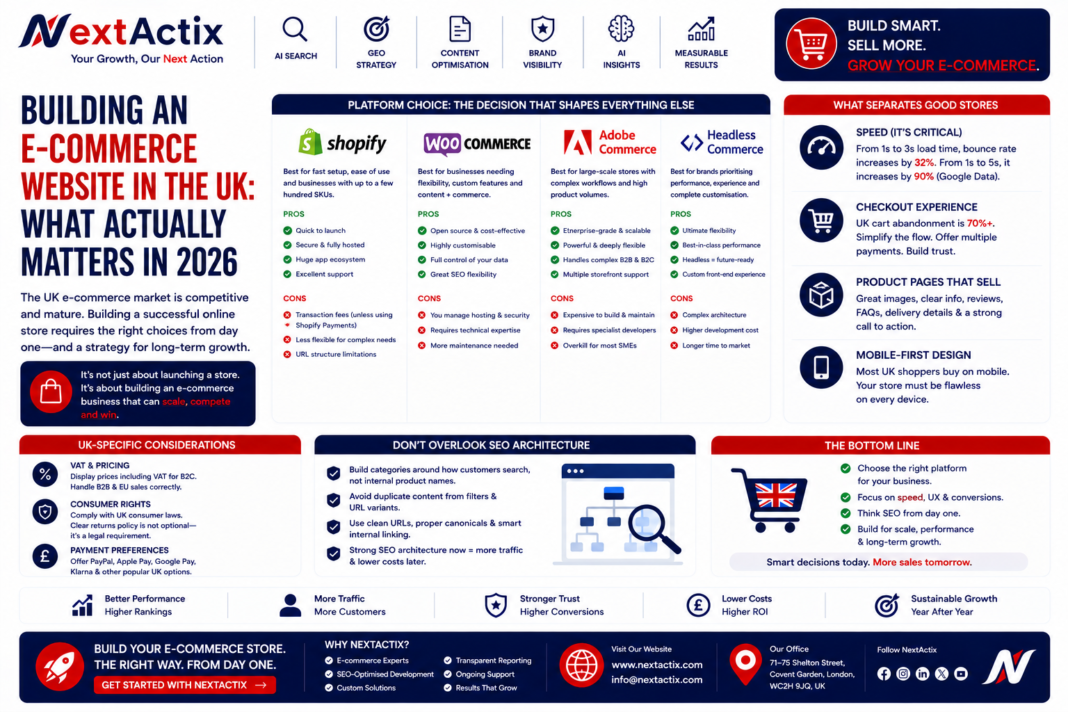
Platform Choice: The Decision That Shapes Everything Else
Almost every conversation about e-commerce development starts here, and rightly so. The platform you build on determines your costs, your flexibility, your scalability, and — more than people realise — your SEO potential. Here’s an honest take on the main options:
Shopify
Shopify is the default choice for a huge percentage of UK e-commerce businesses, and for good reason. It’s fast to set up, well-supported, handles hosting and security for you, and has a massive ecosystem of apps and integrations. For product businesses selling up to a few hundred SKUs, it’s genuinely excellent.
Its limitations become relevant at scale. Custom functionality is possible but often requires expensive app subscriptions or custom development that fights against the platform’s structure. SEO flexibility is good but not perfect — URL structures, for example, are more rigid than on other platforms. And transaction fees (unless you use Shopify Payments) add up.
WooCommerce
WooCommerce sits on top of WordPress, which gives it enormous flexibility. It’s open source, highly customisable, and has no platform fees. For UK businesses with complex product requirements, custom integrations, or a large content-plus-commerce operation, it’s often the better technical choice.
The trade-off is that you own the infrastructure. Hosting, security, updates, backups — these are your responsibility (or your developer’s). A poorly configured WooCommerce install is slower, less secure, and harder to maintain than Shopify. Done well, though, it outperforms Shopify on flexibility and long-term cost at scale.
Magento / Adobe Commerce
For genuinely large operations — hundreds of thousands of SKUs, multiple storefronts, complex B2B workflows — Magento is often the right choice. It’s enterprise-grade, deeply flexible, and built to handle scale. It’s also expensive to build and maintain, requiring specialist developers and a meaningful ongoing investment. It’s overkill for most UK SMEs and exactly right for a certain tier of larger retailer.
Headless Commerce
Increasingly, UK businesses are separating their front-end experience from their back-end commerce engine. A headless setup uses a best-in-class CMS or custom front end for the customer experience while connecting to a commerce platform (Shopify, BigCommerce, or a custom API) for product management, checkout, and fulfilment. It’s more complex and expensive to build, but gives the most control over performance and user experience. Worth considering if performance and brand distinctiveness are critical.
The Things That Separate Good E-commerce Sites from Average Ones
Speed — and Not Just ‘Pretty Fast’
Google’s data shows that as page load time increases from one second to three seconds, the probability of a mobile visitor bouncing increases by 32%. From one second to five seconds, it’s 90%. In the UK market, where mobile commerce is now the majority of online shopping, this matters enormously.
‘Speed’ in e-commerce is also more nuanced than it sounds. Your homepage might load quickly because it’s relatively simple. Your category pages with dynamic filters and pagination, your product pages loading multiple image variants, your checkout flow — these are where performance typically degrades. Testing speed across the full purchase path, not just the homepage, is essential.
Checkout Flow
The average e-commerce checkout abandonment rate in the UK is somewhere north of 70%. Most of those abandonments happen because the checkout is too long, asks for too much information, doesn’t offer the right payment options, or doesn’t look trustworthy enough for people to enter their card details.
UK shoppers increasingly expect: guest checkout, PayPal, Apple Pay and Google Pay, Klarna or similar buy-now-pay-later options, and a clear delivery estimate before they commit to payment. Optimising your checkout is often the highest-ROI improvement an established e-commerce site can make.
Product Pages That Actually Sell
Most product pages are built to display information. The best ones are built to overcome hesitation. There’s a meaningful difference. Good product pages include: multiple high-quality images (including lifestyle context, not just product shots), clear delivery information, honest reviews, answers to the most common questions, and a clear, unambiguous call to action. Writing great product copy that is both compelling and keyword-relevant is an undervalued skill in UK e-commerce.
UK-Specific Considerations
VAT and Pricing
UK VAT rules are straightforward but need to be built into your platform correctly. B2C prices should include VAT by default; B2B customers often expect ex-VAT pricing. If you sell into the EU post-Brexit, you’ll also need to think carefully about customs, import duties, and how you communicate this to customers.
Consumer Rights
UK consumers have strong statutory rights under the Consumer Rights Act and Consumer Contracts Regulations. Your website needs to clearly communicate returns policies, and your platform needs to support those processes operationally. Getting this wrong isn’t just a customer service problem — it’s a legal one.
Payment Preferences
UK shoppers use a wide range of payment methods. Beyond the obvious card networks, PayPal remains hugely popular. Apple Pay adoption is growing rapidly. BNPL (buy now, pay later) options like Klarna are now expected in certain categories. Making sure your platform supports the options your customers expect is a conversion issue, not just a payment processing one.
One Thing That’s Often Overlooked: SEO Architecture
Many e-commerce websites are built with almost no thought given to how they’ll be found organically. Categories are created based on how the internal team thinks about the products, not based on how customers search for them. Filters create thousands of near-duplicate URLs. Pagination is handled in ways that confuse search engines.
Getting your e-commerce SEO architecture right at build time is dramatically cheaper and more effective than trying to fix it after launch. If you’re working with a development agency, push hard on this before a single line of code is written.
E-commerce SEO in the UK is a serious discipline. The businesses that dominate organic search in retail categories do so because they made smart structural decisions early and then invested consistently in content and links over time. It’s genuinely possible to compete — even against much larger players — if you get the foundations right.